
Blog Summary: Static screens vs advertising robots in supermarkets is really about how your advertising reaches shoppers. Most grocery operators already have screens across their stores. The real question is how much of the selling floor those screens reach, how close the media sits to the purchase decision, and what measurable data a campaign delivers when it ends.
Key Takeaways
- A fixed screen reaches shoppers within a single location, while an advertising robot carries the same creative into the aisle where shoppers are still choosing between two products.
- What is an advertising robot? The simple answer to this is an autonomous robot that plays ads and runs your campaign in the supermarket.
- Additionally, the advertising robot gives you all important campaign data captures across the supermarket.
- Measurement is the sharper divide, because static signage reports modeled impressions while a patrolling robot returns proof-of-play records alongside tap and QR engagement.
- One Odigo robot carries two 32-inch advertising faces that travel across zones and dayparts, which detaches sellable inventory from a fixed location.
- Static screens still hold the entrance, the checkout queue and the service desk, where saturating a choke point beats targeting anyone in particular.
- Most operators arrive at a hybrid estate rather than a replacement, and they define the split zone by zone against a floor plan.
- The same patrol that delivers advertising also answers shopper questions, escorts visitors and flags shelf exceptions, which changes how a media buyer should judge the cost of the robot.
How Static Screens and Advertising Robots Differ in Supermarkets?
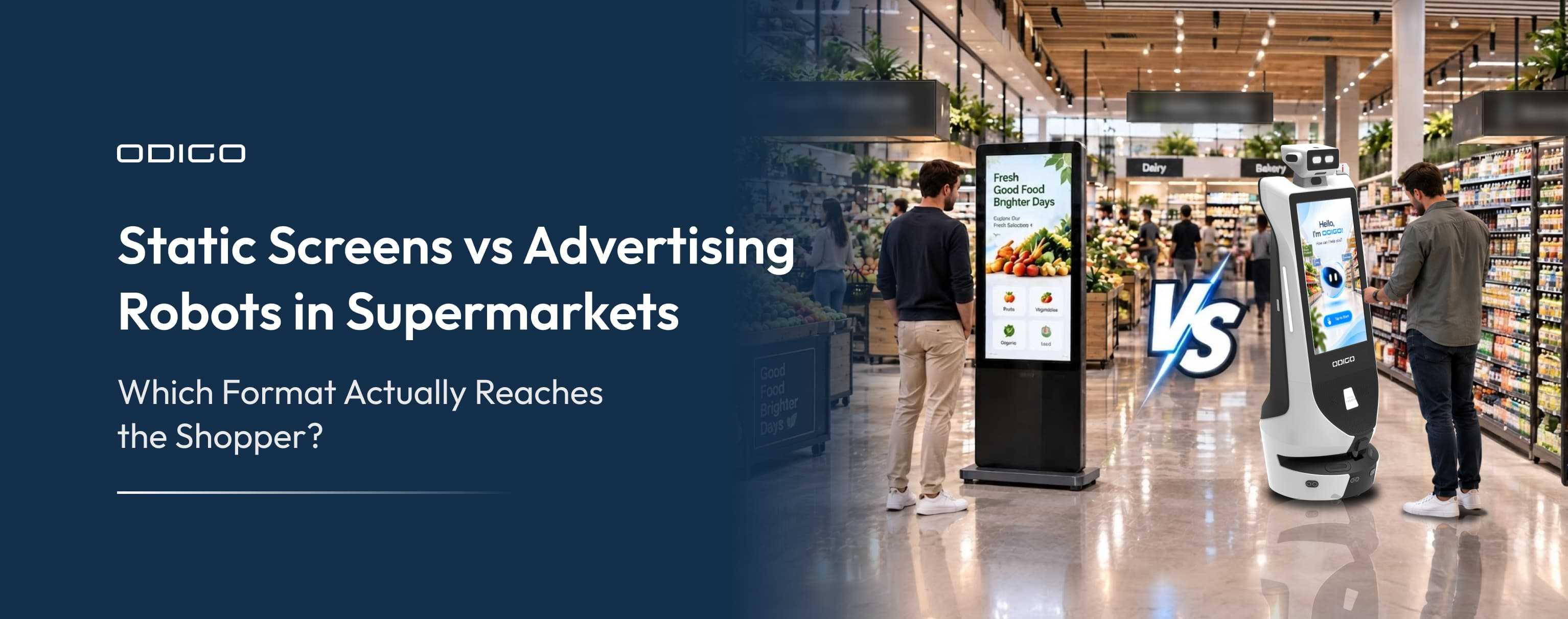
Static screens vs advertising robots in supermarkets comes down to where your advertising reaches shoppers and when it reaches them. A store manager walks past screens near the entrance while, two aisles away, a customer stops to ask where the gluten-free flour is. The advertising stays fixed at the front while the shopper moves deeper into the store. The media network works hardest where shoppers are least undecided, then falls silent in the aisle where they actually choose what to buy.
The opportunity is gaining attention across US retail. eMarketer forecast in January 2026 that US in-store retail media ad spending would climb 33.1% during 2026, while still representing less than 1% of total US retail media ad spending. (Source: eMarketer)
That raises a practical question for supermarket operators. What happens when advertising can move beyond fixed placements? An advertising robot brings media into different areas of the store as shoppers move through their journey.
Odigo is an autonomous advertising and customer-assistance robot designed to engage shoppers across high-traffic retail environments. Odigo combines mobile advertising with shopper assistance, wayfinding, and measurable interactions, creating a different approach to reaching shoppers on the sales floor.
We built Odigo because mobile robots change the proposition for supermarket industries. Let dive depper into the blog to understand the core difference between static screens vs advertising robots in supermarkets. You’ll learn how AI robot assistants work makes the distinction clearer, since an advertising robot is not a screen that happens to move, but media inventory that travels to the shopper.
Static Digital Screens vs Advertising Robots: What Each Format Does on a Supermarket Floor
Static digital display and advertising robots both deliver promotional content on a supermarket floor, but they differ in how they reach shoppers.
Ideally, a static digital screen stay in a fixed location whereas supermarket operators can place them near entrances, checkout queues, service desks, endcaps, and other high-traffic areas. These screens support retail advertising, seasonal campaigns, product messaging, and retail media. Their reach stays tied to the screen’s installation location.
Advertising robots can move digital advertising across the sales floor. Instead of waiting for shoppers to pass one fixed point, a mobile advertising robot can travel through selected store zones during scheduled campaigns. This gives operators more flexibility in where and when they display promotional content.
The practical difference in advertising robot vs static screens in supermarkets comes down to placement, movement, reach, and interaction. A static screen provides consistent visibility from one location, while a mobile advertising robot can carry campaigns across multiple areas.
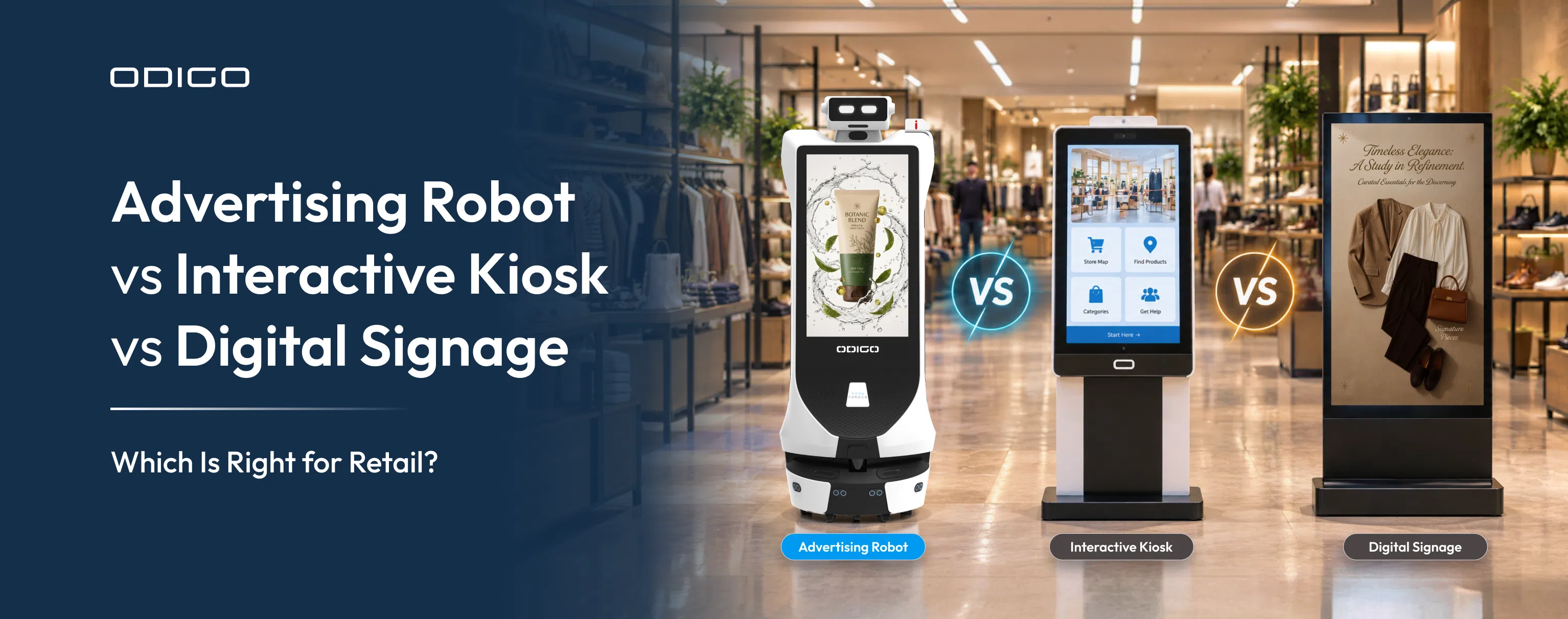
The distinction also becomes clearer when comparing an Advertising robot vs interactive kiosk vs digital signage, since each format uses a different combination of mobility, placement, and shopper interaction.
Where Odigo, an Advertising Robot for Supermarket Fits?
Odigo combines mobile advertising with shopper assistance and digital wayfinding. The 32-inch interactive touch display can deliver promotional content while allowing shoppers to request information or directions.
Its AI navigation, smart obstacle avoidance, autonomous charging, and centralized advertising management support mobile deployment across the supermarket floor. Advertising campaigns can also be managed based on factors such as location, day, and time.
This makes Odigo, Advertising Robot different from a screen that remains tied to one physical position. The advertising surface can move between selected zones while also serving an interactive role during the shopper journey.
For supermarket operators, static digital screens vs advertising robots is therefore not only a comparison of display formats. It is a comparison of how advertising is placed, how far it can move, and what shoppers can do with it.
The next comparison looks more closely at these differences across coverage, proximity, interaction, measurement, and operational requirements.
Static Screens vs Advertising Robots in Supermarkets: The Head-to-Head Comparison
Before working through the criteria one at a time, most evaluation teams want the two formats side by side on the points a media or operations lead has to defend internally. The table below sets out what each format does rather than what each format promises.
| Criteria | Static digital screen | Advertising robot |
| Placement and reach | One fixed sightline, reaching whoever passes the mount | Patrols multiple zones across a trading day |
| Advertising faces per robot | One | Two 32-inch faces, front and rear, plus a top display |
| Audience reached | Shoppers who walk past the mount | Shoppers in the aisle, plus anyone the robot meets on route |
| Interaction possible | None on standard signage | Touch, voice, search, QR and on-screen forms |
| Content updates across sites | Site visit or CMS push per screen | Remote push and over-the-air updates, no local staff required |
| Behavior during network loss | Depends on the player, often blank | Content syncs locally and playback continues |
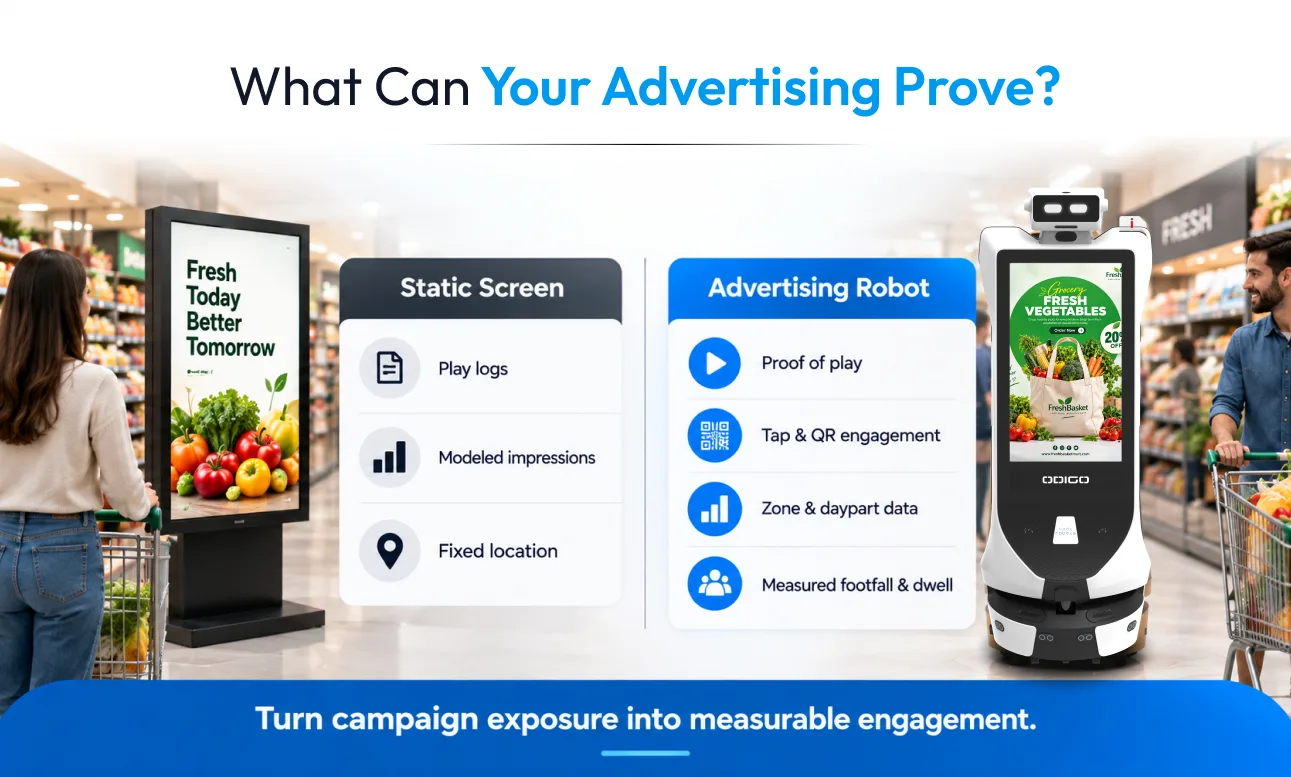
| Data returned | Play logs and modeled impressions | Proof of play, tap and QR events, zone and daypart records |
| Behavior when nobody engages | Keeps playing to an empty sightline | Runs always-on advertising while patrolling |
| Install requirements | Mounting, cabling and power at every position | No floor markers, rails, beacons or building re-fit |
| Targeting granularity | Screen-level scheduling | Zone, route, daypart and individual point of interest |
| Additional jobs performed | None | Concierge, escort, shelf exception checks, footfall capture |
| Environmental constraints | Few, mounts almost anywhere indoors | Flat solid indoor floors, no carpet or slopes |
What the Comparison Means for Supermarket Operators
Five rows in that table carry the commercial decision, and the rest of this piece works through them in order. Coverage determines how much of the selling floor your media touches, while proximity determines whether the media reaches shoppers whose choice is still open.
Measurement determines what your team can sell to a supplier and defend at renewal, and operational overhead determines what the estate costs your staff in hours rather than in capital. The fifth criterion, the work a static screen structurally cannot perform, shows whether operators can price the two formats against each other at all.
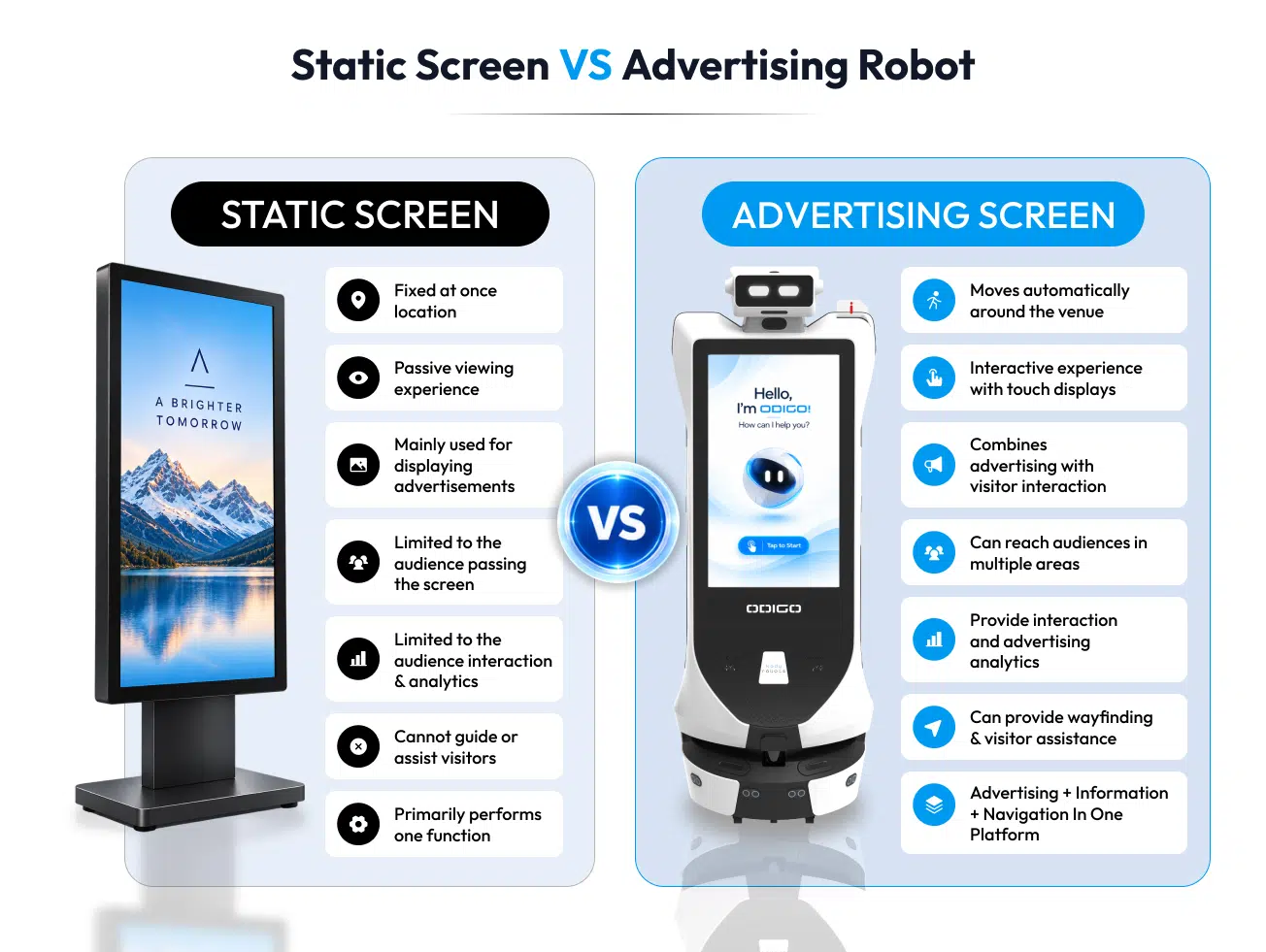
How Advertising Robots and Static Screens Differ Across a Supermarket
Static screens and advertising robots can both support retail media, but each format reaches shoppers differently. Understanding what is an advertising robot also helps clarify how mobility changes in-store advertising. The comparison becomes clearer when you look at where advertising appears, how close the message gets to the shopper, and what retailers can measure and control.
Coverage: One Unit Against the Same Square Footage
Comparing diagonal screen sizes misses the commercial point entirely, because the honest comparison in mobile advertising robot vs static screens is reach, impression, and request per robot. A mounted screen covers one sightline for the whole of its service life, whereas a patrolling Odigo robot crosses zone after zone on a single charge lasting 10 or more hours, depending on how hard the store works the robot.
Mobility gives Odigo a different advertising footprint from a fixed screen. A static screen remains tied to one location, while Odigo can carry campaigns across different areas of the store while patrolling the sales floor.
Odigo can run daily offers, clearance promotions, and seasonal campaigns while moving through the store, without requiring shopper interaction to display an advertisement. Location-based targeting can also align campaigns with specific areas, while scheduling by time and day gives retailers greater control over when promotions appear.
Multiple Odigo robots can further expand advertising coverage across a store, allowing different campaigns to operate in different areas. For retail media teams, the difference between static screens vs advertising robots in supermarkets is therefore more than screen placement. Mobility creates additional opportunities to package advertising inventory across the sales floor.
The operational difference also extends to deployment. Odigo uses Dual SLAM with laser and visual sensing for indoor navigation, reducing the need for fixed navigation infrastructure. Static screens, by comparison, remain tied to their installed positions and the infrastructure required at each location.
Proximity: Reaching the Shopper at the Moment of Decision
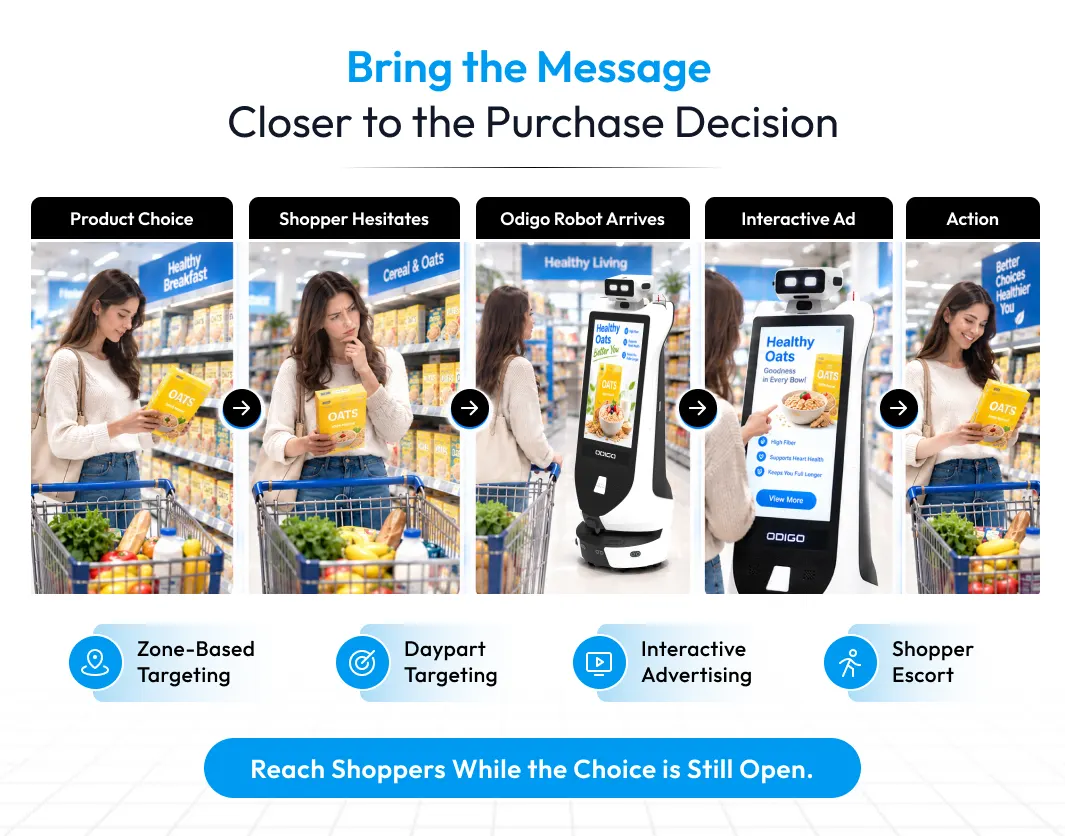
Placement decides intent, and any media lead who has bought in-store inventory knows the pattern. Entrance screens reach shoppers before intent has formed, checkout screens reach the same shoppers once the basket has closed, and both moments have value without being the moment a supplier is really paying for. Closing that gap is the whole of Static Screens vs Advertising Robot for Advertising in Supermarkets, because aisle-level delivery reaches a shopper while the choice between two competing products remains open.
Odigo targets geo-contextually by day, time and zone, so one robot carries different messages in different aisles and different dayparts without any change to the creative library. Campaign scheduling runs down to zone, route and individual point of interest, and operators can trigger brand-sponsored interactive experiences at a defined physical location rather than serve them on a general rotation.
Escort is where the dwell argument becomes concrete. When a shopper asks to find an item, Odigo guides them to the shelf rather than describing the route, while both advertising faces keep playing throughout the walk. No fixed placement can manufacture attention of that quality, because the shopper has chosen to follow the robot. The gap between leading a visitor and handing a visitor a map is the same gap wayfinding robots vs wayfinding kiosks examines across both formats.
Measurement: Robotic Advertising vs Static Digital Signage on What Comes Back
Fixed signage reports plays and, at best, reports modeled impressions built on foot-traffic assumptions that nobody in the room fully believes. Advertisers increasingly treat modeled reach as the proxy it is, which is why robotic advertising vs static digital signage now gets settled on evidence rather than on reach claims.
Odigo logs proof of play as an auditable record of what ran, in which zone, and at what time. Tap and QR engagement then produce a class of signal that no fixed placement can generate, simply because standard signage gives the shopper nothing to act on. Real-time ad-play and engagement analytics break plays down by zone, section, and time, while the partner and wallet module tracks performance, exposure, earnings, and sales for each advertising partner separately.
A live multi-floor deployment at Jio World Drive also recorded 295,419 ad plays and 18,457 shopper interactions over 31 days, showing how a deployed advertising robot can return both campaign delivery and shopper engagement data from the same environment. The same deployment recorded 2,509 navigation sessions, with 13.59% of interactions converting into navigation, adding a measurable action layer beyond ad exposure.
One boundary deserves stating plainly to any buyer who asks. Posting campaign telemetry back for attribution against your own retail media measurement requires integration with your ad stack and is scoped during deployment, so the capability is implementation work rather than a switch in a settings panel.
| What you can prove | Static screen | Advertising robot | Needs integration |
| Play confirmed | Yes | Yes | No |
| Exact location of play | Fixed, always the same | Yes, by zone and route | No |
| Daypart | Yes | Yes | No |
| Engagement action taken | No | Yes, tap and QR | No |
| Audience passing | Modeled | Measured footfall and dwell | No |
| Attribution to sale | Rarely | Yes, through your ad stack | Yes |
| Export for downstream analysis | Varies | Yes, filtered record export | No |
Measurement quality is the first thing to press any vendor on, well before hardware specifications enter the conversation, and best advertising robots for US supermarket applies that same lens when comparing robots.
Running Cost and Operational Overhead: Fixed Digital Signage vs Advertising Robots
For multi-site grocers, fixed digital signage vs advertising robots presents two different approaches to day-to-day content management. Odigo accepts an instant remote content push with no on-site reprogramming and no site visit, creative management and rotation run across one robot or an entire fleet, and over-the-air updates roll out without local technical staff at any location. Offline playback continues through a network interruption because content syncs to the robot first, so a dropped connection costs the campaign nothing.
Refreshing a distributed screen estate across fifty stores rarely moves that cleanly, and the coordination burden lands on staff hours your business is already paying for, which is the multi-site picture autonomous robots for superstore sets out.
Odigo carries overhead of its own, and we would rather your team price that overhead accurately than discover it during rollout. The robot docks and recharges without staff intervention, so daily handling is minimal, but the deployment conditions are real.
Odigo requires flat, solid indoor flooring, which rules out carpeted areas, slopes and any outdoor space. Every site also needs a mapping and configuration pass at deployment, covering routes, virtual walls and no-go zones around stockrooms and forklift traffic. A mounted screen carries none of those conditions, and any honest comparison should say so.
What Fixed Screens Cannot Deliver on the Sales Floor
Everything above treats Odigo as a media robot, which undersells the platform and explains why Static Screens vs Advertising Robots in Supermarkets resists a like-for-like price comparison.
The patrol that delivers advertising also resolves shopper questions along the way. Opening hours, returns policy and aisle locations are answered on the robot in the shopper’s own language, with no app to download, no account to create and no sign-in step.
Routine questions get handled at the point they are asked, which leaves associates free for the questions that genuinely need their expertise, and that concierge layer is the work a robot assistant performs between campaign plays rather than instead of them.
In grocery the operational output compounds quickly. A shopping list submitted by voice, text or photograph becomes one optimized route with chilled and heavy items sequenced last, a capability that requires integration with your inventory systems and is scoped during deployment.
While patrolling, Odigo flags shelf gaps, wrong facings and missing price labels as exceptions for the floor team, again subject to integration and per-store calibration. Queue depth at checkout is signaled to a duty manager before shoppers abandon a basket, and footfall and dwell are captured continuously across every patrol, whether or not a single shopper interacts with the robot. AI robot assistant for supermarket covers how those outputs land inside a grocery operation.
A media budget buying that combination of outputs is not buying what a screen budget buys, and the two lines should be evaluated accordingly.
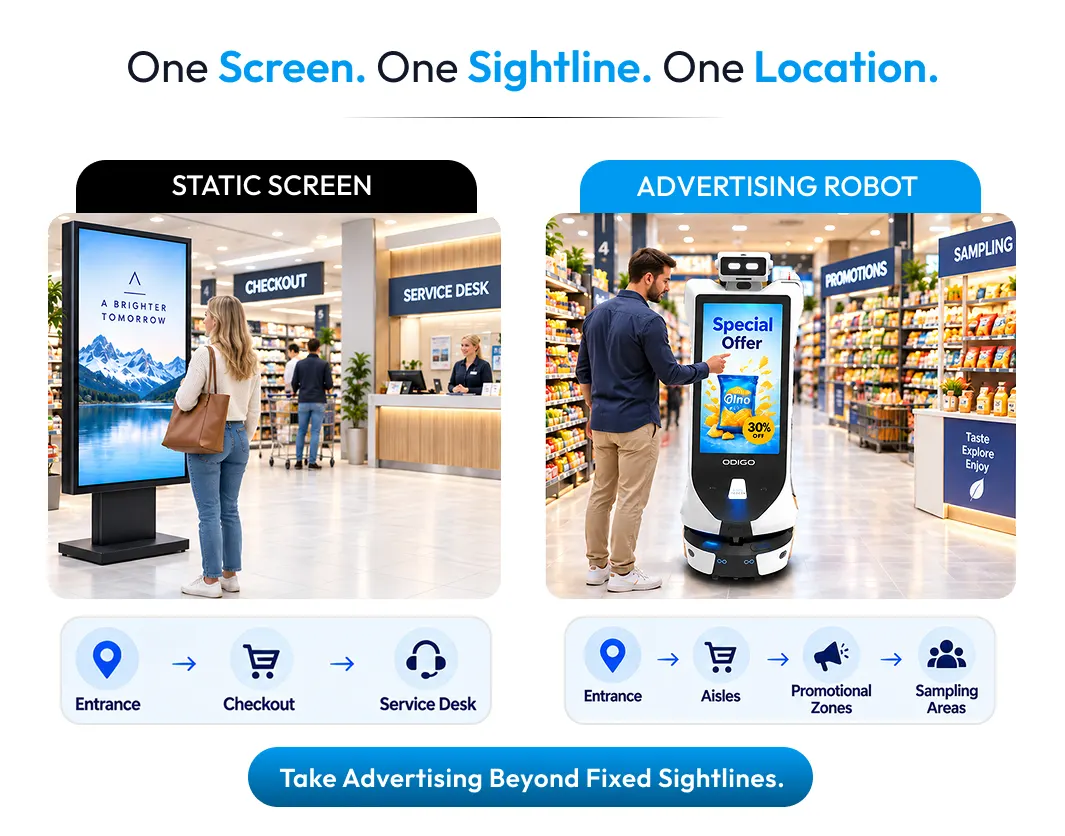
Choosing the Right Advertising Format for Each Supermarket Zone
Static screens and advertising robots serve different positions on the supermarket floor. A fixed screen remains useful where shoppers naturally pass through the same point, such as entrances, checkout queues, and service desks. These locations provide consistent visibility without requiring movement or floor space.
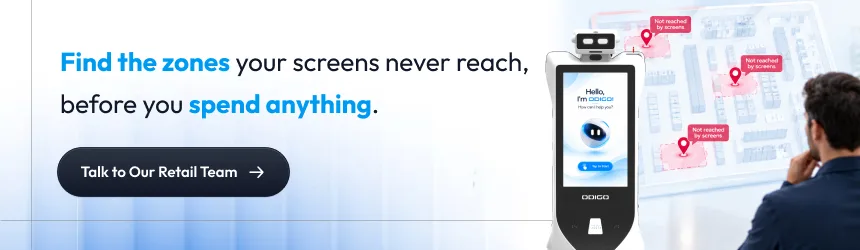
The calculation changes when the goal is to reach shoppers deeper inside the store. Aisle interiors, promotional zones, sampling areas, and other mid-journey locations may benefit from a mobile advertising robot because the media can move across zones instead of remaining tied to one sightline.
This also matters when advertising needs to do more than display a message. If a campaign includes touch interaction, QR engagement, shopper assistance, or store navigation, the advertising surface can become part of the shopper journey rather than a fixed display.
For supermarket operators, the decision can therefore start with the zone, campaign objective, and measurement requirement. A fixed screen can continue serving high-traffic points, while an advertising robot by Kody Robots can extend advertising into areas where mobility and interaction add value.
A Hybrid Approach for Supermarket Advertising
This approach also supports a hybrid deployment. Existing screens can continue serving fixed locations while a mobile advertising robot covers selected zones, dayparts, or promotional areas. The combination allows retailers to use each format according to the role it needs to perform rather than treating one as a replacement for the other.
| Store zone | Recommended format | Why |
| Entrance | Static screen | Everyone passes, so saturation beats targeting |
| Checkout queue | Static screen | Captive dwell at a fixed point, lowest cost per face |
| Inventory Reflection System | Advertising robot | Robot holds presence and handles queries and tickets |
| Promotional endcap | Advertising robot | Offers change by daypart and by zone |
| Aisle interior | Advertising robot | Reaches shoppers mid-decision, where mounts cannot cover |
| Sampling or demo station | Advertising robot | Routes footfall to the station and reports engagement |
| Back of store | Neither | Outside shopper-facing media scope |
The right format depends on where shoppers move, what the campaign needs to achieve, and how performance needs to be measured. Static screens can anchor fixed zones, while advertising robots extend campaigns into deeper store zones. For many supermarkets, advertising robots perform better as the robot creates a more flexible advertising network across the sales floor.
Static Screens vs Advertising Robots in Supermarkets: What to Check Before You Commit
Take the following list into any vendor conversation, including ours, because the list separates what ships on day one from what gets built during implementation.
- Which capabilities depend on integration with your inventory, POS, loyalty or ticketing systems, and which of those capabilities are scoped during implementation rather than available at go-live.
- Who controls recordings and recognition data, which retention windows apply, and how permissions are granted for each user and each site.
- Floor surface, temperature range, and any zone the robot must be kept out of by configuration.
- How content reaches every store, and whether a multi-site rollout needs technical staff physically present.
- What the analytics export contains, and whether the export format drops cleanly into the tools your media team already runs.
- How the robot behaves when connectivity drops, and which functions continue to run locally on board.
Requirements shift with store format and footprint, and a large-format site raises questions a neighborhood store never will, which is the ground big box store robot covers.
Bring Mobile Advertisement in Your Supermarket with Odigo
Static screens give you reliable advertising placements, while advertising robots can bring campaigns into different areas of the store. The right choice depends on where you want to reach shoppers, how often campaigns change, how many locations you manage, and what your team needs to measure.
Before investing, look beyond the display itself. Review store layout, campaign goals, content management, integration requirements, deployment conditions, and the level of shopper interaction you want. A fixed screen may be the right fit for a defined placement. A mobile advertising robot can make more sense when you want advertising to move across the sales floor while also supporting shoppers.
If you are evaluating static screens vs advertising robots in Supermarkets, Odigo gives you an opportunity to test the mobile approach against your actual store environment. Share your store layout, campaign objectives, and current advertising setup with our team. We can walk you through where Odigo fits, what deployment requires, and how the advertising model can work across your locations.
Static Screens vs Advertising Robot in Supermarkets – General FAQs
We have listed a few questions regarding “Static screens Vs advertising robots in supermarkets” that might help answer your basic questions. If you have any queries after reading this, Kody Robots is just a call away.
1. Static Screens vs Advertising Robots in Supermarkets: Which Delivers Better ROI?
Returns follow what a retailer can prove. Static screens cost less per advertising face but report modeled impressions, while advertising robots cover more floor and return proof of play with tap and QR engagement that advertisers trust at renewal.
2. What Is the Difference Between Advertising Robots and Static Screens?
The difference between advertising robots and static screens is movement combined with interaction. Signage is a fixed surface shoppers walk past, while an advertising robot patrols the floor, carries two touch-enabled advertising faces, and answers shoppers instead of only displaying to them.
3. Can Advertising Robots Replace Digital Signage in a Supermarket Entirely?
No, and replacement is rarely the goal. Fixed screens remain the cheapest way to saturate entrances, checkouts and service desks, where every shopper passes one point. Robots take the aisles, promotional zones and sampling areas that mounts cannot reach.
4. How Do Advertising Robots Measure Campaign Performance Compared to Static Screens?
Advertising robots log proof of play plus tap and QR engagement by zone and daypart, while static screens report modeled impressions only. Measurement decides most Static Screens vs Advertising Robots in Supermarkets budgets, and advertising robot vs static screens in supermarkets evaluations should start there.
5. What Parameters Can an Advertising Robot Improve in a Supermarket?
An advertising robot can help improve advertising reach, shopper engagement, campaign interactions, aisle coverage, footfall insights, and shopper assistance. Operators can track metrics such as ad plays, taps, QR scans, dwell time, and interactions to measure its impact.
6. What Store Areas Can Benefit Most from an Advertising Robot?
An advertising robot can support high-traffic aisles, promotional zones, product launches, sampling areas, and other shopper engagement points where brands want more visibility and interaction.