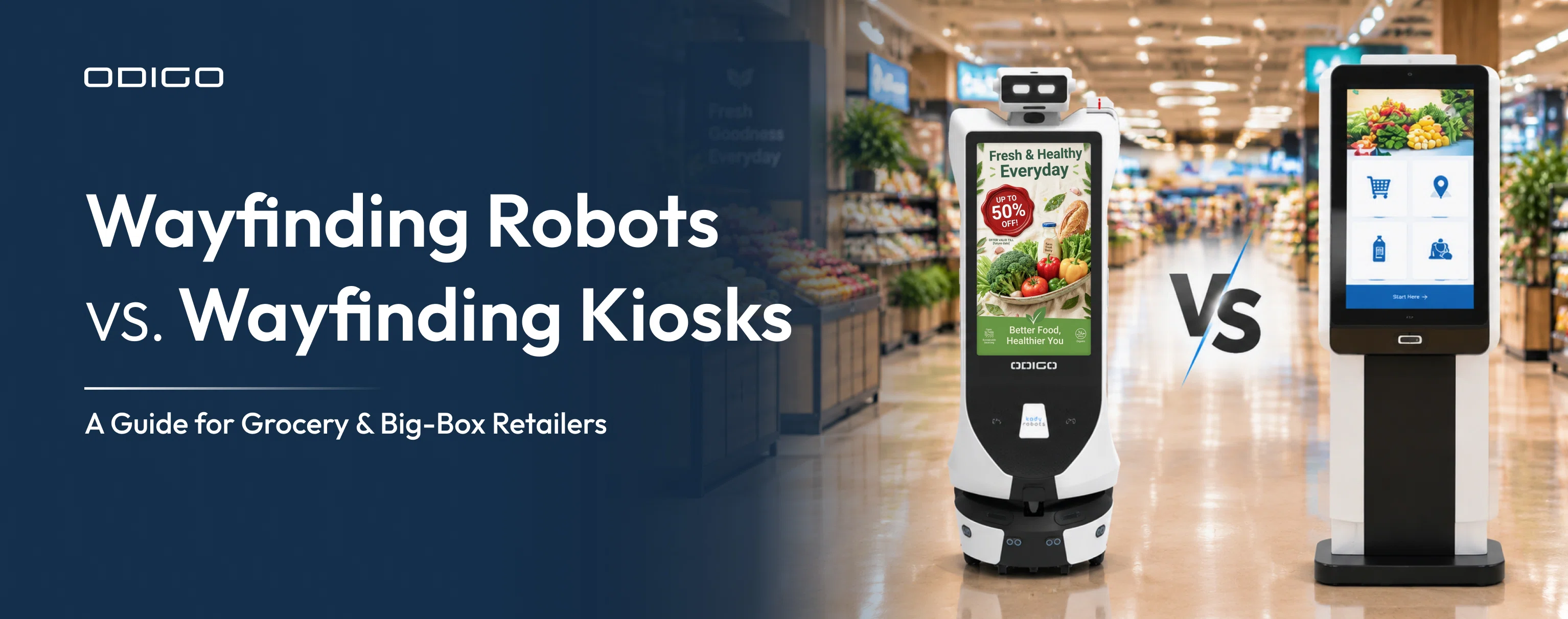

Quick Summary: Wayfinding robots vs wayfinding kiosks explores two approaches to helping shoppers navigate grocery and big-box stores. This blog compares both approaches across capabilities, technology, efficiency, ROI, and store requirements, helping retailers understand which solution fits their customer journey and operating environment.
Key Takeaways
- When evaluating wayfinding robots vs wayfinding kiosks, retailers should consider the store environment, customer flow, coverage needs, and interaction requirements.
- Wayfinding robots can bring mobile, interactive assistance across designated store areas, while kiosks provide a fixed point for digital maps, directions, and store information.
- Technology plays an important role in wayfinding performance, including navigation and mapping, connectivity, interactive interfaces, analytics, centralized management, and scalability.
- Odigo extends beyond wayfinding by combining navigation, voice assistance, digital advertising, visitor assistance, multilingual interaction, analytics, and fleet monitoring.
- Grocery and big-box stores have different navigation requirements, making store layout, aisle structure, customer movement, and destination patterns important factors in the decision.
- Retailers can evaluate wayfinding efficiency through customer usage, search requests, interaction rates, frequently requested destinations, and employee time.
- A meaningful ROI evaluation brings together total cost of ownership, customer utilization, employee workload, business value, and additional use cases.
Big-box retailers and grocery stores face a persistent challenge: helping shoppers find different products, aisles, and departments without placing constant demands on store employees. According to FMI’s 2026 U.S. grocery shopper trends, 69% of shoppers say being able to find aisles and departments easily can improve their experience, making store navigation an important part of the in-store experience. (fmi)
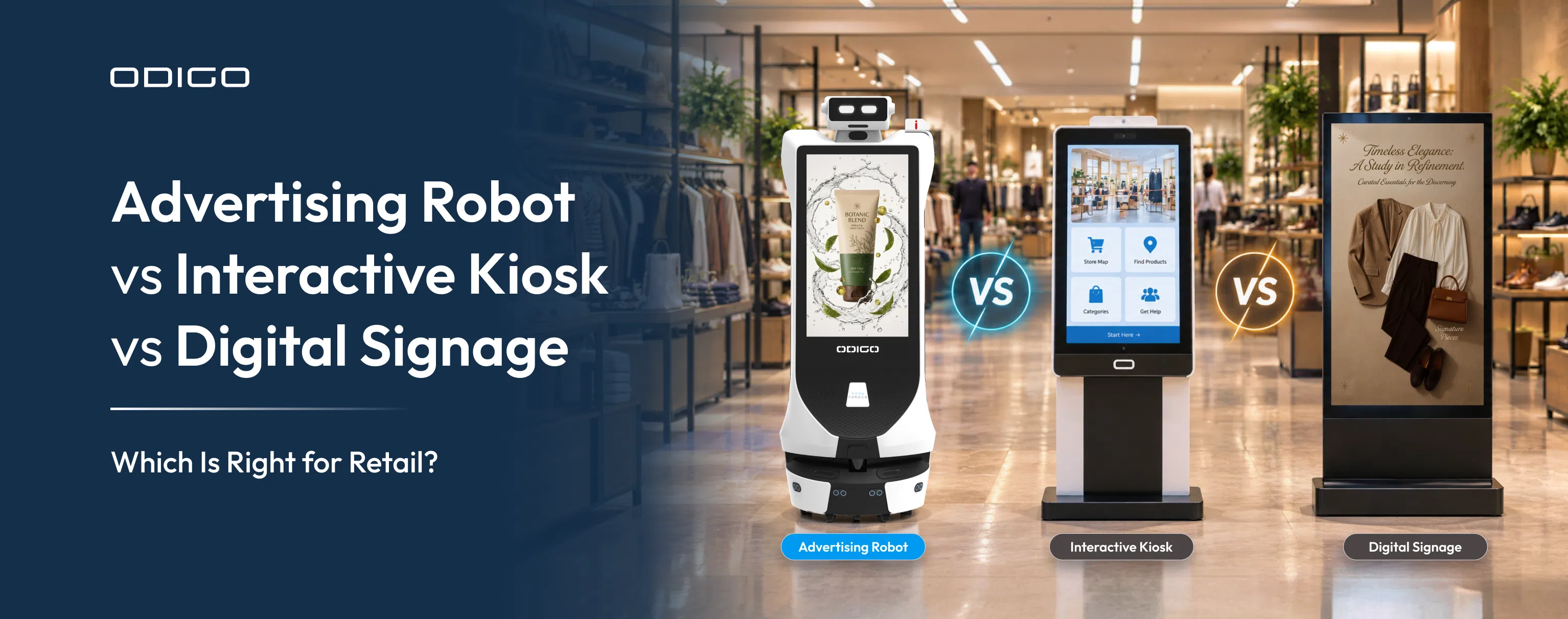
This is where Wayfinding robots vs wayfinding kiosks becomes an important consideration. A wayfinding kiosk can support shoppers with store maps, directions, and product or department information from a fixed location. While a wayfinding robot can take that assistance further by bringing an interactive guidance point into the store and helping shoppers navigate towards store zones, with product advertising, offers and alternative displays. The wayfinding experience is supported by the broader capabilities of how AI robot assistants work, including autonomous movement, interaction, and assistance within physical environments.
Now, the question for retailers is not simply whether they should offer digital wayfinding. The question is which approach can deliver the right level of assistance, flexibility, coverage, and long-term value for the store environment.
What Are Wayfinding Robots and Wayfinding Kiosks?
For grocery and big-box retailers, wayfinding technology provides shoppers with digital assistance for navigating large store environments. The two common approaches, wayfinding robots and wayfinding kiosks, differ primarily in how that assistance is delivered across the store.
What is a wayfinding robot?
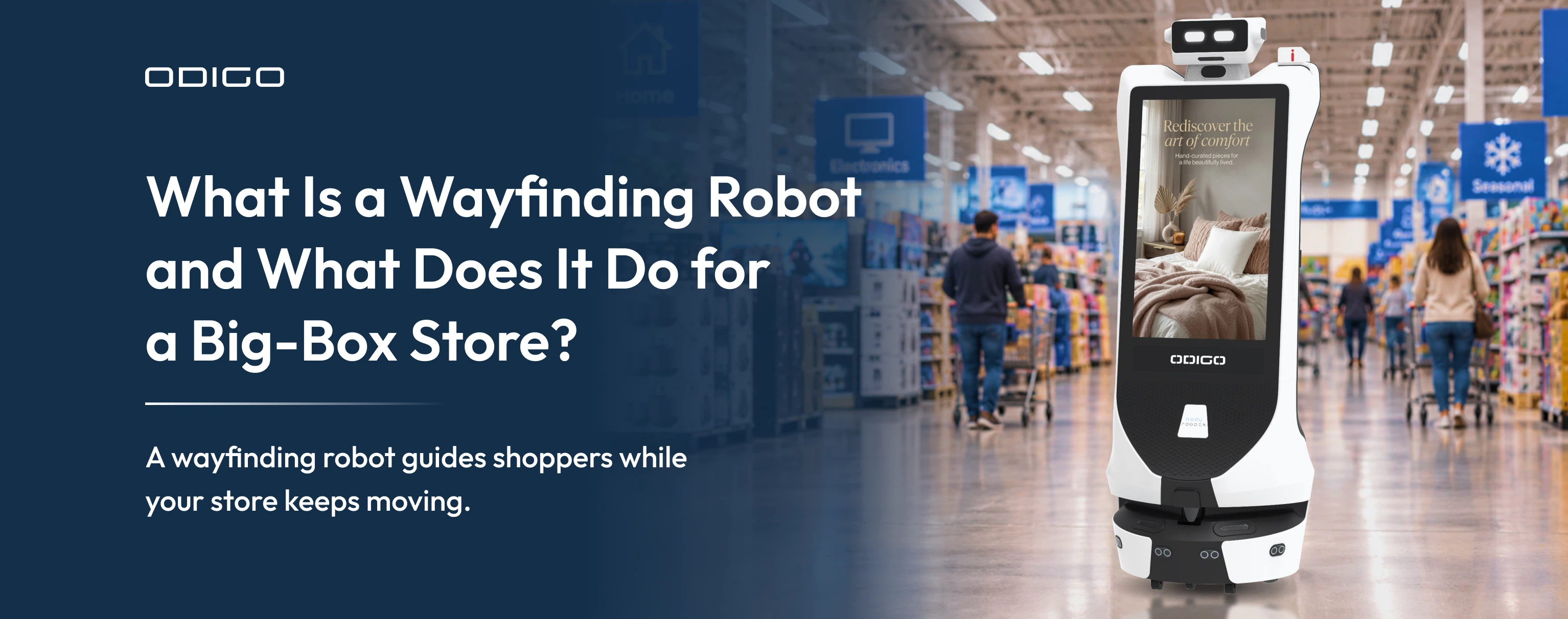
A wayfinding robot is an autonomous mobile system designed to help shoppers navigate through large retail environments such as grocery stores and big-box stores. Wayfinding robots can move with your customers through designated areas and interact with them through interfaces such as touchscreens, multilingual voice assistance, and advertisement display, depending on configurations. This combination of mobility, navigation, and interaction is central to what is a wayfinding robot, particularly in retail environments where shoppers need assistance across different areas of the store.
What is a wayfinding kiosk?
A wayfinding kiosk is a fixed, self-service digital station that helps shoppers find products, departments, aisles, services, or other destinations within a store. Customers approach the kiosk, search for their destination, and follow the directions displayed on the screen. This gives retailers a defined location for digital wayfinding and creates a straightforward self-service interaction for shoppers.
With the basic models established, the next step is understanding how each solution delivers assistance on the store floor.
Together, wayfinding robots and kiosks offer different approaches to helping shoppers navigate large retail spaces. While kiosks provide fixed self-service assistance, robots bring that assistance directly to customers as they move through the store.
Wayfinding Robots vs Wayfinding Kiosks: How Each Solution Works in grocery and Big-box stores
Both wayfinding robots and wayfinding kiosks help shoppers find departments, products and store services; however, they deliver wayfinding in different ways. The key difference lies in how shoppers access information and how they are guided to their specific destination.
How does a wayfinding robot work?
A wayfinding robot combines autonomous navigation with an interactive interface, so it can easily identify the shoppers’ requested location, determines a route, and navigate through the store while detecting and responding to obstacles in the path. Depending on the configuration, the robot can provide directions, display offers, avoid obstacles, interact with customers in multiple languages, and guide them to a specific aisle or department.
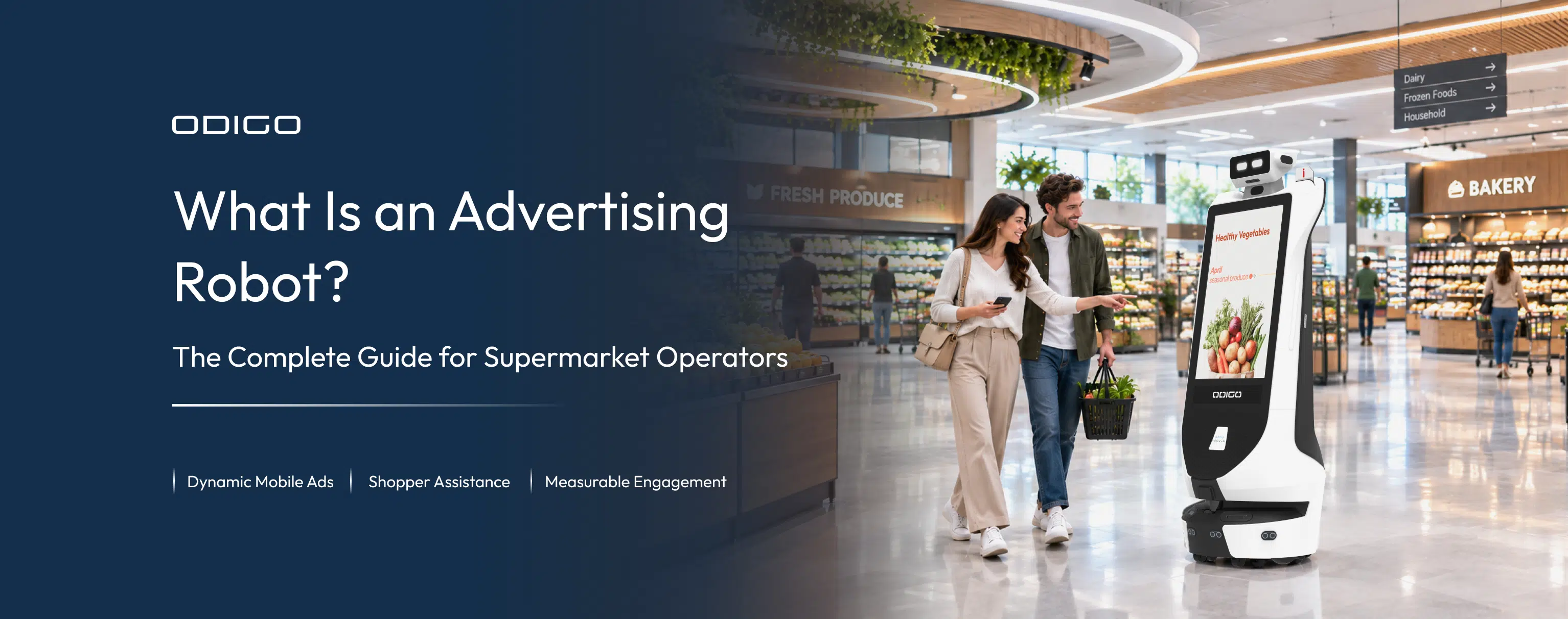
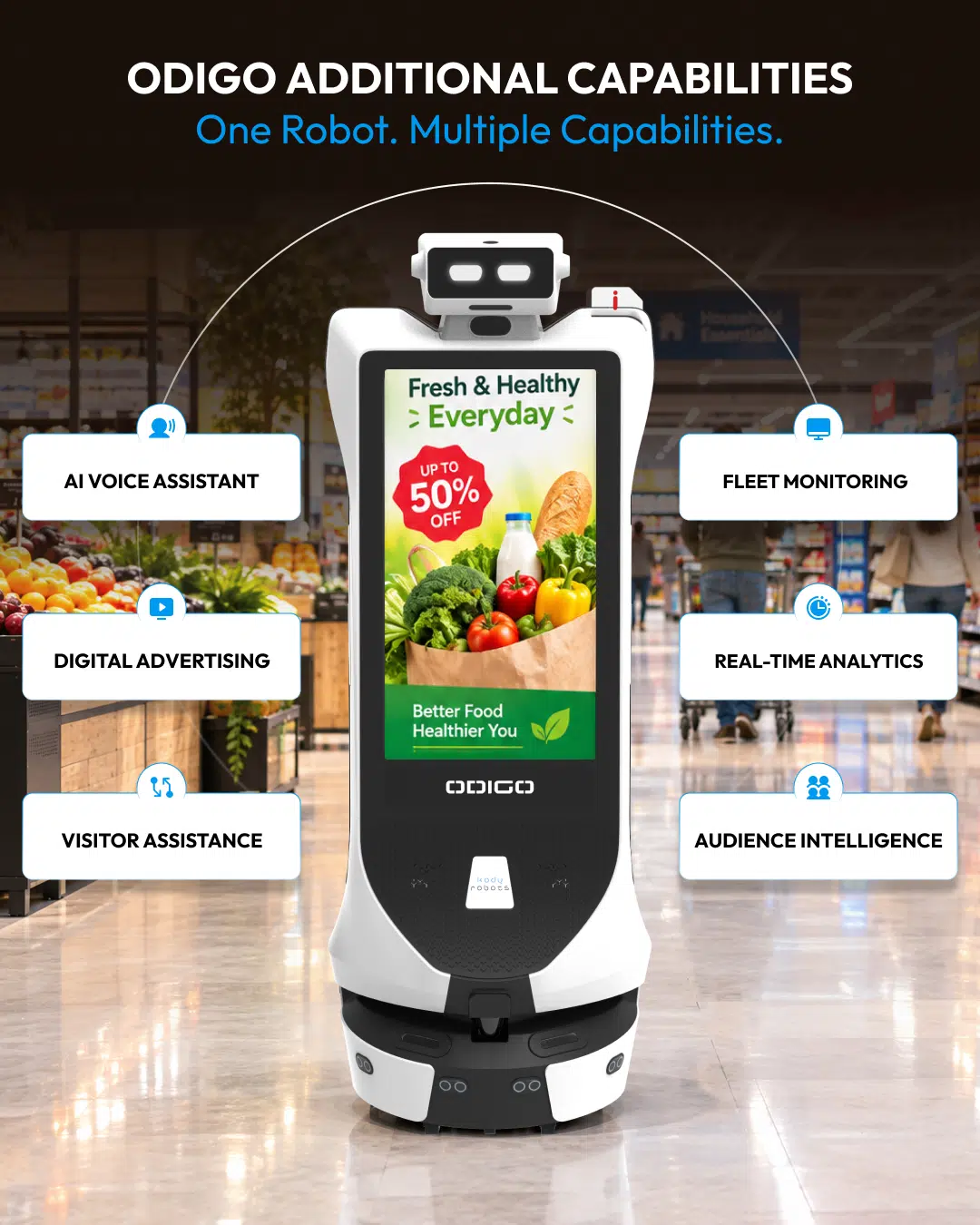
For example, Odigo combines autonomous navigation, visitor assistance, intelligent wayfinding, multilingual interaction, digital advertising, and analytics within one platform. Odigo, an AI robot assistant for supermarket, features AI-powered dual SLAM navigation combining laser and visual sensing, obstacle avoidance, a dual 32-inch touchscreen display, and Wi-Fi and Bluetooth connectivity.
How does a wayfinding kiosk work?
A wayfinding kiosk provides navigation through a fixed digital interface. Shoppers can receive directions or a store map on the screen and can follow the displayed instructions to reach their destination.
The shopper then uses the displayed information to continue toward the requested destination. Kiosk placement, store mapping, information accuracy, and interface usability can therefore influence how effectively the solution supports the shopping journey.
The two workflows provide the foundation for evaluating the differences between mobile and fixed wayfinding models.
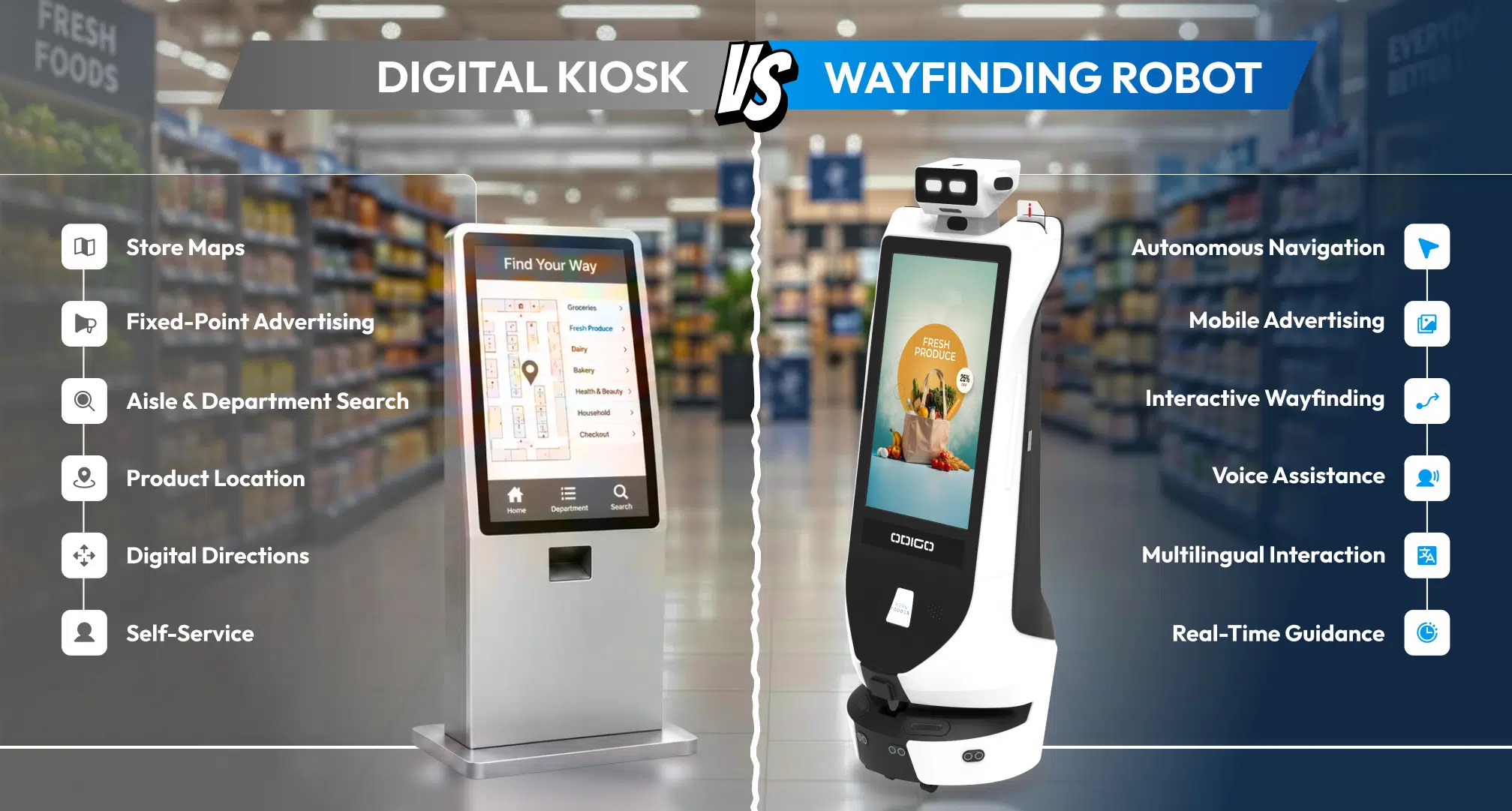
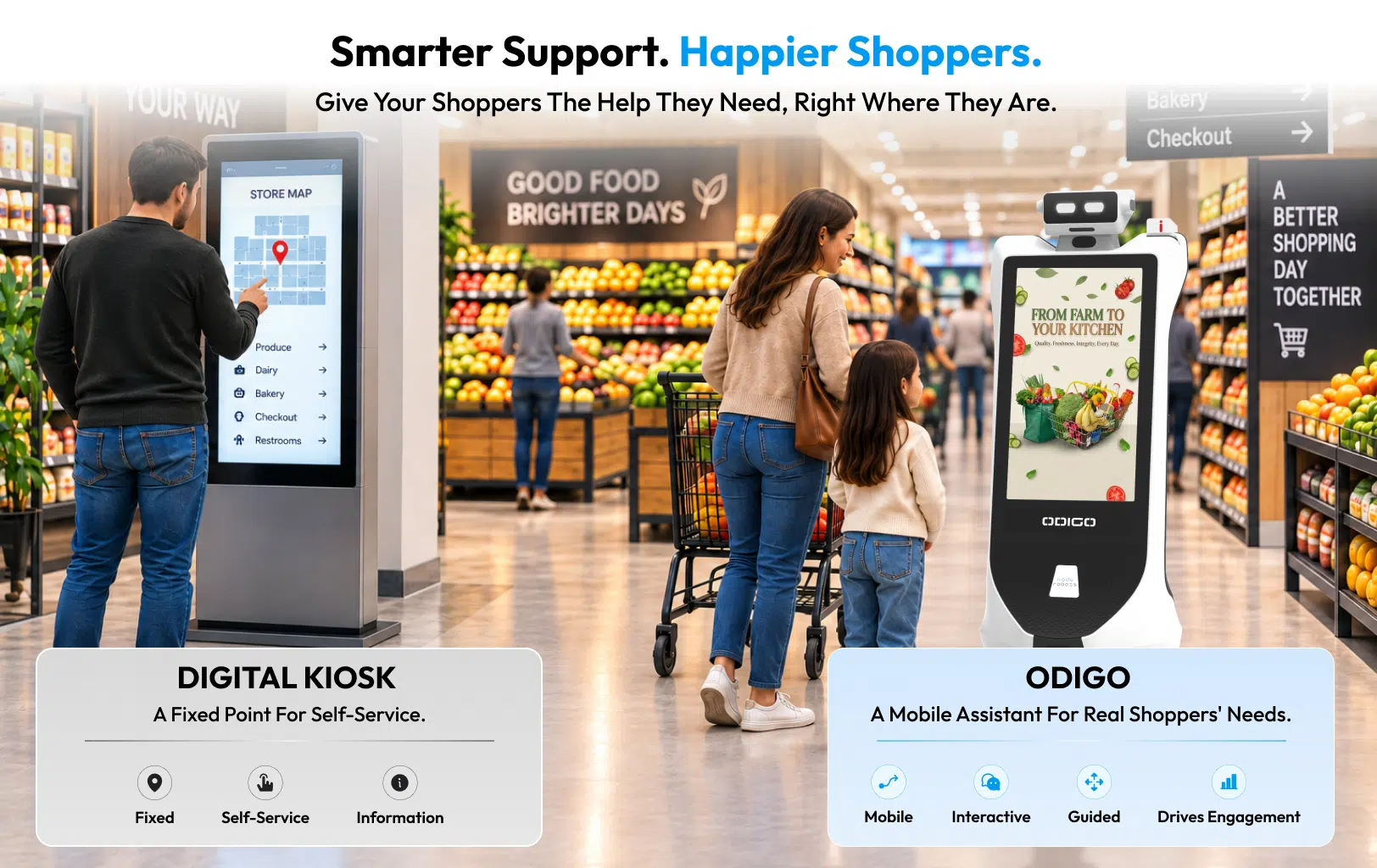
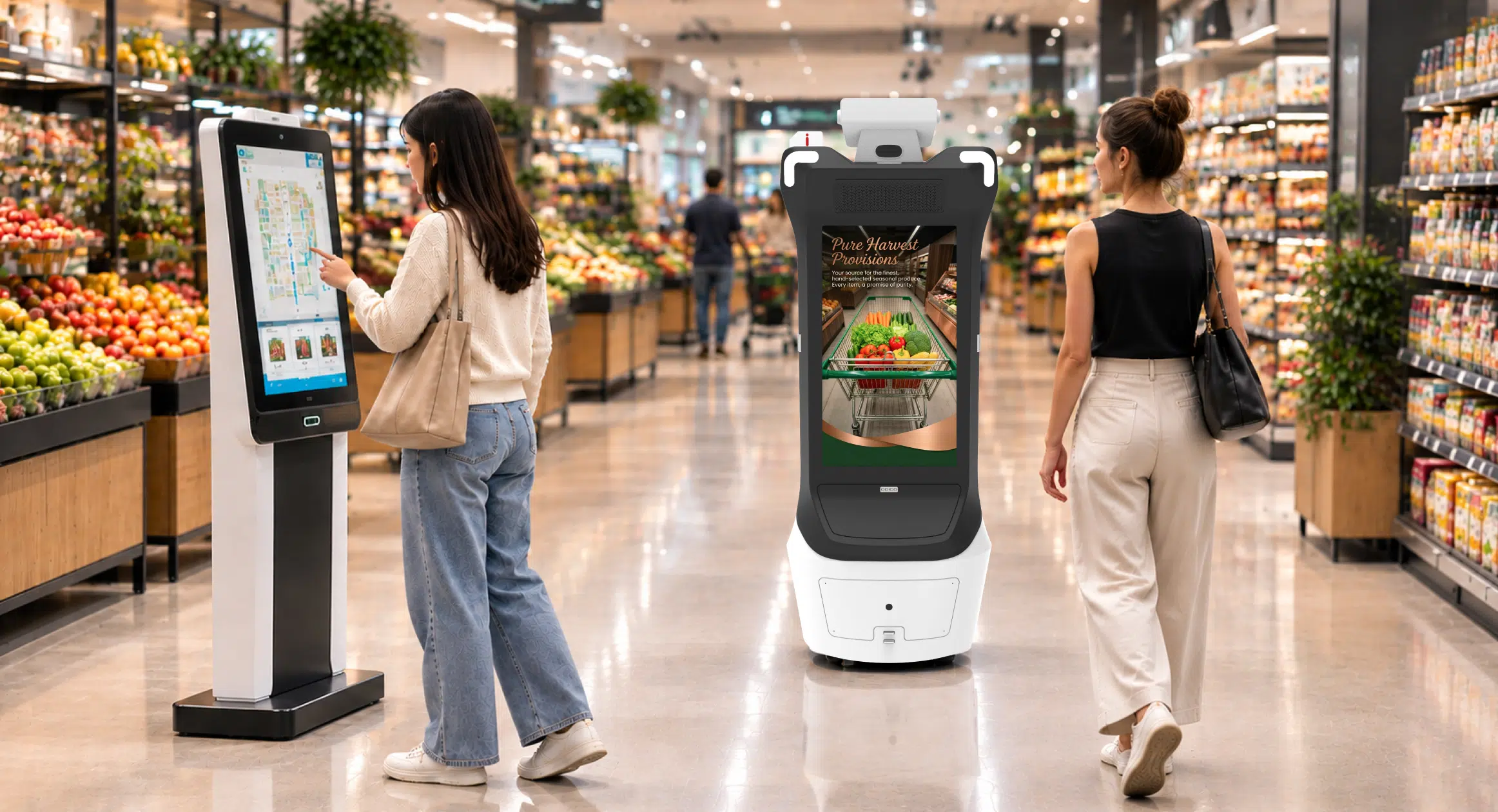
The biggest difference is simple: a wayfinding robot comes to the shopper, while a shopper has to go to a wayfinding kiosk for assistance. This mobility changes how and where shoppers can access wayfinding support in the store.
Wayfinding Robots vs Wayfinding Kiosks: What Sets Them Apart?
Wayfinding robots and kiosks address the same pain point for retailers: improving the store environment by helping shoppers find products, aisles, departments, and services. However, they deliver assistance differently in terms of interaction, mobility, flexibility, and coverage. Understanding these differences can help big-box retailers and grocery stores evaluate which solution aligns with their store environment and customer experience.
| Key Features | Wayfinding Robot | Wayfinding Kiosk |
| Mobility | Moves through store areas | Remained at a fixed location |
| Customer interaction | Support interactive, multilingual mobile assistance | Provide self-service interaction |
| Wayfinding | Can navigate shoppers through aisle and departments | Display maps and directions |
| Flexibility | Can be deployed on the floor across different areas | Location is determined during installation |
| Store coverage | Can serve complete store area | Serves shoppers near its location |
| Customer efforts | Assistance can be brought into the store environment | Shoppers needs to locate and approach the kiosk |
| Engagement | Can interact with shoppers while moving | Engagement occurs at the kiosk |
| Additional capabilities | Can show offers, alternative products, shelf gaps, misplaced product, depending on configuration | Primarily serves information and wayfinding needs |
The difference between wayfinding robots and wayfinding kiosks becomes particularly relevant in big-box stores. A kiosk creates a clear, accessible point where shoppers can easily search for information, while a robot can make that assistance mobile and available across store zones.
For grocery stores and big-box retailers, the comparison is less about which technology is more advanced and more about how shoppers need assistance, where that assistance is required, and what retailers expect the solution to contribute beyond basic directions.
What Value Do Wayfinding Solutions Add?
Wayfinding solutions can do more than help shoppers locate an aisle or department. For grocery and big-box retailers, these wayfinding solutions can efficiently reduce navigation-related friction, support employees to concentrate on high value tasks, and make store information easier to access. The business value depends on the deployment model, customer usage, store environment, and capabilities included in the solution.
Value a wayfinding robot can deliver
A wayfinding robot extends assistance beyond a fixed information point by moving through multiple store areas and interacting with shoppers. The value of a robot include:
Interactive engagement
Shoppers can interact with robot assistant like Odigo through touch or voice assistance, depending on configuration.
Mobile assistance
Wayfinding robots offer guidance across different areas of stores, so that shoppers can reach their destination.
Physical guidance
The robot can direct shoppers towards relevant aisle, department, or store zone.
Multilingual assistance
The voice-based interaction of a wayfinding robot like Odigo can support shoppers across different languages.
Broader functionality
Depending on the platform and the requirement of retailer, the robot can support capabilities such as advertisement, customer engagement, empty shelf information and retail insights.
Now, let us explore how a wayfinding kiosk can deliver value for grocery and big-box stores:
Value a wayfinding kiosk can deliver
A wayfinding kiosk offers shoppers a dedicated self-service point for finding, aisle, product and other destinations in a store. A kiosk value can include:
Consistent information
Through one interface shoppers can access store map, direction and product information.
Self-service assistance
Shoppers can easily find information without any assistance from employees.
Reduce routine queries
Employees can concentrate on high-value tasks instead of handling basic directional questions.
Strategic placement
Wayfinding kiosks can be positioned at entrances or other high traffic areas to make information easy to access.
Focused functionality
A wayfinding kiosk provides a straightforward solution for stores primarily seeking fixed-point wayfinding.
The value of each approach therefore depends on how the technology fits the store’s operating model and the type of assistance shoppers need. The right wayfinding solution can turn navigation from a basic utility into a more efficient and engaging part of the in-store experience.
Grocery Stores Wayfinding Robots vs Wayfinding Kiosks: Which Is Right for You?
For grocery retailers, choosing between the right wayfinding approach depends on how customers move through the store and where navigation support is most needed. A grocery store with a compact layout may have different requirements from a large format supermarket with multiple departments, entrances and high traffic customers.
When wayfinding kiosks may fit grocery stores
A wayfinding kiosk can be a practical choice when the grocery store wants a dedicated location for shoppers to access store information. Kiosk can make sense when:
- Shoppers typically enter through a limited number of access points.
- The store has a relatively predictable customer flow.
- The primary requirement is self-service navigation and information.
- Fixed wayfinding stations can offer sufficient coverage.
- The retailer prefers a focused solution with a defined physical footprint.
For example, a grocery store may position a kiosk near entrances or major decision-making points where shoppers are more likely to look for directions before exploring the store.
When wayfinding robots may fit grocery stores
A wayfinding robot may be worth considering when navigation support is required to extend beyond designated information point. This can be relevant for large grocery stores where customers move across multiple departments and may require assistance at different points while exploring the store. Retailers may consider a mobile approach when they want to:
- Create a more interactive customer assistant model.
- Extend wayfinding assistance across different store areas.
- Support navigation through store alongside other customer-facing functions.
- Adapt the deployment to different areas or operating requirements.
- Use a designated platform for multiple customer service applications, where supported.
- Assess potential ROI based on customer usage, employee time saved, and additional capabilities such as digital advertising and shoppers assistance.
For grocery decision-makers, the choice ultimately comes down to the store’s physical layout, expected usage, customer flow, and the role the retailers want wayfinding technology to play within their broader business operations.
Big-Box Stores Wayfinding Robots vs Wayfinding Kiosks: Which Is Right for You?
Big-box stores introduce additional considerations because departments may be widely distributed across a large selling floor, with multiple entrances, service areas, seasonal layouts, and longer customer journeys.
When wayfinding kiosks may fit big-box stores
A wayfinding kiosk can work well when big-box retailers want to establish a clear, fixed access point for store navigation. Kiosk may be appropriate when:
- The store layout supports strategically placed information points.
- Customers enter the store through a defined location.
- The retailers want a dedicated self-service navigation system.
- Shoppers primarily require directions at different stages of their journey.
- Fixed infrastructure aligns with the store’s existing technology setup.
For big-box retailers, multiple kiosks can be positioned at entrance and in different zones where shoppers frequently need orientation.
When wayfinding robots may fit big-box stores
A wayfinding robot can be considered when the big-box retailer wants navigation assistance across the larger store zones rather than being tied to fixed locations. A wayfinding robot may be relevant when:
- Customer journeys include substantial movement between store zones.
- Departments of stores are spread across a large floor area.
- Navigation support required to be available beyond entrance.
- The retailers want to evaluate a customer-facing platform with uses beyond wayfinding.
- Store teams are looking for technology that can serve different operations or customer experience so that they can focus on high-value tasks.
For big-box decision-makers, the selection between kiosks and robots therefore does not only depend on the initial installation. The decision may depend on customer movement, store footprint, deployment coverage, technology requirements, ongoing utilization, and the potential for additional applications to determine which model fits the business.
How Do Wayfinding Options Compare on Efficiency?
For grocery and big-box retailers, efficiency is not just about how quickly shoppers receive directions. It also involves the operational effort required to support kiosks and robots, how consistently they assist shoppers, and how well they fit into existing store operations.
A practical wayfinding robot vs digital kiosk evaluation can consider:
| Efficiency Indicators | Wayfinding Kiosks | Wayfinding Robot |
| Employee involvement | Provide self-service information. | Can handle routine wayfinding interaction, depending on configuration. |
| Shopper access | Assistance is accessed at a fixed location. | Assistance can be available across different store zones. |
| Flexibility | The physical location of a kiosk remains fixed. | Deployment can be easily adjusted across support areas. |
| Additional usage | Generally focused on information and direction. | May support other customer-facing functions, depending on the configuration. |
The efficiency equation of kiosks and robots can differ. A kiosk can be efficient when strategically placed information points provide enough coverage. A robot on the other hand may be relevant when retailers value mobile assistance or want one platform to support multiple customer-facing applications.
Retailers should also evaluate utilization. Search volume, requested destinations, interaction rates, peak usage periods, and employee time associated with routine navigation questions can help establish how the solution performs after deployment.
How Should Retailers Evaluate ROI of a wayfinding solution?
Grocery and big-box retailers can evaluate the ROI of a wayfinding solution based on their specific business case. Wayfinding Robots vs Wayfinding Kiosks can involve different hardware, installation, maintenance, software, and utilization costs, so you should compare total costs with the value generated over time.
A practical evaluation can include:
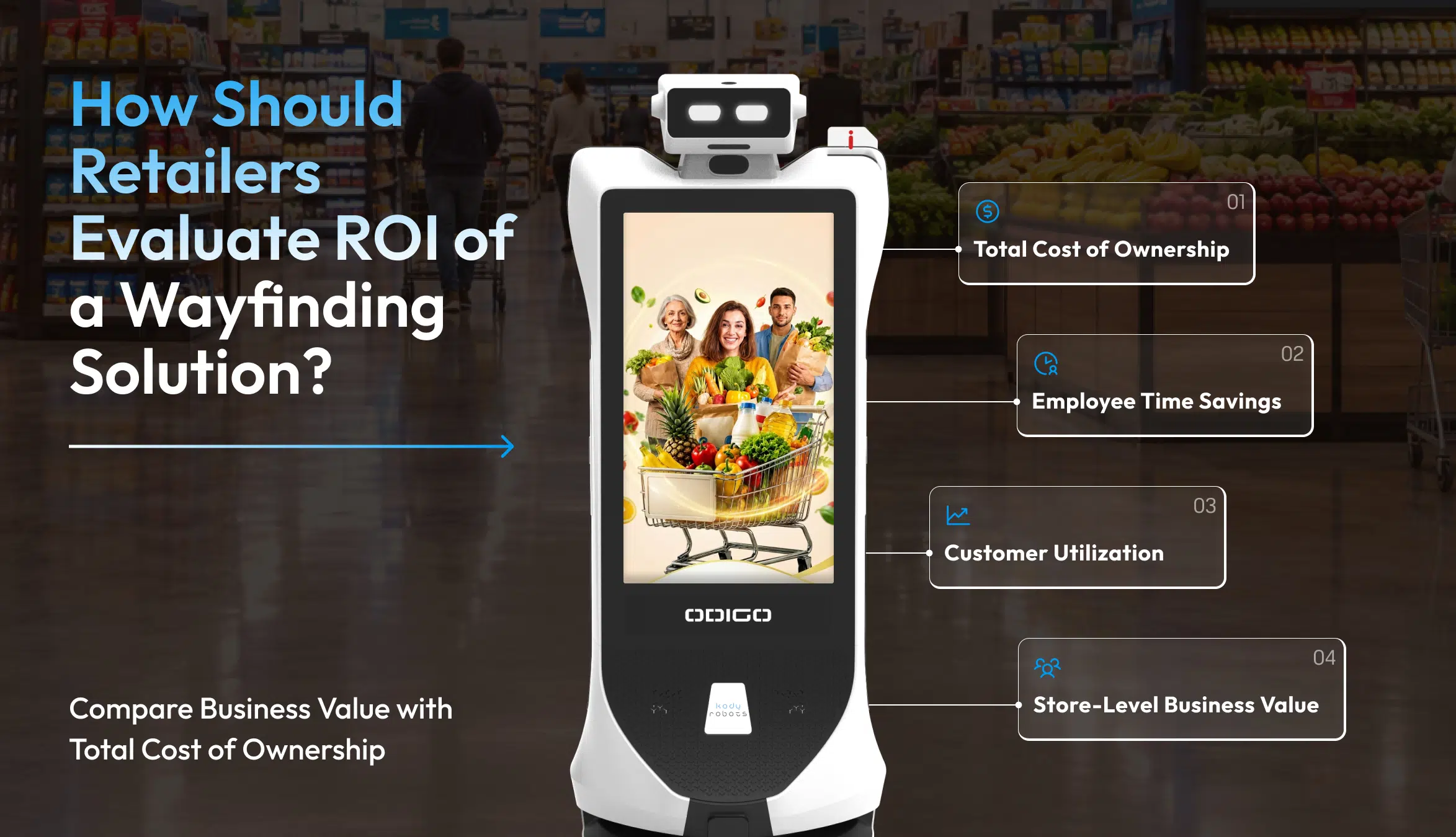
1. Total cost of ownership
Consider the complete investment required to operate the solution, including hardware, software, maintenance, connectivity, updates, support, and infrastructure requirements.
2. Employee time
Estimate how much time employees currently spend answering routine navigation questions and whether the wayfinding robot or wayfinding kiosk can redirect some of that time toward higher-value activities.
3. Customer utilization
Grocery and big box retailers can track searches, destinations requested, interactions, and usage patterns to determine whether the technology is addressing a meaningful shopper’s needs.
4. Store-level business value
You can consider whether easier access to information improves the customer experience and whether usage data can provide insights into demand for products or departments.
5. Additional use cases
Evaluate whether the technology can support other applications. A robot may offer additional customer-facing capabilities such as suggesting offers, alternatives, and nutritional factors, while a kiosk may provide expanded digital information or services.
The most useful ROI assessment should therefore be based on the retailer’s own operating environment:
Total business value generated − total cost of ownership = potential return
Because costs and utilization vary by store format and deployment, you can establish baseline metrics before implementation and measure actual performance after launch rather than relying on generalized ROI assumptions.
Choosing the Right Wayfinding Solution for Your Store
For grocery stores and big-box retailers, Wayfinding Robots vs Wayfinding Kiosks represents a choice between two different models for delivering in-store navigation.
A kiosk can provide a focused, fixed point for self-service navigation with promotion, while a robot can introduce mobile, interactive assistance and, depending on configuration, support broader customer-facing applications. Neither approach automatically fits every retail environment.
For grocery stores and big-box decision-makers, the evaluation should start with the store itself:
- Where do customers need help?
- How frequently?
- How much employee time is involved?
- What coverage is required?
- And how will success be measured?
Answering these questions turns wayfinding from a technology purchase into an operational decision.
The right solution is the one that aligns with the retailer’s store layout, customer behavior, operational priorities, technology environment, and long-term objectives, while delivering measurable value within those conditions.
Explore how Kody Robots AI-powered wayfinding solution can support your store’s customer experience and operational efficiency.
Wayfinding robots vs wayfinding kiosks: General FAQs
Wayfinding Robots vs Wayfinding Kiosks FAQs answer common questions about navigation, store fit, costs, ROI, and shopper assistance.
1. What is the difference between wayfinding robots and wayfinding kiosks?
The difference between wayfinding robots and wayfinding kiosks primarily comes down to how shoppers access assistance. A wayfinding robot can provide mobile, interactive guidance across designated store areas, while a wayfinding kiosk provides digital directions and store information from a fixed location. Wayfinding robots vs wayfinding kiosks can therefore offer different approaches to in-store assistance
2. How do wayfinding robots work in grocery stores?
Wayfinding robots use store mapping and autonomous navigation to move through designated areas and assist shoppers with directions. Depending on the system, shoppers can use a touchscreen or voice interface to request destinations such as aisles, departments, or other store zones.
3. How do wayfinding kiosks work in big-box retail stores?
A wayfinding kiosk provides a fixed digital point where shoppers can search for products, departments, services, or other destinations. It displays relevant store information, maps, or directions based on the store’s mapped environment and available content.
4. How can wayfinding robots reduce the cost of customer assistance?
Wayfinding robots can handle routine navigation and product-location requests, allowing store associates to spend more time on tasks that require human expertise. Retailers can evaluate the value through assisted interactions, request volumes, response times, and changes in staff workload.
5. How does robotic wayfinding compare with kiosk wayfinding?
Robotic wayfinding vs kiosk wayfinding involves two different approaches to delivering in-store assistance. Robotic wayfinding can bring interactive guidance into designated store areas, while kiosk wayfinding gives shoppers access to maps, directions, and store information at a fixed point.
6. What are the benefits of wayfinding robots compared with fixed wayfinding kiosks?
In a wayfinding robots vs fixed wayfinding kiosks evaluation, retailers can consider mobile assistance, interactive engagement, coverage across designated areas, and additional functions such as digital advertising, multilingual interaction, visitor assistance, and analytics, depending on the robot and its deployment.
7. Which is more suitable for grocery stores, wayfinding robots or wayfinding kiosks?
For Grocery Store Wayfinding Robots vs Kiosks, retailers can evaluate store footprint, aisle structure, customer traffic, navigation requirements, expected usage, and desired interaction levels. A kiosk can provide a defined self-service point, while a robot can provide interactive assistance across its designated operating areas.
8. Which is better for big-box retailers, wayfinding robots or digital kiosks?
For Big-Box Retail Wayfinding Robots vs Kiosks, the evaluation can include store size, department distribution, customer movement, required coverage, and potential use cases. A fixed kiosk can support strategically positioned information points, while a mobile robot can provide assistance across designated areas.
9. Can wayfinding robots guide shoppers directly to products and aisles?
Yes. A wayfinding robot can provide directions toward supported products, aisles, departments, and other store destinations. The accuracy of the experience depends on the store map, destination data, navigation system, and how regularly store information is maintained.
10. Can wayfinding kiosks provide real-time store navigation?
A wayfinding kiosk can provide digital maps and directions based on the information available in its system. The quality of navigation depends on the accuracy and currency of the store map, destination information, and software supporting the kiosk.
11. Can wayfinding robots improve supermarket sales?
Wayfinding robots can contribute to a better shopping experience by helping customers find products more easily and reducing the friction of navigating large stores. Their impact on sales can depend on factors such as product discovery, shopper engagement, promotions, and how the robot is integrated into the store experience.
12. How much do wayfinding robots cost compared with wayfinding kiosks?
Costs vary according to hardware, software, installation, mapping, connectivity, maintenance, support, and deployment scale. A useful cost comparison should evaluate total cost of ownership alongside utilization, employee workload, customer engagement, and the additional functions each solution can support.
13. How are retailers using Wayfinding Robots vs Kiosks in the USA?
Wayfinding Robots vs Kiosks in USA can be evaluated through different retail use cases, including store navigation, product discovery, customer assistance, and digital engagement. Walmart has documented store maps and product-finding capabilities that help shoppers locate products and aisle locations. ALDI’s app provides store maps, directions, and product-location support through its in-store mode. Lidl provides a U.S. store finder and digital shopping features through Lidl Plus. These examples show how digital tools can connect store information with the physical shopping journey, with specific capabilities varying by retailer.
14. What ROI metrics should retailers track for wayfinding robots?
Retailers can measure ROI through metrics such as the number of shopper interactions, product searches, navigation requests, assisted journeys, engagement with promotions, repeat usage, and time saved on routine assistance. These measures can help connect robot activity with shopper experience and operational outcomes.
15. Can wayfinding robots increase shopper engagement and retail media revenue?
Beyond navigation, mobile robots can create an additional in-store engagement channel by presenting promotions and advertising as they move through shopper areas. Retailers can evaluate performance through ad plays, shopper interactions, QR or touchscreen engagement, campaign reach, and other available engagement data.