odigo
AI Retail Store Robot That Answers, Guides, and Sells While It Moves
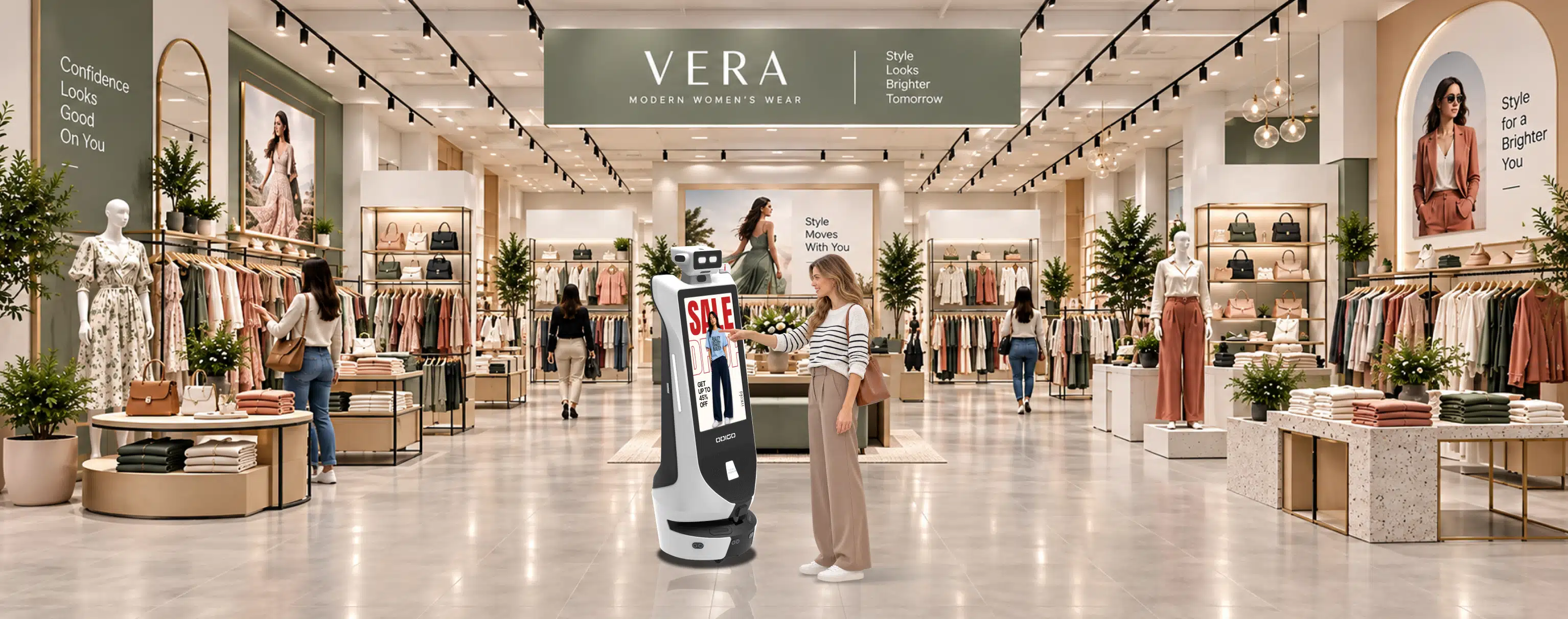
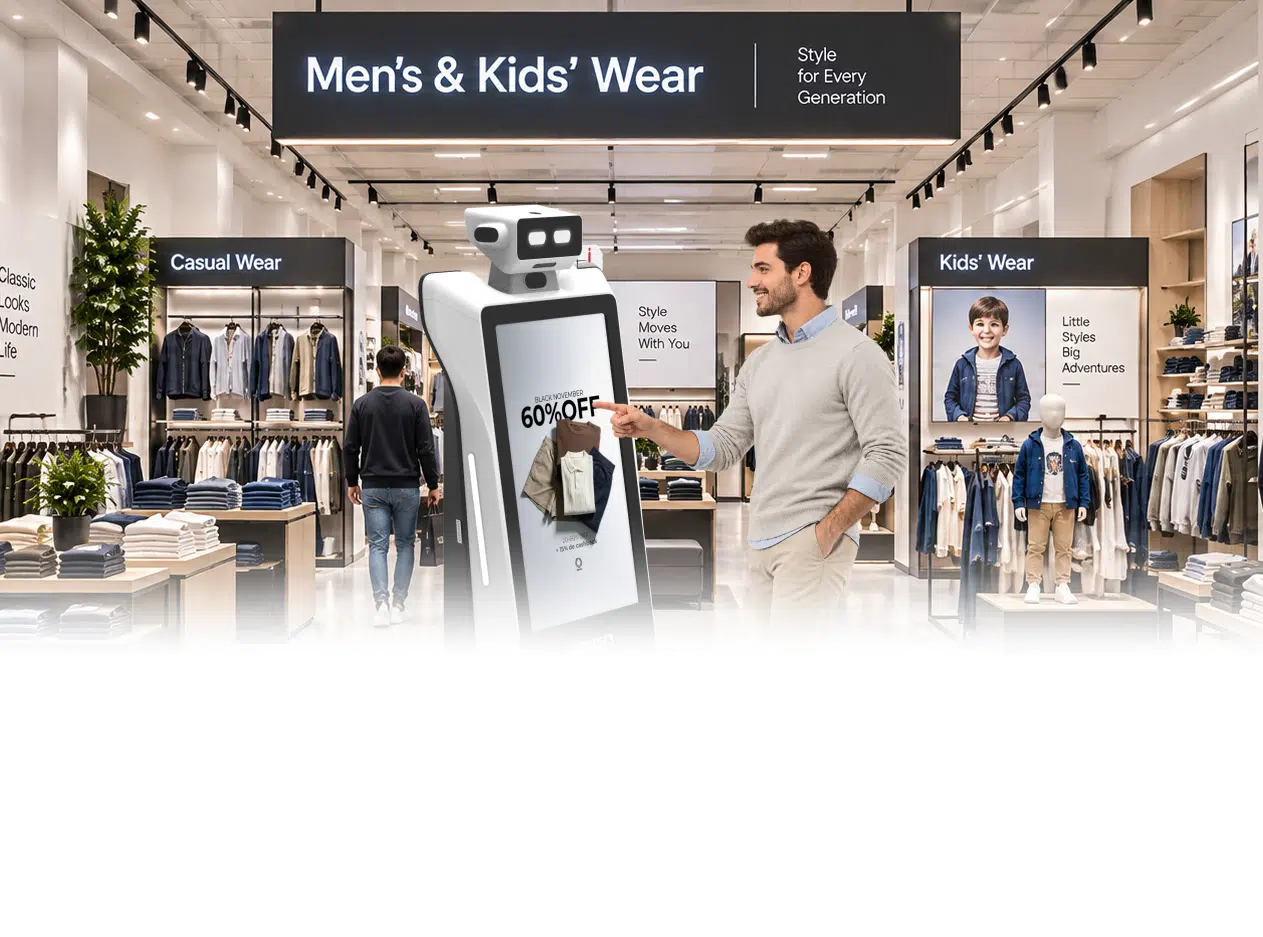
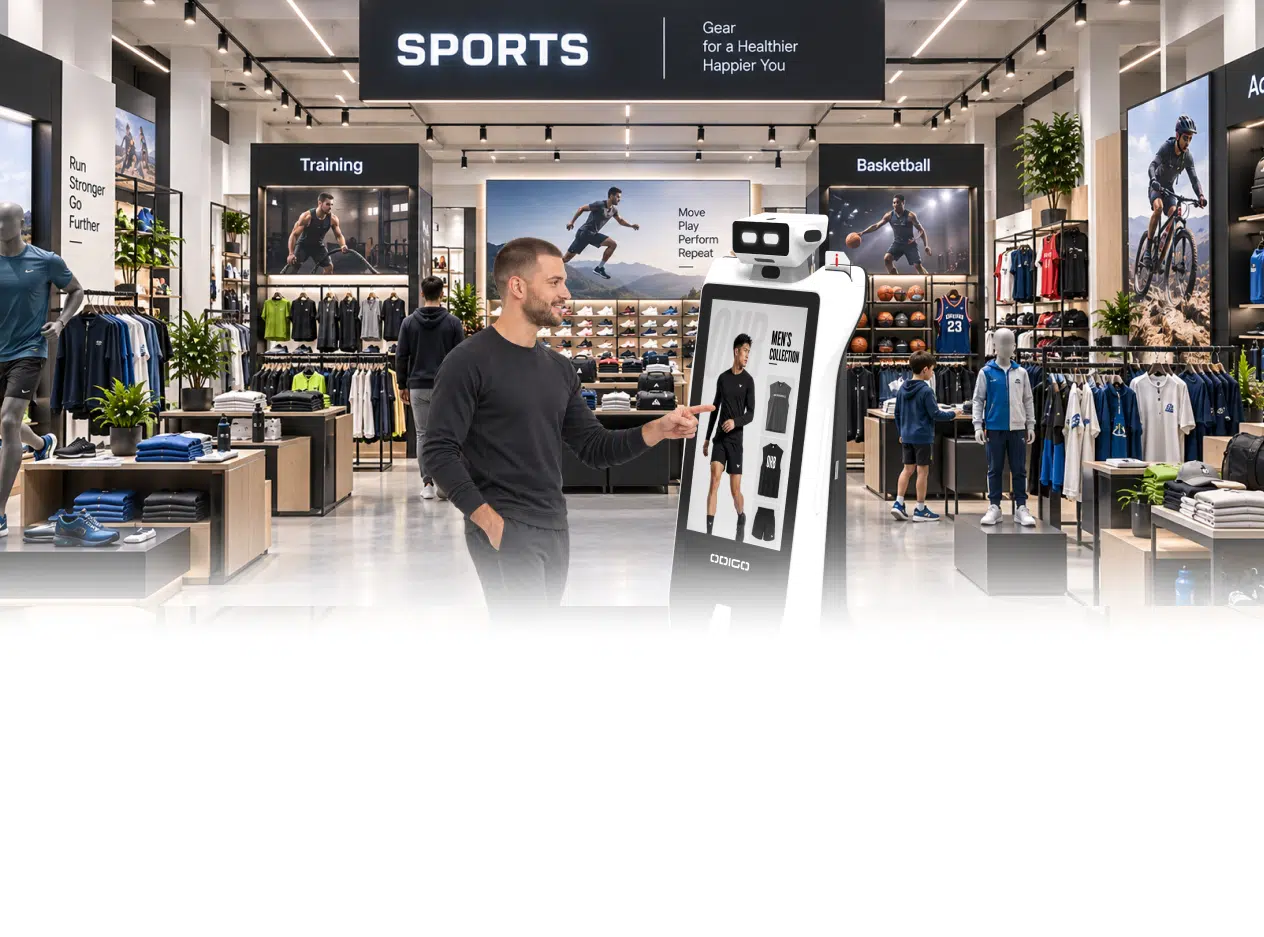
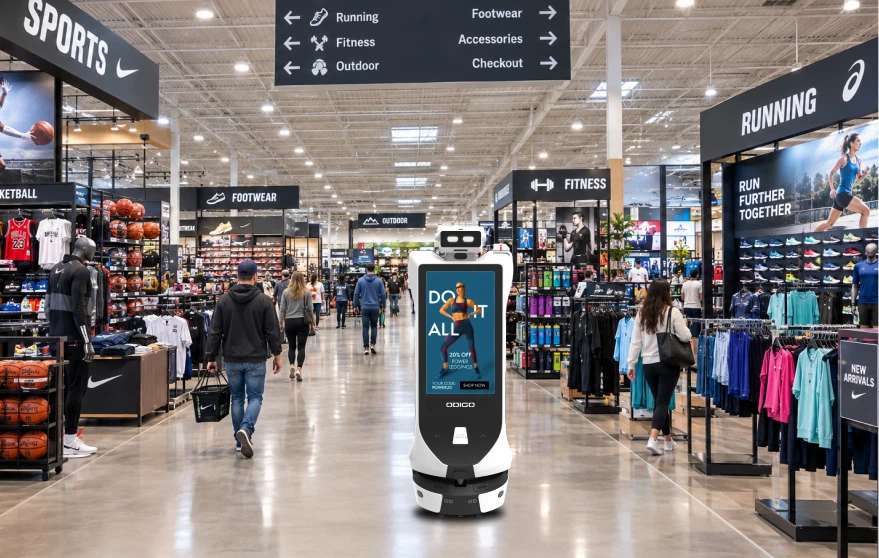
Odigo brings shopper assistance, product discovery, mobile advertising, and store-floor monitoring into one unit that moves through your retail store. It answers questions in the shopper’s own language, walks them to the right aisle, shows what else is worth considering, and reports back what your floor actually did.
Where the Retail Store Robot Fits
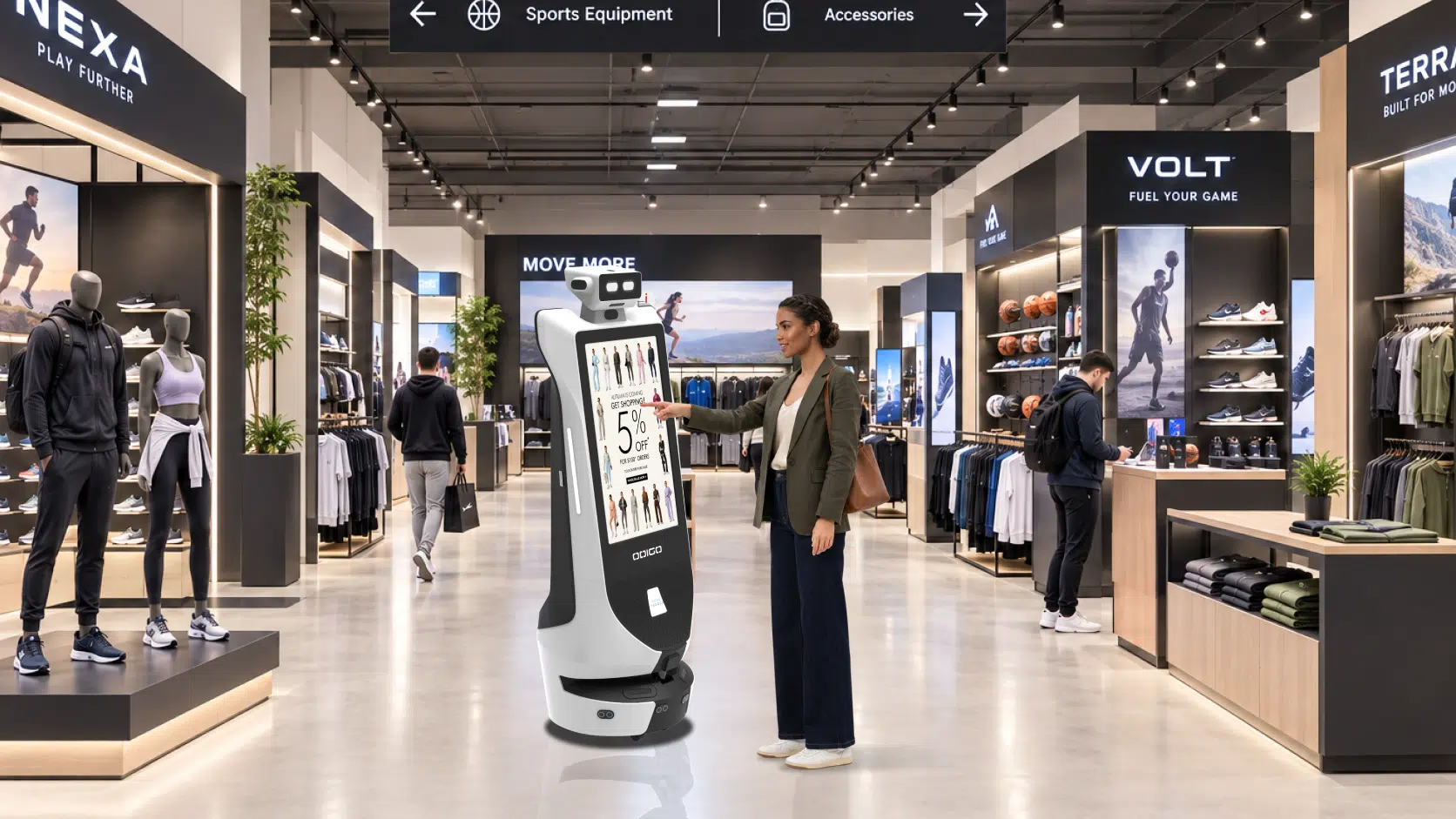
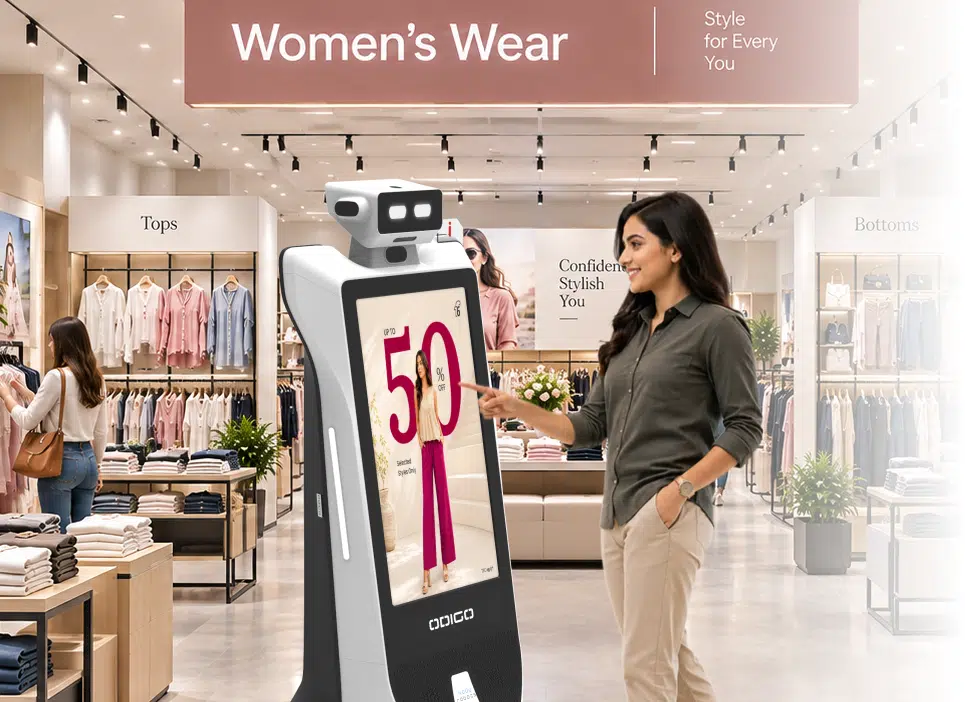
Entrance, aisles, promotional zones, and checkout areas. Odigo works on mapped routes across the full floor, guiding shoppers, surfacing offers, and collecting interaction data during ordinary patrols instead of waiting to be approached.
What the Robot Takes Off Your Team
Handles FAQs, navigation requests, product discovery, and increases safety. An AI robot for retail store answers on the spot, so an employee doesn’t have to abandon a task to answer them.
What the Retail Store Robot Gives
Managers gain a running record of shopper demand, traffic patterns, failed searches, recurring service issues, and safety events picked up while the unit was simply completing its rounds.

Shoppers Cannot Find What They Came For
A shopper knows what they want but doesn’t know where to find it. Meanwhile, static signs point to a category and leave the shoppers to work out the rest alone. At the same time, the rest of the search happens aisle by aisle.

The Shelf Doesn’t Reflect the Inventory
The system says the product is available, but when the shopper reaches the shelf, they find nothing. Sometimes the product sits in the back room while nobody on the floor knows.
The Tag and Register Disagree
Manual re-tagging, split promotion systems, and app-only coupons can put three prices in front of one shopper. Every dispute at the lane costs time and teaches that shopper to verify everything next visit.
Help Is Never Where the Shopper Stands
Frontline headcount is set against a labor budget rather than live demand, and high turnover keeps product knowledge thin. During a busy hour, one simple question turns into a small waiting line.

Queues Build Before Lanes Open
By the time a queue becomes noticeable, shoppers are already waiting. Your team then has to react quickly, open another lane, and manage the rush without much warning.
Floor Conditions Change Between Checks
Spills, fallen stock, blocked exits, and restricted-area breaches appear between manual inspections. A robotic assistant for retail store teams patrols continuously, so the store hears about a hazard before a shopper finds it.
What Odigo Brings to Retail Floors
What the Retail Store Robot
Brings to Your Store Floor
Eleven capabilities on one chassis, working together in a single unit, Odigo is a customer service robot for floors, an advertising surface, a safety patrol, and a shelf auditor in one unit, bringing multiple retail functions together on a single platform.
AI Safety and Security Patrol
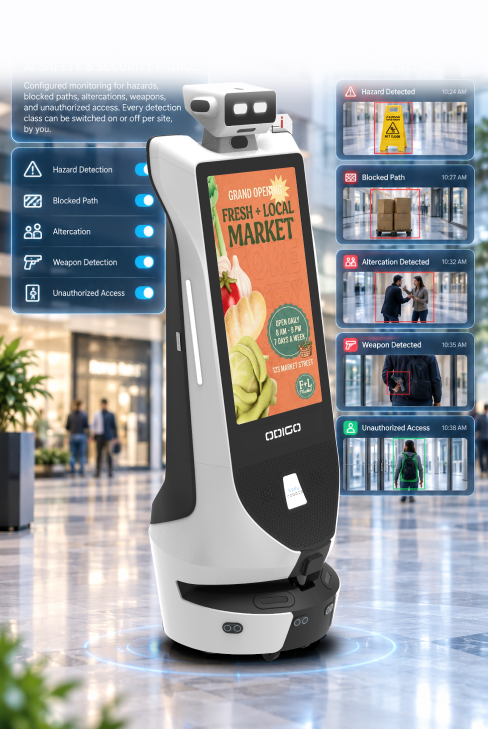
Configured monitoring for hazards, blocked paths, altercations, weapons, and unauthorized access. Every detection class can be switched on or off per site, by you.
Real-Time Retail Intelligence
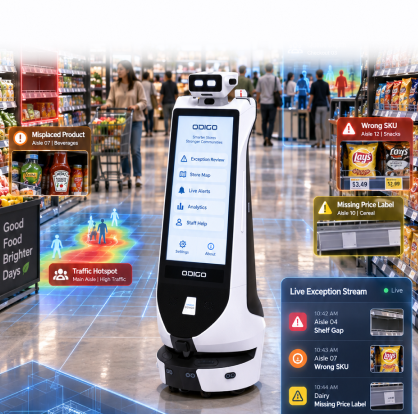
Shelf gaps, misplaced product, wrong SKUs, and missing price labels arrive as a single exception stream, alongside traffic hotspots and queue depth at counters.*

Interactive Product Information
The screen displays product details such as nutrition, ingredients, dietary suitability, ratings, and pack-size price comparisons, helping shoppers make informed decisions without reaching for their phones.
Multilingual Voice Interaction
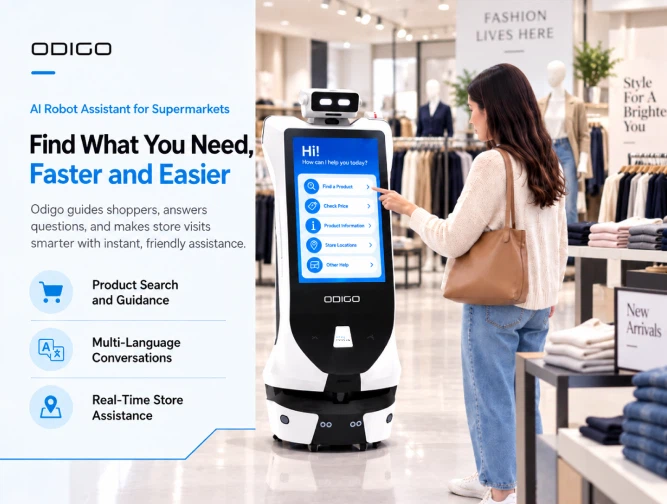
Voice and touch with automatic spoken-language detection. Shoppers ask in their own language rather than working through a menu, with no app, account, or sign-in.
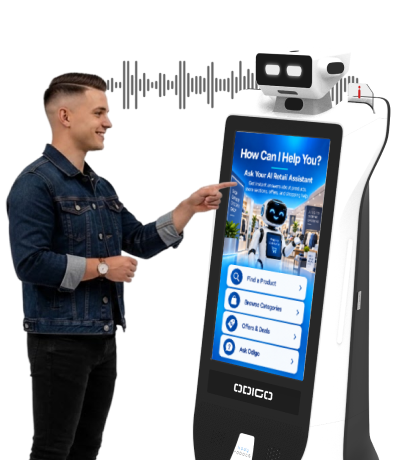

Product Search and Navigation
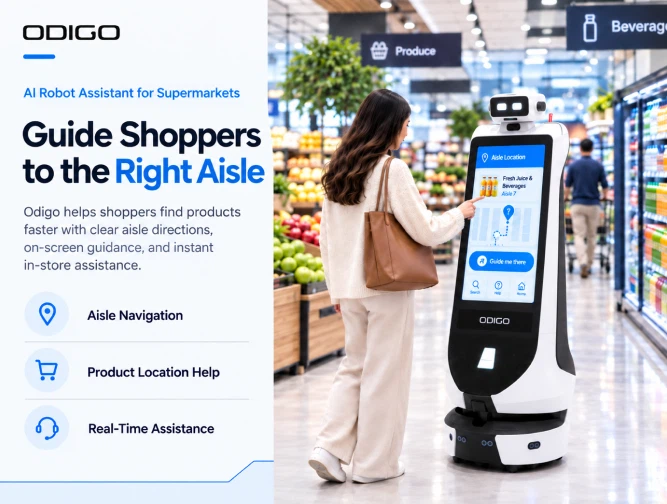
Shoppers search by voice or touchscreen, find the aisle and zone for a named item, and ask Odigo to take them straight to it.
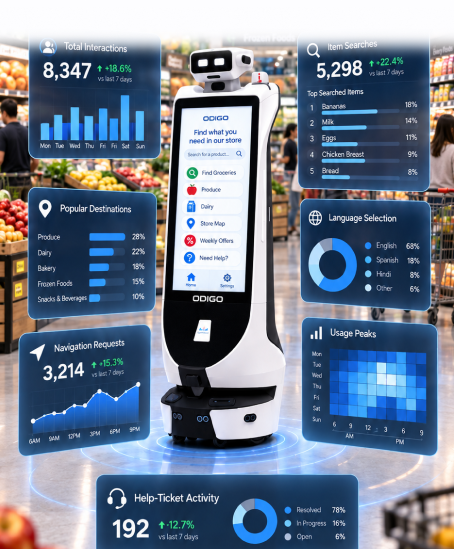
Interaction and Demand Analytics
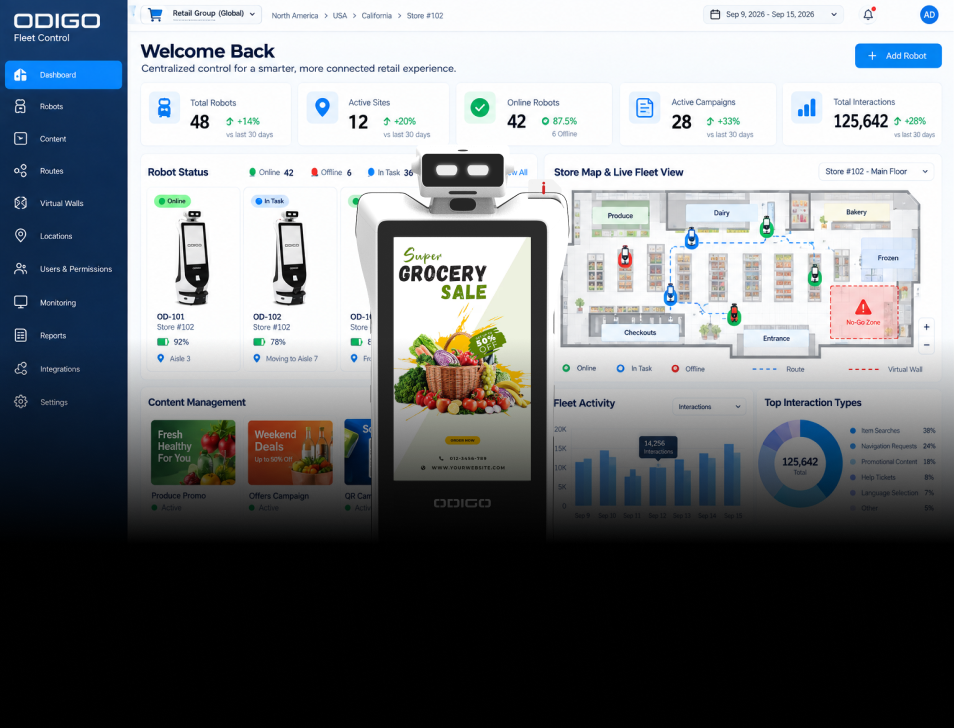
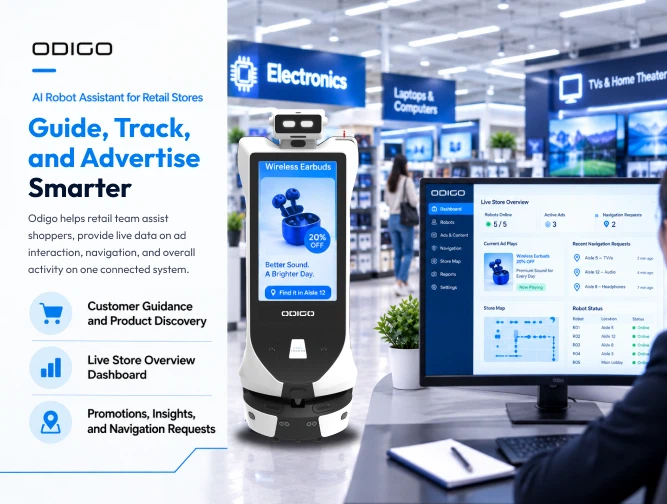
Odigo logs interactions, item searches, popular destinations, language selection, navigation requests, usage peaks, and help-ticket activity, drawn entirely from its own operating records.

Contextual Product Recommendations
When connected to your product, pricing, promotion, and inventory data, Odigo surfaces a suitable alternative if a requested item is unavailable, or a better-value offer sitting nearby.*
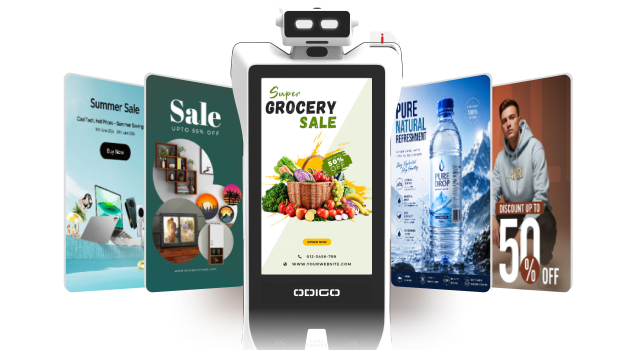
Mobile Advertising on Patrol
Between interactions, Odigo patrols and advertises without pause. Daily offers, clearance, and seasonal campaigns vary by zone, daypart, and route across twin 32-inch Full HD screens.
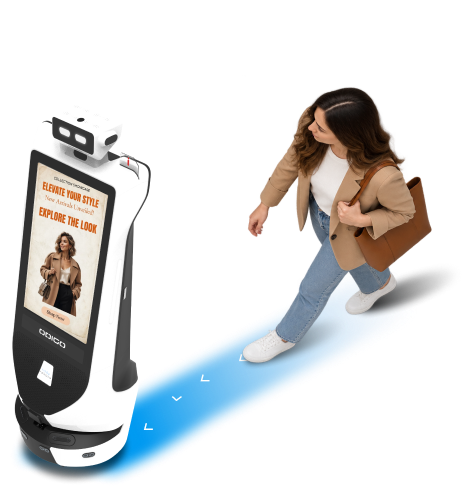
Physical Shopper Guide
Odigo does more than point shoppers in the right direction. It leads them across mapped zones to products, service counters, restrooms, pickup areas, and exits at a configurable travel pace.

Autonomous Navigation and Charging
Dual SLAM with LiDAR, depth, and ultrasonic sensing runs a full trading day past ten hours, detects stair edges and level changes, then docks and resumes unattended.
See Robot Assistant in Action
Give Shoppers a Smart Assistant
That Moves with Them
A fixed sign must be found first. A retail store robot arrives where the shopper already is. Book a walkthrough and watch Odigo search, speak, guide, advertise, patrol, and report from wherever it happens to be standing on your floor.
Book a Demo Today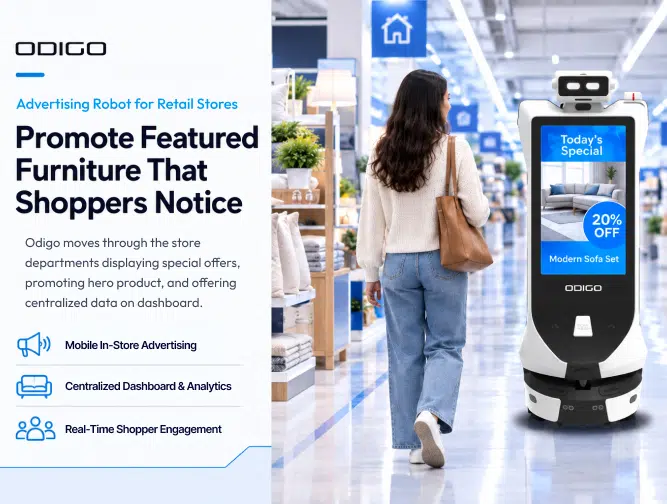
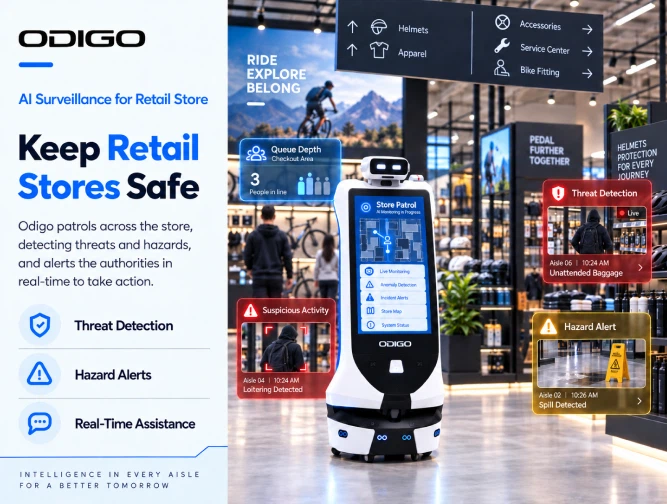
Beyond Traditional Store Assistance
Why a Moving Assistant Works Differently from a
Fixed One
Traditional store assistance solves one moment in one place. A retail automation robot connects assistance, movement, promotion, and floor intelligence, so a single interaction serves the shopper and the business at once.
Turn Store Activity Into Evidence
Robot Assistant
vs Static Signage
| Criteria | Robot Assistant | Static Signage |
|---|---|---|
| Answers a specific product question | Yes | No |
| Physical escort to the destination | Yes | No |
| Reaches every aisle, not one position | Yes | No |
| Multilingual voice interaction | Yes | No |
| Live price and promotion accuracy | Yes* | Limited |
| Suggests an alternative when stock is out | Yes* | No |
| Product detail and pack-size comparison | Yes* | Limited |
| Content changed remotely, same day | Yes | No |
| Proof the content was actually seen | Yes | No |
| Multi-site central management | Yes | No |
| Hazard and safety monitoring on patrol | Yes | No |
| Shopper interaction analytics | Yes | No |
Turn Store Activity Into Evidence
Know What Shoppers Ask, Where They Go,
and What Needs Fixing
Retail robots produce operational and engagement data as a byproduct of working on the floor, without every metric having to come out of your existing systems. Managers filter and export records by unit, site, destination, category, month, and year.
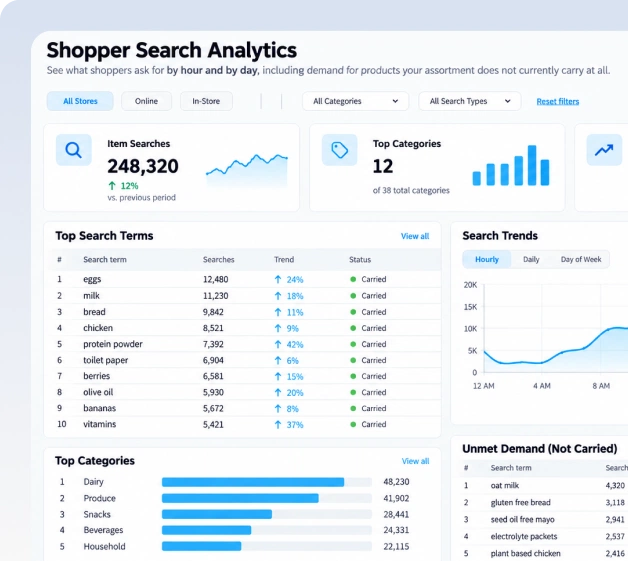
Shopper Demand
Metric: Item searches, top categories, and search trends
See what shoppers ask for by hour and by day, including demand for products your assortment does not currently carry at all.
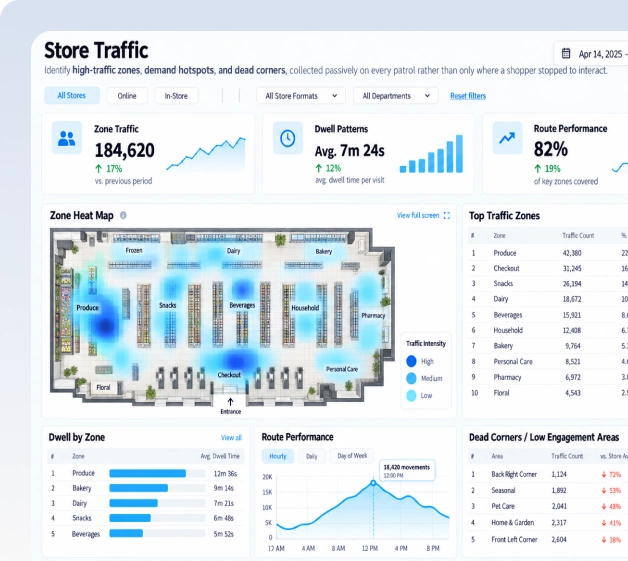
Store Traffic
Metric: Zone traffic, dwell patterns, and route performance
Identify high-traffic zones, demand hotspots, and dead corners, collected passively on every patrol rather than only where a shopper stopped interacting.
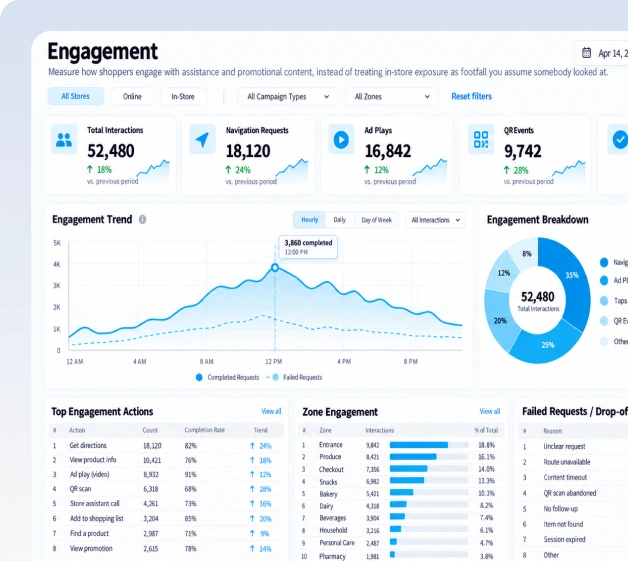
Engagement
Metric: Interactions, navigation requests, ad plays, taps, and QR events
Measure how shoppers engage with assistance and promotional content, instead of treating in-store exposure as footfall you assume somebody looked at.
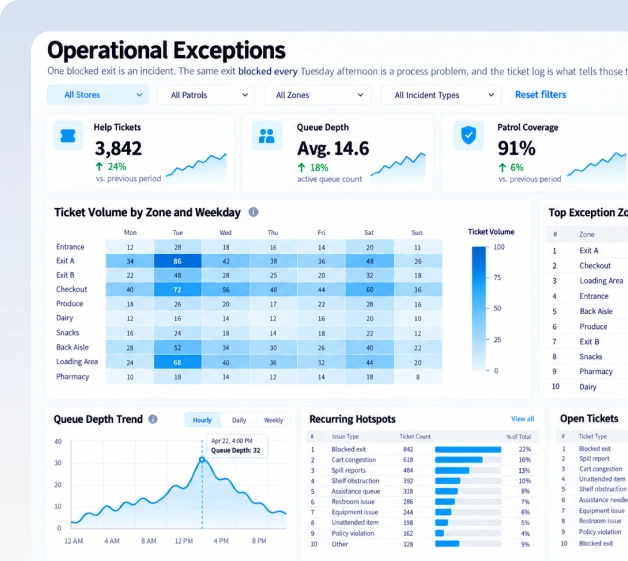
Operational Exceptions
Metric: Help tickets, queue depth, patrol coverage, recurring hotspots
One blocked exit is an incident. The same exit blocked every Tuesday afternoon is a process problem, and the ticket log is what tells those two apart.
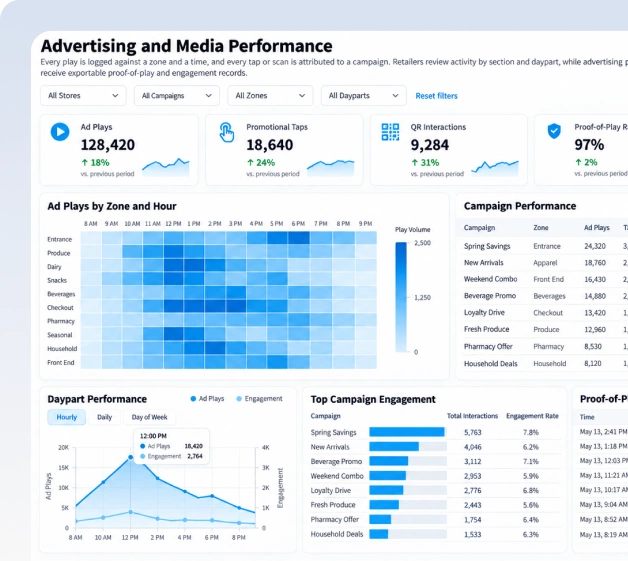
Advertising and Media Performance
Metric: Ad plays by zone and hour, promotional taps, QR interactions, proof-of-play
Every play is logged against a zone and a time, and every tap or scan is attributed to a campaign. Retailers review activity by section and daypart, while advertising partners receive exportable proof-of-play and engagement records.
Built Specially for Your Retail Operations
Retail Store Robot Deployments for Single Stores and Chains
Odigo supports single-store and multi-location deployments across the U.S. Route design, zone count, and unit numbers shift with the format, while content, campaigns, devices, and reporting stay under one dashboard. Every deployment is scoped to your floor plan, your connected systems, and your policy requirements.
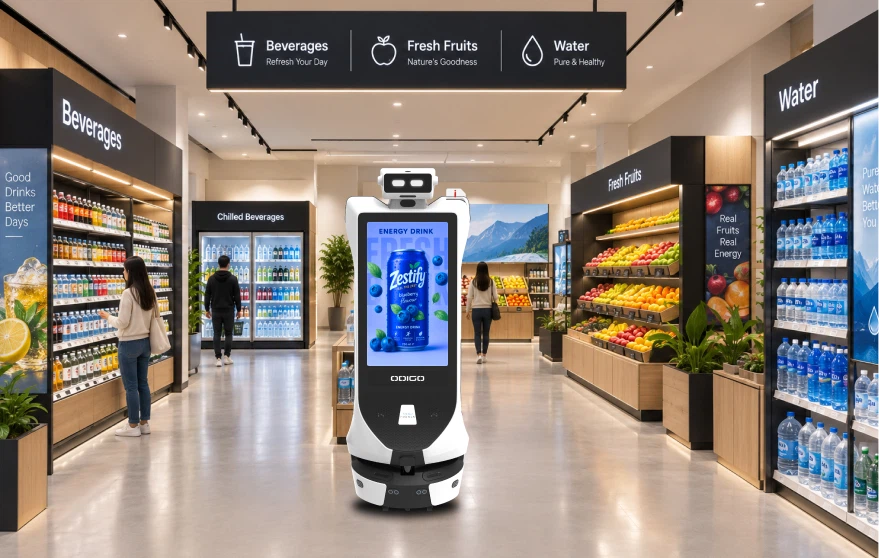
Grocery Store
AI Robot Assistant for Grocery Store
In a compact footprint, a single unit works the entire sales area on one cruise route, alternating between assistance during peak hours and advertising patrol through quieter windows. Mapping is usually a one-day exercise.
AI Grocery Store Robot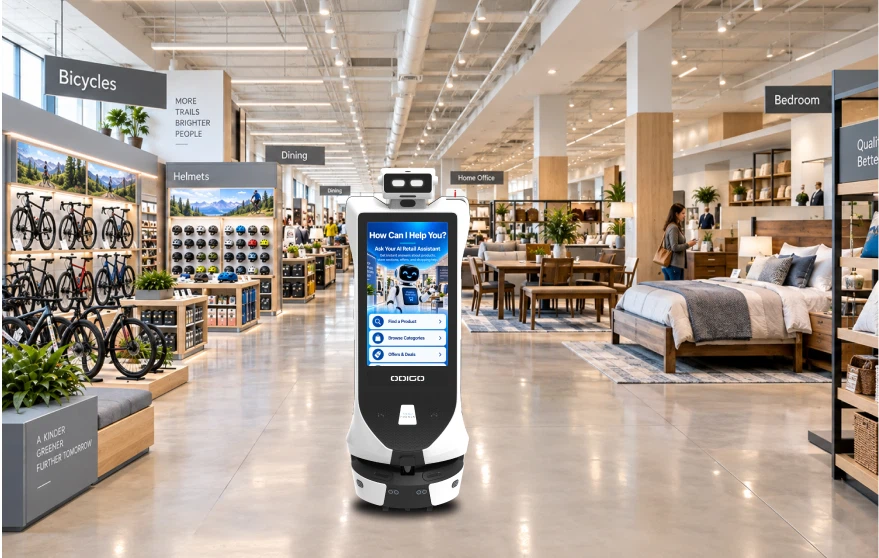
Big-Box Stores
AI Robot Assistant for Big-Box Store
In large Big-Box stores like Walmart, shoppers can spend several minutes walking in the wrong direction. Multiple units can run zoned routes, with each assigned a specific section, points of interest, and campaign schedule from the same console.
Supermarket
AI Robot Assistant for Supermarket
A robot for supermarket networks must be governable. The hierarchy runs region, site, agency, and vendor, so a campaign reaches one banner or every store, and permissions stay with the people who should hold them.
AI Robot Assistant for SupermarketA Shopper Journey from Request to Store Insight
How Odigo Works Across the Retail Store Journey
Odigo ties customer interaction to physical movement and operational data, so a smart robot for retail store floors serves the shopper and the business inside the same ten steps.

Shopper Approaches
Odigo registers a person nearby and opens with an interactive greeting, offering voice, touch, and on-screen search.

Language Sets Itself
Spoken language is detected automatically, so nobody navigates a language menu before asking the question they walked over to ask.

Shopper Asks
A product search, a policy question, a destination request, or a service inquiry, submitted by voice or through the touchscreen.

Odigo Understands
The request is interpreted against configured knowledge, the store map, and connected systems where those integrations are in place for your site.

Shopper Gets the Answer
Aisle and zone location, product or service detail, promotional information, or a clear next step, delivered in seconds on the screen.

Retail Robot Guides
For location requests, an interactive robot for retail store aisles physically escorts the shopper across mapped zones rather than handing over directions they will misremember.

Relevant Content Appears
During guide and patrol, Odigo displays promotions, seasonal campaigns, clearance messages, and location-specific offers tied to the zone it is currently in.

The Shopper Discovers More
Nearby products, suitable substitutes, and better-value pack sizes surface against the original request, where your product and promotion data is connected. *

Escalation or Next Destination
Anything beyond the unit’s scope becomes a help ticket carrying issue type, zone, and timestamp. Otherwise, Odigo routes the shopper onward to the next destination. *

Feedback and Back on Patrol
The retail robot invites a rating on the visit, logs everything from the interaction into the console, then resumes its cruise route and starts again.
Value Across the Store
One AI Robot Assistant, Four Business Perspectives
A retail store robot rarely gets approved by one department alone. Shoppers evaluate the experience, associates manage the day-to-day workload, managers oversee store operations, and brand partners want measurable proof that their advertising delivers value.

Shoppers
- Find a specific item without walking every aisle.
- Get an answer immediately, without hunting for an associate.
- Receive physical guidance to any mapped destination.
- Ask in their own language, with no app required.

Store Associates
- Fewer interruptions for directions and repeat questions.
- Help requests arrive with zone and issue context attached.
- Time stays with the customers who need real expertise.
- Early signals on queues, hazards, and floor activity.

Store Management
- Shopper demand and high-intent zones are measured daily.
- Recurring service and safety issues surfaced during patrol.
- Promotional delivery and engagement tracked zone by zone.
- Content, routes, and devices managed from one console.

Brands and Retail Media Teams
- Promotional content that moves through the store.
- Campaigns targeted by zone, daypart, and route.
- Proof-of-play, taps, and QR events as exposure evidence.
- Campaign telemetry posted to your measurement systems.*
Bring Odigo to Your Floor
See What Your Store Could Do with a Mobile AI Assistant
The retail technology worth buying is not the kind shoppers stop and admire. It is the kind that removes friction, creates another chance to sell, and leaves you with a clear view of the floor. Bring a floor plan and see what a retail store robot does with it.
Book a Live Odigo Demo for Your Retail Store
- A walkthrough of Odigo’s retail store capabilities
- Product discovery and physical escort, demonstrated live
- Promotion, interaction, and analytics overview
- Which capabilities need integration to your systems
- Deployment scope, site survey, and rollout sequence
Questions Retail Leaders Ask
General FAQs –
AI Retail Store Robot
Definitions, capabilities, control, deployment, and cost everything is answered here for you. These are the questions retail robots get asked inside a buying committee. Connected capabilities depend on your systems, your configuration, and the scope agreed at deployment; hope this helps answer your questions.
A retail store robot is a self-navigating unit that works on your sales floor instead of waiting in one position. Odigo combines shopper assistance, physical escort, interactive advertising screens, configured safety monitoring, and store-floor analytics on a single mobile platform.
A retail store robot maps your store, then follows routes you define. Odigo uses AI navigation with LiDAR, visual sensing, depth cameras, and ultrasonic sensors to move through live aisles. Shoppers interact by voice or touch, and everything is reported into one console.
An AI robot for retail store floors can answer routine questions, locate products, escort shoppers, display promotions, present configured product information, support multilingual interaction, collect feedback, raise help tickets, monitor defined safety conditions, and generate floor-level analytics.
A customer service robot for retail floors removes the two longest delays in a store visit: finding someone to ask and finding the product. Shoppers get an immediate answer, then physical guidance to the aisle rather than directions to remember.
Yes. Retail robot, Odigo returns the aisle and zone for a named item and supports a “take me to” request by voice or touch. It then escorts the shopper across mapped zones to products, service counters, restrooms, pickup, or exits.
Yes, and mobility is the whole argument. An interactive robot for retail store aisles carries promotions to the shopper instead of waiting for footfall. Twin 32-inch Full HD screens run zone-specific offers, scheduled campaigns, and clearance messages, managed remotely.
Engagement stops depending on whether a shopper walks over. A mobile unit initiates contact, holds a two-way conversation, and runs interactive experiences triggered at a physical location. Ratings, forms, and quizzes capture feedback during the visit, not afterward.
Both, inside one interaction. Assistance covers hours, policy, returns, order pickup, membership, and stock questions. Wayfinding covers items, departments, and amenity routing with a physical guide. Anything outside its scope becomes a help ticket carrying zone and issue context.*
A retail robot assistant gives you coverage without added headcount pressure, assistance that reaches the aisle, advertising that reports on itself, safety monitoring during normal patrol, and a continuous read on what shoppers asked for and could not find.
A retail store robot is priced per deployment rather than off a published list. Unit count, route complexity, integrations, enabled detection classes, hosting and retention requirements, and site count all move the figure. Contact our consultants for a scoped quotation.
By shortening the gap between something going wrong and somebody knowing about it. Queue depth, hazards, blocked exits, missing price labels, and shelf gaps are flagged as the unit passes, rather than at the next audit or after a complaint.
No, and it doesn’t. A robotic assistant for retail store floors handles the repeat questions: where is it, when do you close, what is the returns policy. Associates keep the work that needs product knowledge and judgment.
Anything touching live inventory, pricing, promotions, loyalty identity, bookings, retail media attribution, or your ticketing tool needs integration, and those items carry an asterisk on this page. Assistance, wayfinding, guide, advertising, navigation, safety patrol, and Odigo’s own analytics do not.
You do, per site. Each detection class can be enabled or disabled independently. Retention windows, whitelisting, and access paths are configurable; granular permissions govern who sees recordings and recognition data, and records can sit on your own infrastructure.*
Enterprise formats are supported, and scope is set per retailer. A warehouse-club layout with wide aisles and pallet displays routes differently from a dense grocery floor, so each is mapped during the site survey. Larger footprints usually run several units on zoned routes.
Odigo is a retail robot handles multilingual voice and touch interaction with automatic spoken-language detection, so shoppers are not choosing from a menu first. Language selection distribution also appears in your reporting, which shows which languages your floor genuinely needs. Confirm your set while scoping.
Battery life runs past ten hours of continuous operation on a single charge, usage dependent. The unit returns to its dock below a configurable threshold, then resumes its own. Charging takes six to eight hours on the 4 A adapter.
Yes. The console structures your estate from country and region down to site, agency, and vendor, which suits multi-brand, franchise, and agency-sold models. Maps, routes, content, and permissions are set centrally, with updates delivered over the air.
See Autonomous Robots In Action For Your Operations
Share your environment and requirements and we will walk you through how robots fit into your operations.
Brands we worked with