
Blog Summary: Retail advertising depends on getting the right message in front of shoppers at the right moment. Fixed in-store placements can become predictable over time, raising questions about how moving advertising can create new attention opportunities. The blog explores how moving advertising changes where ads appear and how they are measured, where fixed screens still fit, and how retailers can test moving advertising alongside existing in-store media.
Key Takeaways
- Banner blindness is linked to predictable advertising placement and learned attention patterns.
- Moving inventory changes the physical placement of the advertising opportunity, but movement alone does not guarantee attention.
- Fixed screens remain useful for campaigns requiring consistent location, category adjacency, or defined high-dwell placements.
- Odigo provides mobile advertising inventory with interactive displays, audio capability, centralized campaign management, and scheduled content delivery.
- The right way to evaluate moving retail media is through a controlled pilot with an agreed measurement methodology and a fixed-screen baseline.
- The strongest commercial question is not whether moving media replaces fixed media, but where it adds measurable value within the existing retail media mix.
The Cost of Attention in Retail Advertising
Retail advertising is becoming a larger part of how brands reach shoppers closer to the point of purchase. U.S. commerce media advertising revenue reached $63.4 billion in 2025, up 18% from the previous year, according to the IAB/PwC Internet Advertising Revenue Report. As more spending moves into commerce media, in-store advertising faces a practical question: what does a retailer actually deliver when it sells an advertising placement inside a store?
A screen can occupy a valuable position for hours each day, but its presence does not tell a media buyer whether shoppers noticed the message. Shoppers move through stores comparing products, finding categories, checking prices, and responding to promotions. A fixed placement stays in the same physical position throughout that journey.
For media buyers, that creates a cost-per-attention question. The issue is not simply how many screens are available or how many times an advertisement plays. It is whether the inventory creates measurable opportunities for exposure and engagement.
That question becomes more relevant when the advertising display itself moves.
What Banner Blindness Actually Is
Banner blindness describes a learned tendency to overlook content that users recognize as advertising, particularly when it appears in predictable locations.
The term emerged from web usability research in the late 1990s. In a 1998 study, Jan Panero Benway found that users could overlook prominent banner-style links while searching for specific information. The position of the advertising element affected whether users noticed it.
The broader lesson is about attention and placement. People develop expectations about where useful information and advertising are likely to appear. When a visual element repeatedly occupies a familiar advertising position, users can learn to pay less attention to that area.
That does not mean people consciously ignore every advertisement. Attention depends on the task, placement, visual characteristics, and surrounding context.
For retail media, this provides a useful way to examine fixed advertising placements. A shopper who regularly follows the same route through a store may encounter the same screen in the same location each time. The advertising content can change, but the physical placement remains familiar.
Banner blindness is therefore useful as a framework for understanding how predictable advertising positions can affect attention. It does not establish how shoppers respond to every fixed screen in a supermarket. For a practical explanation of the technology behind this format, read What Is an Advertising Robot.
Why Fixed in Store Advertising Loses Attention on Fixed Screens
The challenge with a fixed advertising placement begins with its position. A screen beside an entrance, checkout area, or aisle remains associated with that location every day. For shoppers who regularly use the same route, the placement remains predictable and familiar.
Attention is selective. Shoppers enter a store with specific tasks, and information related to those tasks competes with surrounding advertising and other visual elements. Familiar advertising positions can become easier to filter as shoppers concentrate on what they need to accomplish.
Content Rotation Does Not Change the Screen’s Physical Position
- Content rotation keeps the message fresh, but it does not change the shopper’s physical relationship with the screen.
- A shopper following the same route may encounter the same advertising placement repeatedly, making its position predictable over time.
- Screen Availability Does Not Equal Advertising Exposure
- A screen can operate for a defined number of hours, but that does not establish how long a shopper had an opportunity to see or process a particular advertisement.
- A shopper may pass quickly, stop to compare products, spend time looking at a shelf, or move toward another area before the relevant creative appears.
- For media buyers, the distinction is between advertising space being available and an advertising exposure being measured.
The point is not that fixed screens have no advertising value. A fixed placement can be useful when a campaign needs consistent visibility in a specific location. Retailers must determine whether that placement delivers the exposure the campaign aims to achieve.
What Changes When the Screen Moves
A moving advertising display changes one basic characteristic of the inventory: its physical position.
A fixed screen anchors the advertising placement to one location. Moving inventory can operate across selected areas of a store, creating opportunities to appear along different shopper paths and in different retail zones.
For media buyers, mobility creates another form of in-store media.
Position Is Not Fixed
A moving display can travel through selected areas instead of remaining associated with one installed position. That can extend the physical reach of one advertising unit across a store.
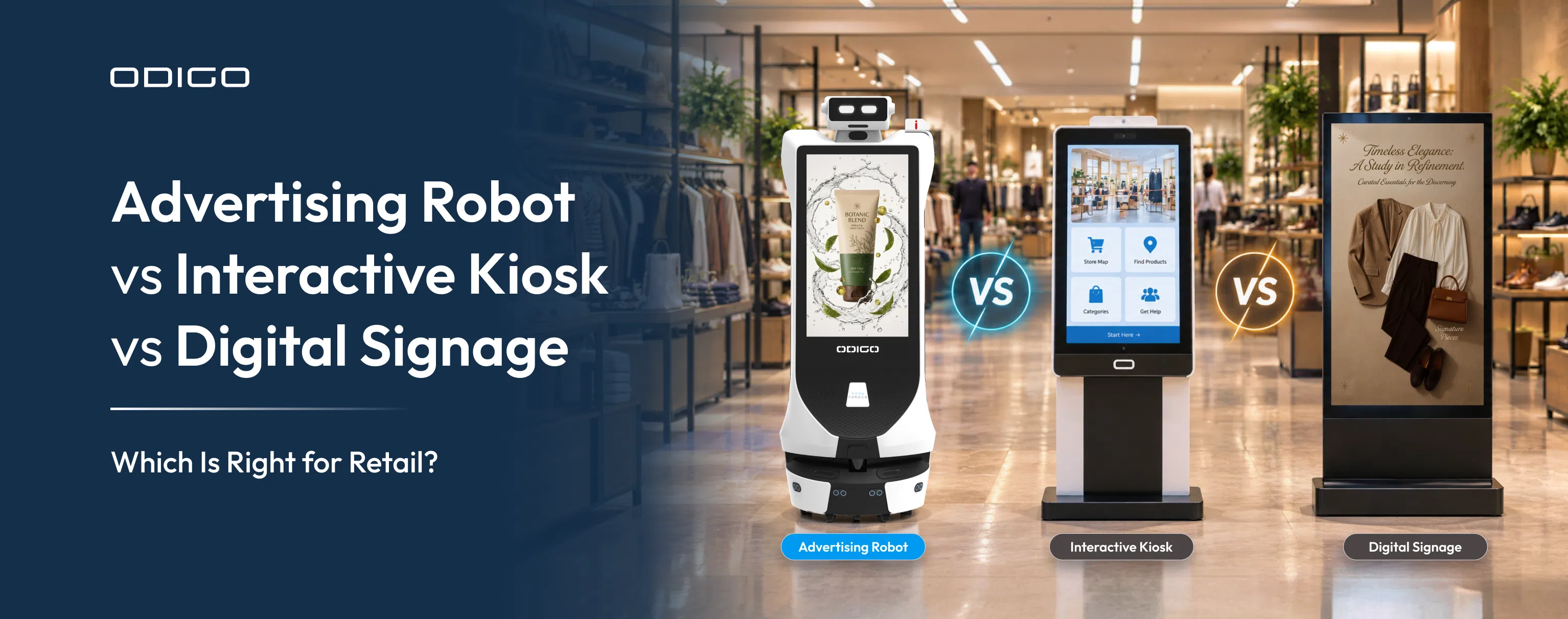
Odigo is an AI robot assistant designed to move through retail environments while supporting advertising, visitor assistance, and other in-store functions. Its mobile displays allow advertising content to travel with the robot rather than remain tied to one fixed screen location. For a closer comparison of advertising robots, interactive kiosks, and digital signage, read Advertising Robot vs Interactive Kiosk vs Digital Signage.
Odigo uses two 32-inch capacitive touchscreen displays with 1080 × 1920 Full HD portrait resolution. A secondary 7.9-inch display provides additional space for ambient branding. Its travel speed is configurable between 0.1 and 1.0 m/s.
These specifications allow the display to function as advertising inventory while the unit moves through the retail environment.
For retailers considering in-store retail media inventory, mobility adds a placement option that can operate across selected store areas.
Motion Changes the Advertising Context
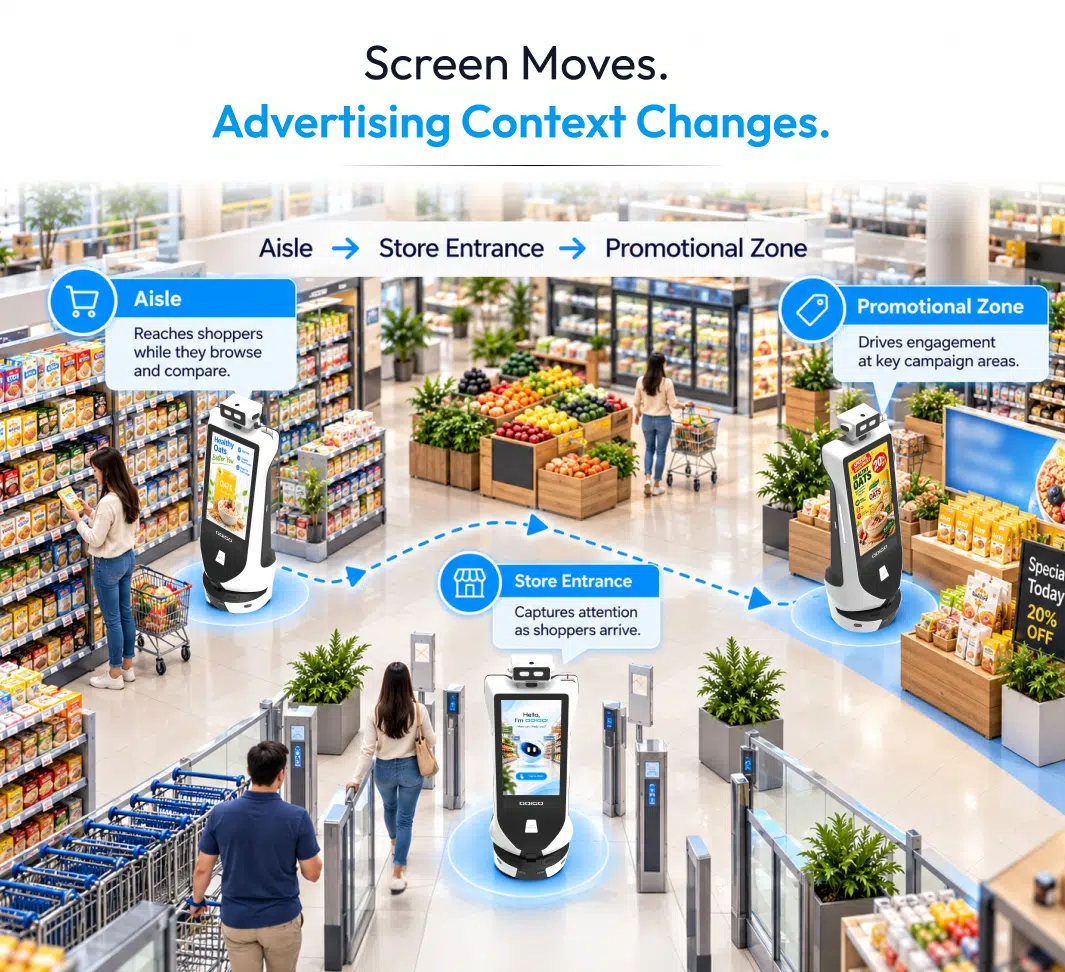
Movement changes the context in which the advertising message appears. The display can enter different shopper paths and operate across multiple store zones during its deployment. For a closer look at the technology behind this type of autonomous movement, read our guide on how AI robot assistants work.
Movement does not guarantee attention. Creative, relevance, timing, proximity, and the shopper’s immediate task still affect whether an advertisement is noticed.
Audio can also be part of the advertising experience. Odigo’s advertising hardware includes four 5W speakers with a 50W × 2 amplifier, supporting audio playback where the deployment calls for it.
Proximity to the Point of Purchase
Point of purchase advertising can become more flexible when advertising inventory can operate across selected areas of a store. The physical context around the advertisement can change as the unit moves.
This gives media buyers another factor to consider when planning a campaign: where the advertising opportunity occurs and how that location relates to the campaign objective.
Unpredictability Changes the Placement Pattern
Banner blindness is associated with learned expectations around predictable advertising positions. Moving inventory changes the physical placement pattern because the advertising opportunity does not remain tied to one fixed point.
Mobility does not remove the need for relevant creative or careful media planning. It changes one variable that media buyers can work with: where the advertising opportunity occurs.
| Factor | Fixed screen | Moving advertising inventory |
| Placement | Tied to one location | Can operate across selected store zones |
| Shopper path | Same physical placement | Can enter different shopper paths |
| Campaign context | Connected to installed location | Can operate across selected areas |
| Category proximity | Linked to fixed position | Depends on deployment and route |
| Display | Fixed screen | 32-inch interactive displays with mobility |
| Content delivery | Associated with installed display | Can be managed centrally |
For a media buyer, the difference is another inventory format to evaluate retail advertising. The main question is where retailers can use mobility to create advertising opportunity and how they can measure those opportunities.
How Retailers Can Measure Moving Advertising
Moving advertising inventory requires a clear measurement framework before retailers can compared it with other media placements.
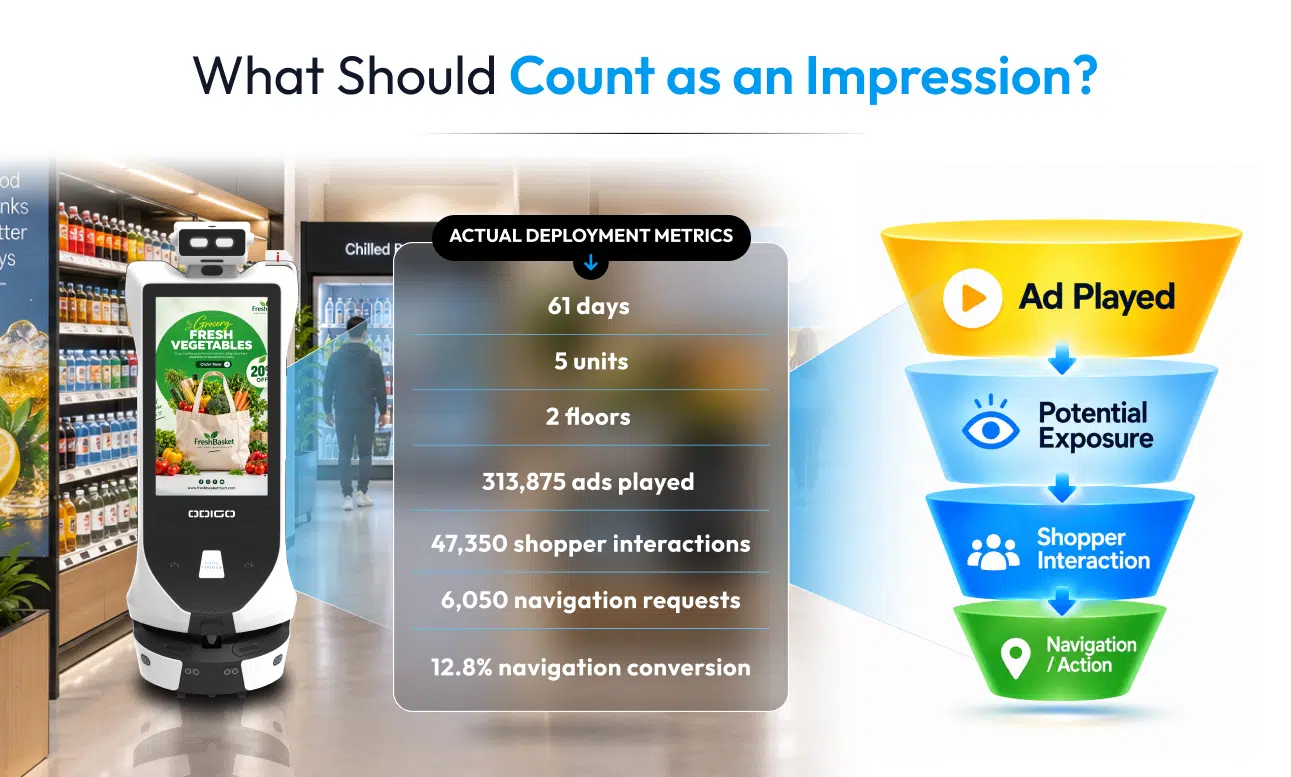
To understand how retailers can measure moving advertising in a real retail environment, consider Odigo’s 61-day deployment in a live location. From June 1 to July 31, 2026, five units operated across two floors, with performance data collected through robot dashboard logs. The deployment recorded 313,875 ads played, 47,350 shopper interactions, and 6,050 navigation requests.
What Counts as an Impression?
An ad play confirms that advertising content was delivered. An impression requires a defined methodology for determining when an advertising exposure qualifies as an impression.
The deployment report records ad plays separately from shopper interactions and navigation activity. It defines user interactions as screen touches or engagements, while navigation records store-guidance sessions started through the platform.
What Gets Reported?
The deployment recorded an average of 5,145 ads played per day, or 1,029 ads played per robot per day across five units. These figures apply to that specific deployment and do not represent a standard capacity benchmark for every store.
The same deployment recorded 47,350 shopper interactions and 6,050 navigation requests, producing a reported 12.8% navigation conversion rate.
For a buyer evaluating programmatic DOOH, keeping delivery, exposure, engagement, and downstream actions separate makes campaign reporting easier to interpret.
Before scaling, retailers should agree on the measurement method, define what the system counts, how it counts, specify which fields advertisers receive, and set the reporting frequency.

Where Fixed Screens Still Make Sense
Moving media is not the right format for every retail advertising objective.
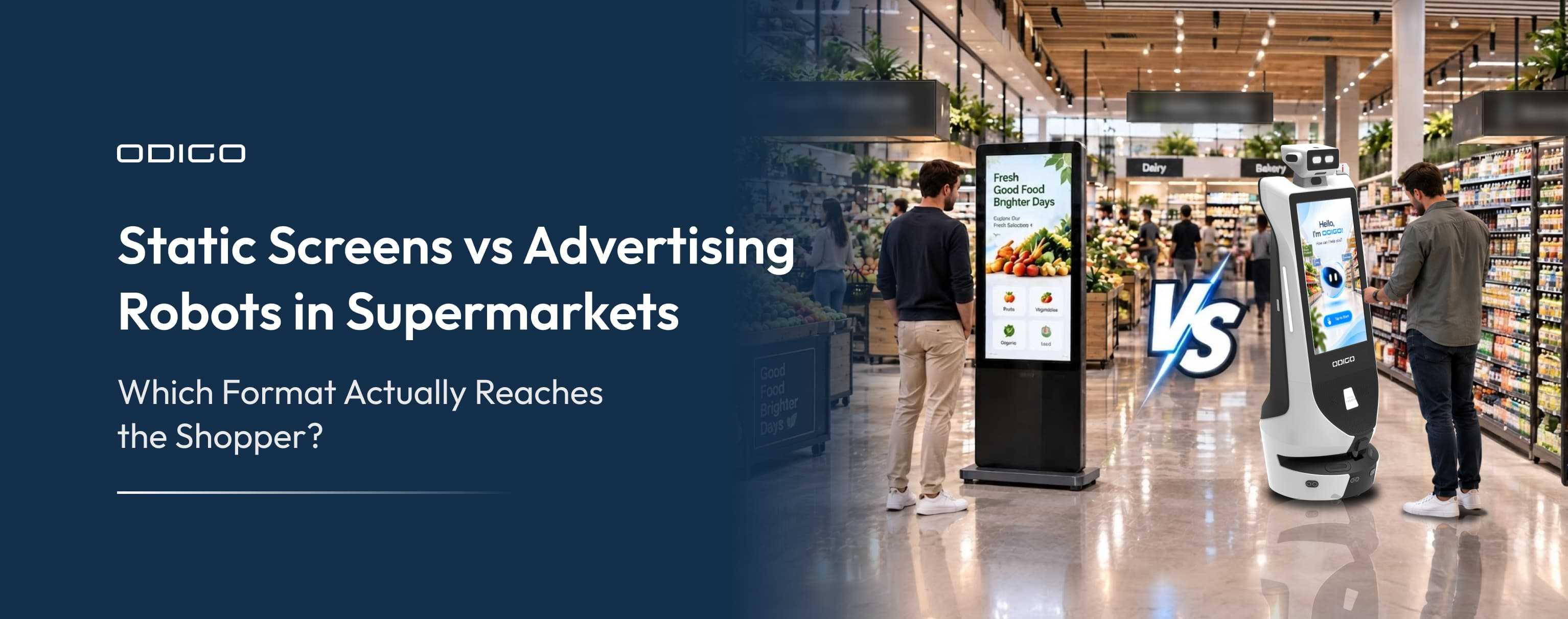
Retailers use fixed screens when a campaign requires a specific location or consistent presence in one area. Positioning a screen near a checkout, queue, or other defined zone gives advertisers predictable inventory where shoppers are expected to spend time.
In addition, fixed inventory can also be practical when a retailer needs a large number of permanent placements across a network. A fixed screen continuously serves its defined area, while a moving unit covers different areas according to its operating route.
Category adjacency is another consideration. Retailers can select a fixed placement based on its relationship to a particular aisle, product category, or point of purchase. That relationship can matter when location is central to the campaign objective.
Moving inventory has a different role. It can be useful when a media plan calls for coverage across multiple store areas, changing shopper contexts, or additional opportunities for interaction.
| Campaign requirement | Fixed media | Moving media |
| Consistent presence in one location | Strong fit | Depends on route |
| Checkout or queue placement | Strong fit | Depends on deployment |
| Category-specific adjacency | Strong fit | Depends on route |
| Coverage across multiple store areas | Limited to installed locations | Supported by movement |
| Changing media context | Limited | Supported by movement |
| Interactive engagement | Depends on hardware | Supported by interactive displays |
The comparison is based on the campaign objective, exposure opportunity, and measurement method.
How Moving Inventory Fits into Shopper Marketing and Retail Advertising
Retail media gives brands access to shoppers at points closer to purchase. Moving inventory can become another format within that environment, alongside existing in-store placements.
For shopper marketing, the opportunity is to package moving inventory around defined store areas, campaign periods, or other parameters supported by the retailer’s media operation.
Odigo supports centralized campaign management, with content pushed to units over the air. Its partner module also supports vendor and agency wallet balances and tracks ad performance by partner.
This gives the media operation a way to manage advertising across deployed units.
| Media requirement | Odigo capability |
| Campaign management | Centralized dashboard |
| Content distribution | Over-the-air content pushes |
| Partner management | Vendor and agency wallet balances |
| Partner reporting | Ad performance tracked by partner |
The 61-day deployment also shows that advertising delivery can be tracked across multiple units. Five units recorded 313,875 total ads played during the measurement period.
Odigo can be considered as an additional in-store media format within a retailer’s broader advertising operation. The commercial structure, including supplier-funded campaigns, retailer revenue sharing, and inventory pricing, follows the retailer’s media model and confirmed commercial terms.
What to Test Before Scaling Moving Retail Media
A pilot should answer whether moving inventory adds measurable value alongside the fixed media a retailer already uses.
| Pilot element | What to define |
| Store | One store with existing fixed in-store media |
| Duration | 60 to 90 days |
| Baseline | Existing fixed-screen delivery and engagement |
| Impression definition | Agreed methodology before launch |
| Campaign mix | Comparable campaign objectives |
| Measurement | Delivery, exposure, engagement, and action |
| Primary outcome | Recall, engagement, or another agreed outcome |
| Operations | Active days, runtime, unit availability |
| Review | Results by location, day part, campaign, and format |
Operational performance should also be tracked. Odigo supports 10+ hours of continuous operation and automatic docking at 20% battery.
For retailers evaluating a grocery store robot as part of an in-store media program, the pilot should also capture unit availability, runtime, campaign delivery, shopper interactions, and other agreed metrics.
The existing deployment report shows why these measures should remain separate. It records ads played, shopper interactions, navigation requests, navigation conversion, runtime, distance, active days, and floor-level performance as distinct data points.
A controlled pilot can answer the practical question: does moving inventory add measurable advertising value alongside the fixed media already available in the store?
If the results support further testing, retailers can identify where the format fits within their broader media mix and determine how it could work across different store environments.
Want to see what moving retail advertising could look like in your stores? Book an Odigo demo with Kody Robots.
Turning Moving Retail Advertising into Measurable Value
For retailers, the decision should not come down to whether a moving screen looks more noticeable than a fixed one. The real question is whether it can create additional advertising value that you can measure, compare, and justify at scale.
That is where a controlled pilot matters. By putting moving inventory alongside existing fixed media and agreeing on the measurement methodology before launch, retailers can see whether the format delivers meaningful differences in exposure, engagement, and shopper response.
If the data shows that movement adds value, the next decision becomes much more practical: where should it be deployed, which campaigns benefit from it, and how should it fit into the existing retail media mix?
For retailers considering the next step in in-store media, the pilot is not simply a test of a new format. It is a way to determine whether moving retail advertising deserves a place in the media strategy.
Retail Advertising: General FAQs
Get clear answers to common questions about retail advertising, from campaign delivery and shopper engagement to measuring performance. Understand how advertising can work across the store environment and support broader retail media goals.
1. What is an advertising robot?
An advertising robot is a mobile platform with a digital advertising display that can move through a defined environment while delivering brand content. In retail, it can function as an in-store media format while also supporting capabilities such as shopper interaction and navigation.
2. How is an impression counted on a moving screen?
An impression requires a defined methodology for measuring advertising exposure. An ad play confirms that content was delivered, but it should not automatically be treated as an impression without an agreed measurement method.
3. Is in-store advertising on a robot better than fixed screens?
It depends on the campaign objective. Fixed screens offer consistent placement in a defined location, while moving inventory can operate across multiple store areas, so the formats should be evaluated against the same campaign goals and measurement criteria.
4. How does moving advertising fit into a retail media network?
Moving inventory can be packaged alongside existing in-store media placements as another advertising format. Kody Robots, Odigo supports centralized campaign management, over-the-air content distribution, and partner-level performance tracking.
5. What creative formats does Odigo support?
Odigo’s main advertising displays are two 32-inch capacitive touchscreens with 1080 × 1920 Full HD portrait resolution, plus a 7.9-inch secondary display for ambient branding. It also supports audio playback; specific file formats, file-size limits, and video or animation requirements need to be confirmed for each campaign.
6. Can advertising content be scheduled by location or time?
Odigo supports geo-contextual and day-scheduled ad serving. Available scheduling parameters can be configured according to the deployment and campaign requirements.
7. How quickly can advertising campaigns be updated across multiple units?
Odigo supports centralized campaign management, with content pushed to units over the air. The specific approval process and turnaround time depend on the deployment workflow established by the retailer and advertising partners.
8. Who pays for moving retail advertising, the retailer or the brand?
The commercial structure depends on the retailer’s media program and agreements between the retailer, brands, agencies, and technology provider. Supplier or CPG-funded campaigns and retailer revenue sharing should be addressed according to the commercial terms in place.
9. How should retailers evaluate the ROI of moving retail advertising?
Retailers should evaluate the format against the campaign objective and an agreed measurement framework. A controlled pilot can compare moving inventory with existing fixed placements using exposure, engagement, and relevant downstream outcomes that can be measured.
10. What should retailers measure during a moving advertising pilot?
Retailers can measure ad delivery, validated impressions, shopper interactions, campaign engagement, calls to action, navigation activity, and inventory availability. A 61-day deployment separately tracked ads played, shopper interactions, navigation requests, navigation conversion, runtime, distance, and active days.