


Quick Summary: Supermarkets face growing pressure to improve the shopping experience, create measurable retail media revenue, and make better-informed operational decisions. Understanding why supermarkets deploy robots means looking beyond the technology to the business problems a deployment can help address. This blog explains how Odigo can support shopper navigation, create mobile advertising opportunities, and provide supplementary activity data that retailers can compare with existing inventory and sales records. It also outlines the metrics, integration requirements, and pilot considerations supermarkets should evaluate to determine where robotic assistance delivers measurable value and where further evidence is needed.
Key Takeaways
- Supermarkets can use Odigo to guide shoppers, address navigation challenges, and identify areas where customers need more assistance.
- Mobile robot screens create additional retail media inventory across approved store zones, campaign schedules, and advertising slots.
- Measuring ad plays, verified impressions, shopper interactions, and sales separately helps retailers assess campaign performance more accurately.
- Comparing shopper enquiries and navigation patterns with inventory and sales records can help teams investigate potential stock or product visibility issues.
- Measuring robot efficiency in supermarket operations requires clear objectives, relevant performance metrics, and a baseline for comparison.
- Running a focused pilot helps retailers validate navigation, connectivity, reporting, and workflow requirements before expanding deployment.
Where Supermarkets Are Gaining Value from Robotics
A supermarket can lose value in three places at once: when shoppers struggle to find products, when brands lack measurable in-store advertising opportunities, and when inventory decisions fail to match demand. Understanding why supermarkets deploy robots starts with examining these challenges and identifying where robotic assistance can add useful operational or commercial value.
The inventory challenge is substantial. The 2025 U.S. Food Waste Pact Data Report recorded 3.98 million tons of unsold food, representing $26.9 billion in lost sales among reporting retailers in 2024. Those retailers represented 54.4% of the U.S. retail segment. (Source: Foodwastepact)
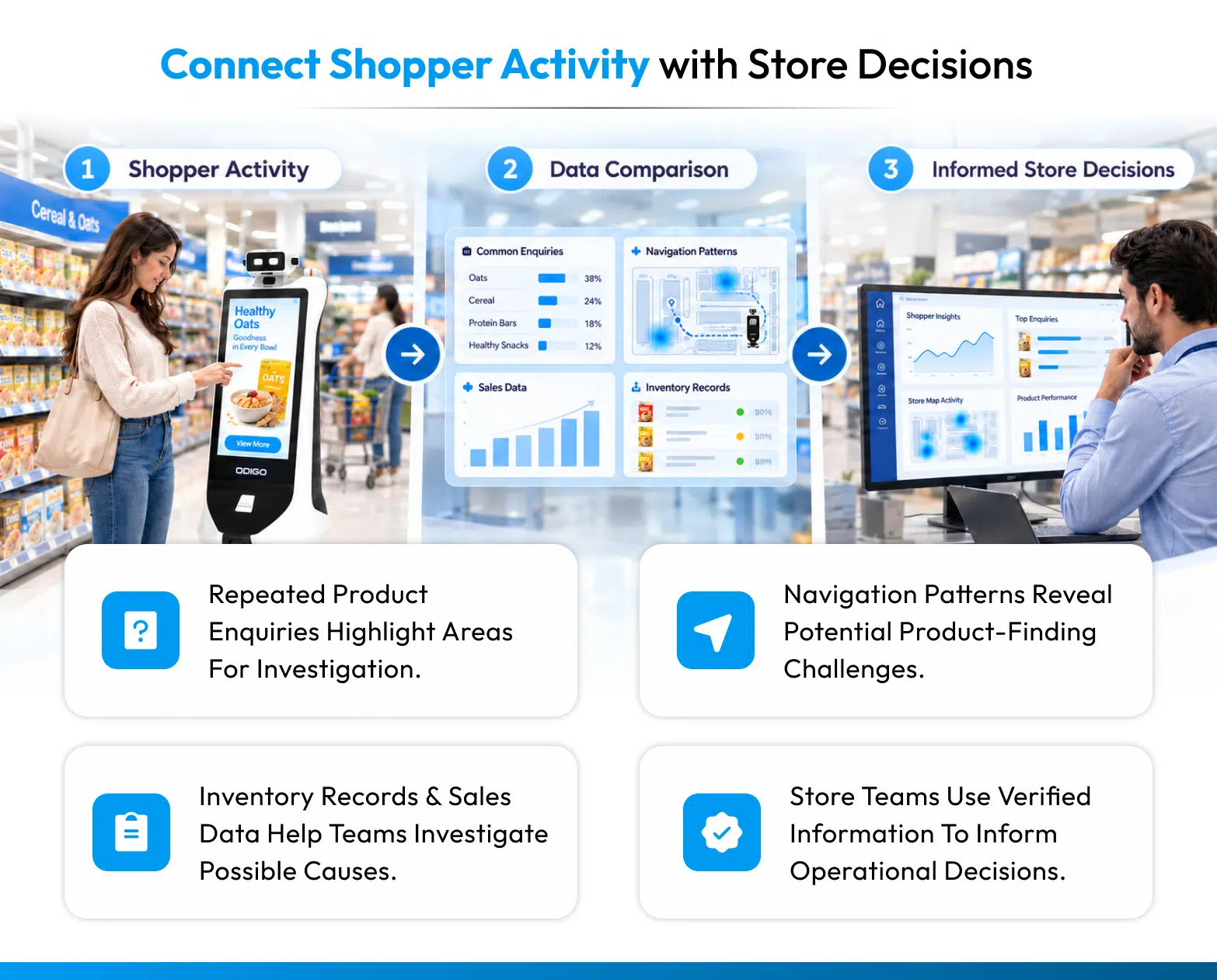
While Odigo does not directly manage inventory or prevent food waste, its shopper assistance and wayfinding capabilities can help retailers understand where customers seek products and request directions. When combined with inventory records and sales data, those activity patterns may help store teams investigate product discovery challenges. However, retailers must validate any connection between shopper behavior and inventory performance before attributing operational improvements to a robot.
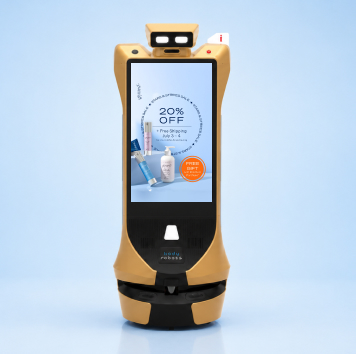
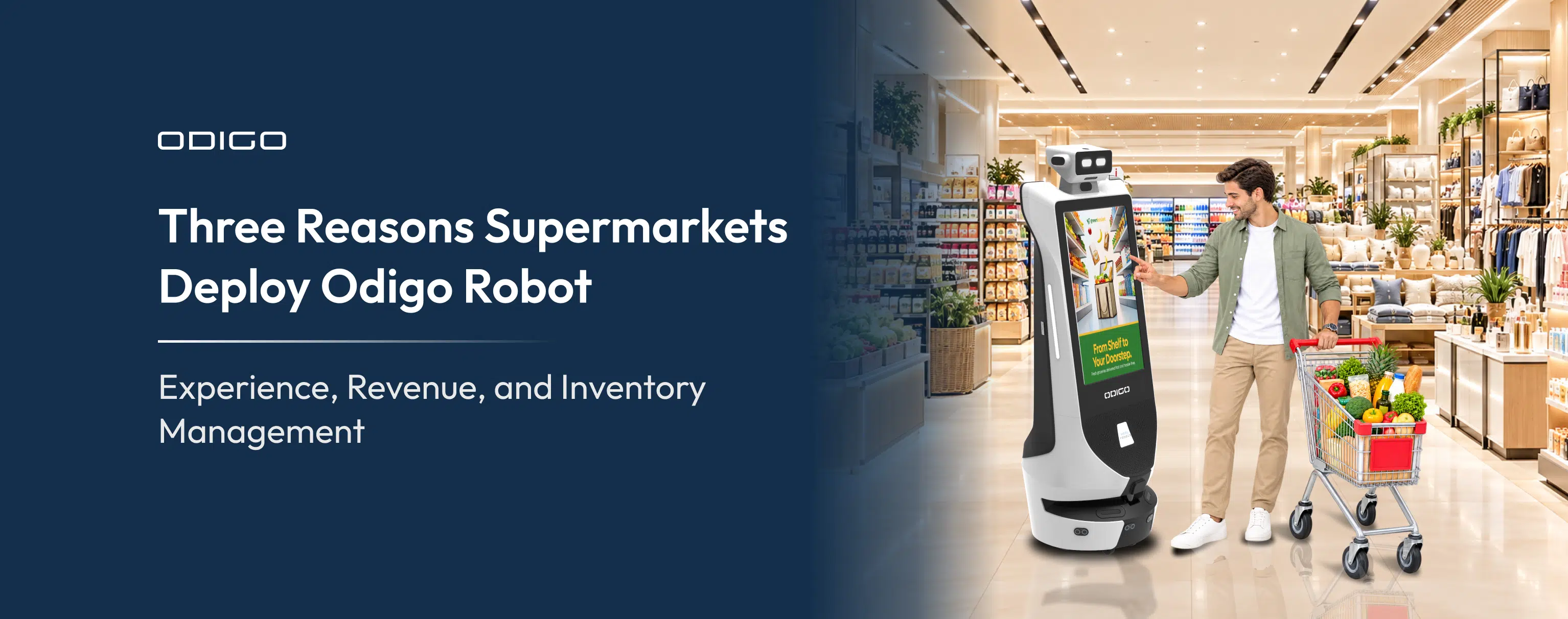
For supermarket leaders, the practical question is where better shopper assistance, new advertising inventory, and additional store activity data can support existing operations. Odigo, from Kody Robots, combines mobile advertising, interactive assistance, and wayfinding. Its value depends on matching those capabilities to a defined business objective and measuring the results against relevant store data.
This guide examines why supermarkets deploy robots, explains how retailers can assess Odigo’s potential contribution to shopper experience, revenue, and inventory-related decisions, and outlines the practical checks that can help determine whether a deployment merits expansion.
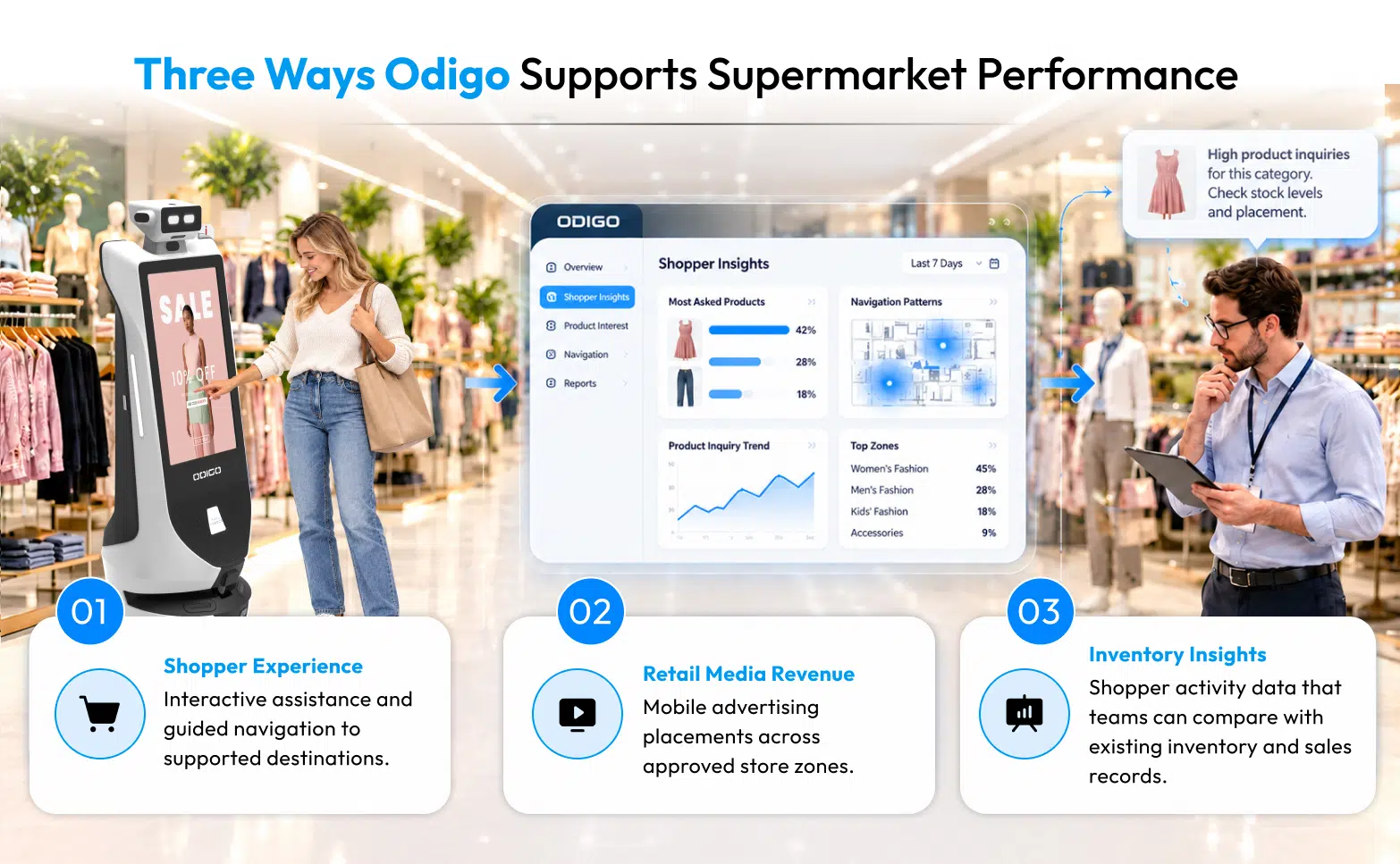
Why Supermarkets Deploy Robots: Three Business Priorities
The main reasons why supermarkets deploy robots relate to specific operational and commercial needs. A robot that supports shopper navigation serves a different purpose from one that delivers advertising or provides activity data for operational analysis. Retailers should evaluate each application against measurable business objectives.
1: Improve the Shopping Experience
Robots can improve the shopping experience by guiding customers to products, answering routine questions, and providing timely assistance. Odigo helps supermarkets make product discovery easier while supporting store associates with everyday shopper enquiries.
How Do Robots Improve the Shopping Experience?
Large-format supermarkets can make product discovery difficult when shoppers cannot locate a department, find a specific item, or get timely assistance. These moments can create frustration and add routine questions to associates’ workloads.
Odigo can provide interactive assistance and guide shoppers towards supported destinations. When evaluating how robots improve the shopping experience, retailers should identify common navigation requests, configure relevant destinations, and test whether Odigo can serve those requests reliably.
A practical way to evaluate the robot experience in supermarket environments is to measure:
- Navigation requests by department and time of day.
- Successful navigation outcomes, where available.
- Common questions that require associate assistance.
- Shopper feedback on finding products and departments.
These measures help teams identify where shoppers need more support. If requests concentrate around a particular department, managers can review signage, product placement, and assistance coverage before changing the layout.
Understanding what is a wayfinding robot helps retailers evaluate how autonomous robots can simplify in-store navigation, guide shoppers to key departments, and make large supermarket layouts easier to navigate.
Where Can Odigo Support Shoppers in a Supermarket?
Odigo can support shoppers along approved routes and within configured store areas. Retailers should map destinations, check navigation conditions, and confirm that the robot can reach the intended locations safely.
For example, a supermarket could configure supported destinations around major departments. The team could then review navigation requests and completion data to determine whether shoppers use the service and where they encounter difficulties.
Retailers evaluating a robot assistant should compare its supported functions, route coverage, and integration requirements against their store’s actual needs. The robot assistant comparison can help teams distinguish advertising, wayfinding, and shopper-assistance applications.
2: Create New Revenue Opportunities Through Retail Media
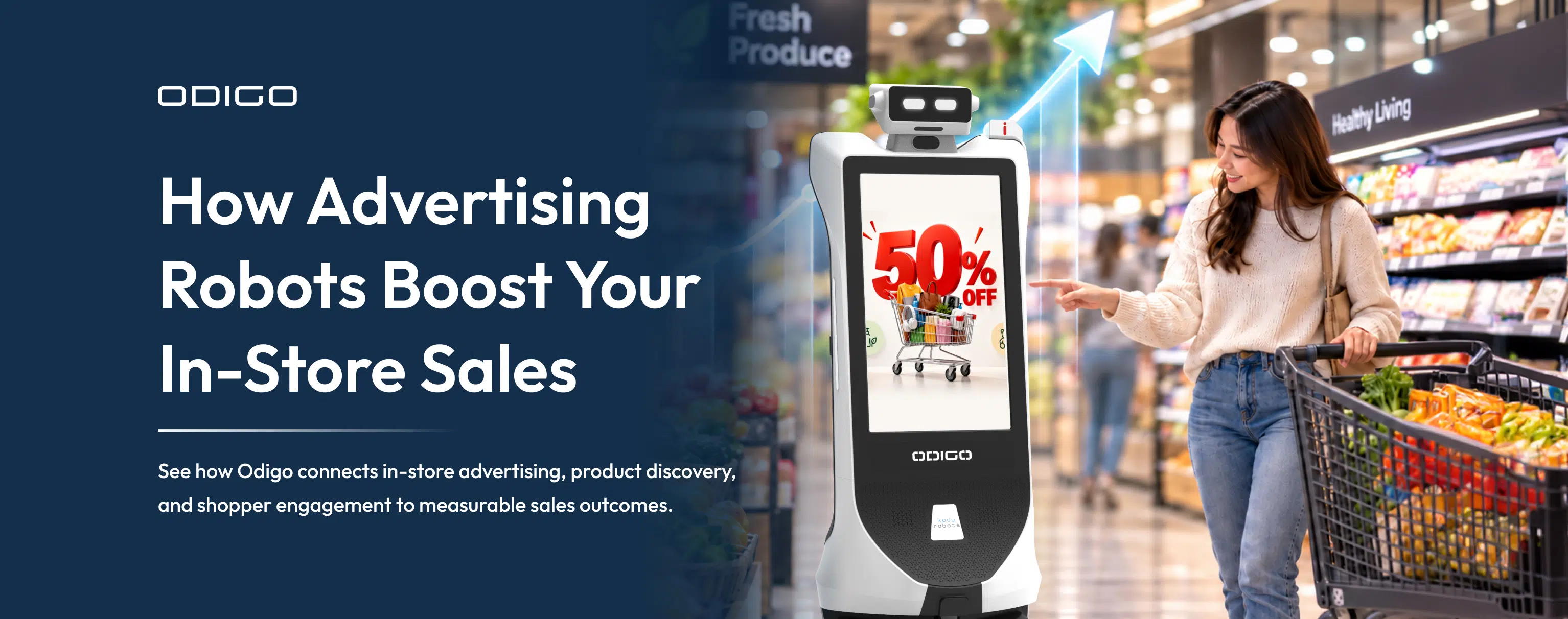
Retail media helps supermarkets create new advertising revenue by connecting brands with shoppers inside the store. Odigo’s mobile screens give retailers flexible placements for product promotions and scheduled campaigns across approved store zones.
Use Mobile Screens to Expand Advertising Opportunities Across Store Zones
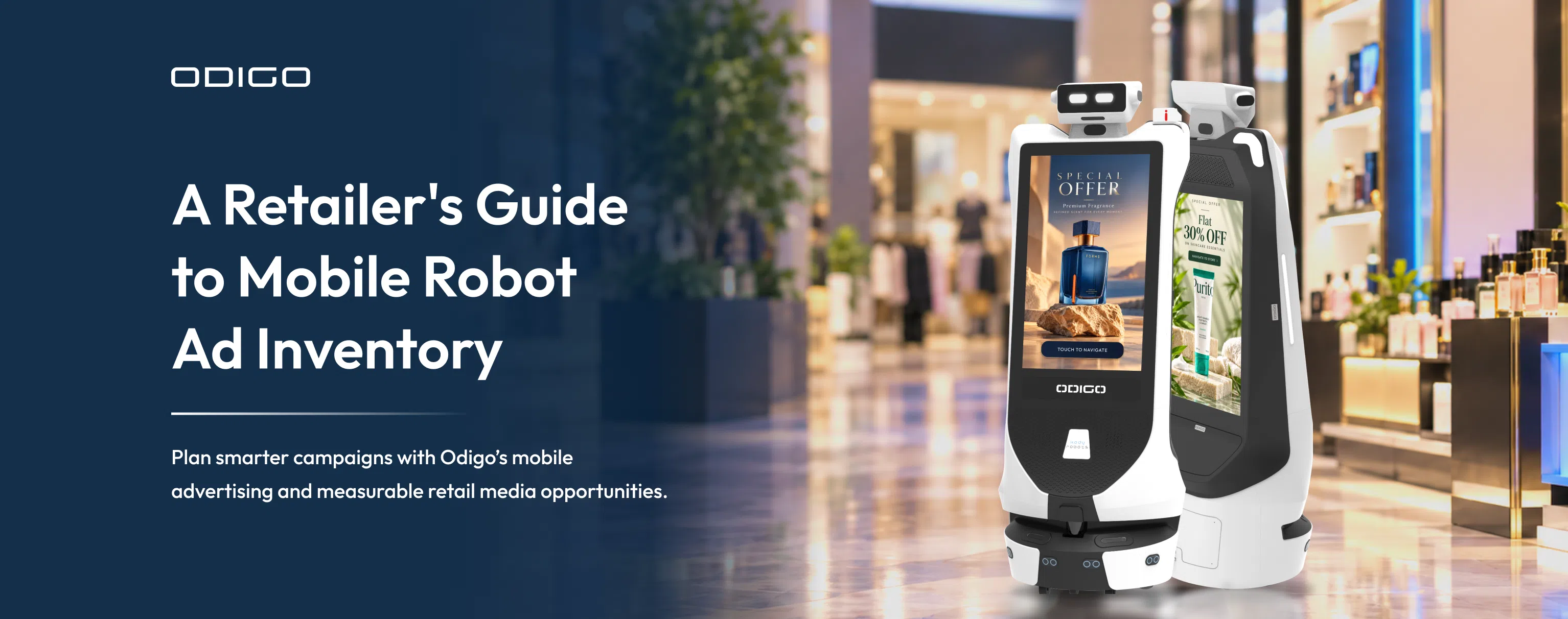
Retail media gives supermarkets another way to commercialize their in-store audience. Odigo adds mobile advertising inventory that retailers can plan around approved routes, eligible locations, operating periods, and available ad slots.
For retailers assessing robot revenue in supermarket environments, the commercial opportunity depends on what they can reliably offer advertisers. Before selling a placement, retailers should verify screen visibility, operating availability, route access, and campaign reporting.
Contextual Promotions, Campaign Scheduling, and Product-Related Advertising
A brand message can be more relevant when it aligns with the shopping environment. A personal-care promotion near the relevant department, for example, has a clear product connection to that location.
Retailers can define campaign creative, scheduled delivery, eligible zones, and reporting requirements. They should also distinguish a scheduled ad play from a verified impression. Playback data confirms that content played, but it does not independently establish that a shopper saw it.
Learn more about what is an advertising robot to understand how mobile advertising can fit into a physical retail environment.
Package Advertising Inventory by Store Location and Daypart
Retailers can make inventory easier to buy by offering defined packages based on participating stores, approved zones, campaign dates, and dayparts. Well-structured retail media inventory gives advertisers a clearer understanding of available placements, delivery expectations, and campaign terms.
Consider a consumer-packaged goods (CPG) brand launching a new body wash. A retailer could offer a weekend campaign in selected stores, with specified ad slots, campaign duration, expected delivery, and available interaction reporting. The media buyer could assess the offer against the campaign’s objectives and budget.
Retailers should define the number of eligible plays, the operating window, and the treatment of missed delivery before confirming the package. This gives advertisers a specific offer they can evaluate and helps retailers manage campaign commitments.
The guide to retail media inventory provides additional context for structuring mobile advertising packages.
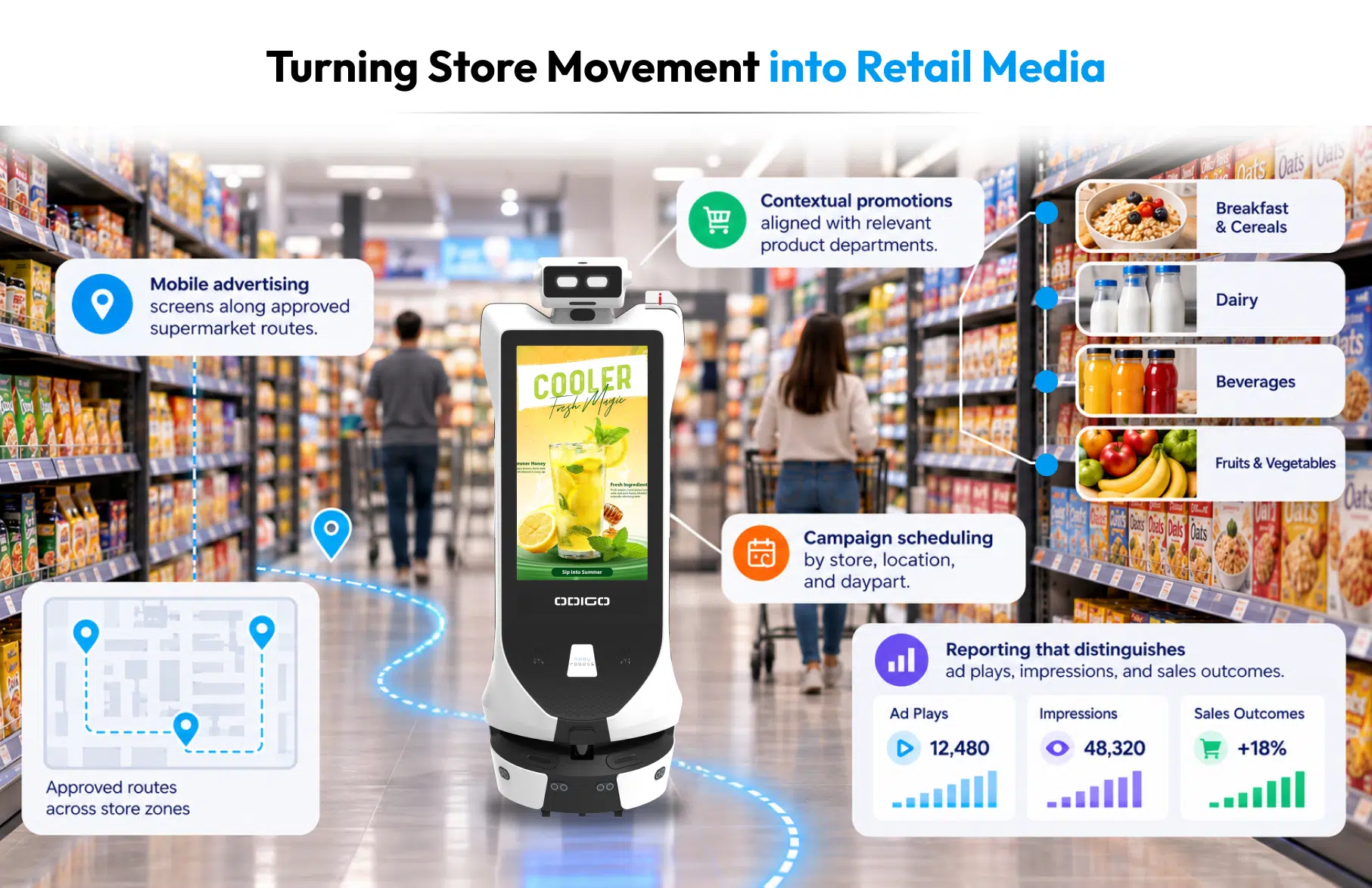
Measure Ad Plays, Impressions, and Sales Outcomes
Retailers need to distinguish between delivery, audience exposure, and commercial outcomes. These distinctions matter when assessing how retail media contributes to robot revenue in supermarket environments.
| Metric | What it tells the retailer | What it cannot establish alone |
| Ad plays | How often content played | How many shoppers saw it |
| Verified impressions | Estimated or measured audience exposure under the stated methodology | Whether exposure caused a purchase |
| Shopper interactions | Recorded engagement with supported robot functions | Purchase intent or satisfaction |
| Sales data | Transactions during the measured period | Whether the campaign caused a change in sales |
Before a campaign starts, the retailer and advertiser should agree on the reporting method and the metrics that define success. Retailers can also compare results against a baseline or suitable comparison group.
A before vs after advertising robot in retail comparison can help teams evaluate differences in campaign delivery and engagement. However, a simple before-and-after comparison cannot prove that the robot caused a sales increase.
For retailers ready to assess the commercial potential of robotic advertising, the advertising robot business model explains how this approach can fit into retail media planning, advertising inventory, and revenue generation.
3: Support Better Inventory Management Decisions
Inventory management challenges often involve maintaining accurate stock records, responding to changing demand, and replenishing products on time. Robots can provide additional shopper activity insights that help supermarkets identify recurring product enquiries and investigate potential availability or product visibility issues.
How Can Robots Help Supermarkets Address Inventory Management Challenges?
Inventory management requires accurate stock records, timely replenishment, and decisions that reflect changing demand. Supermarkets also manage perishable products, date-sensitive stock, and differences in sales across departments.
When assessing robot efficiency in supermarket operations, retailers should distinguish between inventory management capabilities and the operational insights that robot activity may provide. Odigo is not a standalone inventory management system. Its potential contribution lies in shopper activity data that retailers can compare with existing inventory and sales records.
For example, repeated enquiries about a product could prompt a manager to check its availability, placement, and recent sales. If inventory records confirm a stock issue, the team can follow its established replenishment process. If stock remains available, the team might investigate product visibility or shopper navigation.
The distinction matters: robot activity identifies a pattern to investigate; inventory records and operational checks help establish its cause.
How Can In-Store Robot Data Support Inventory-Related Decisions?
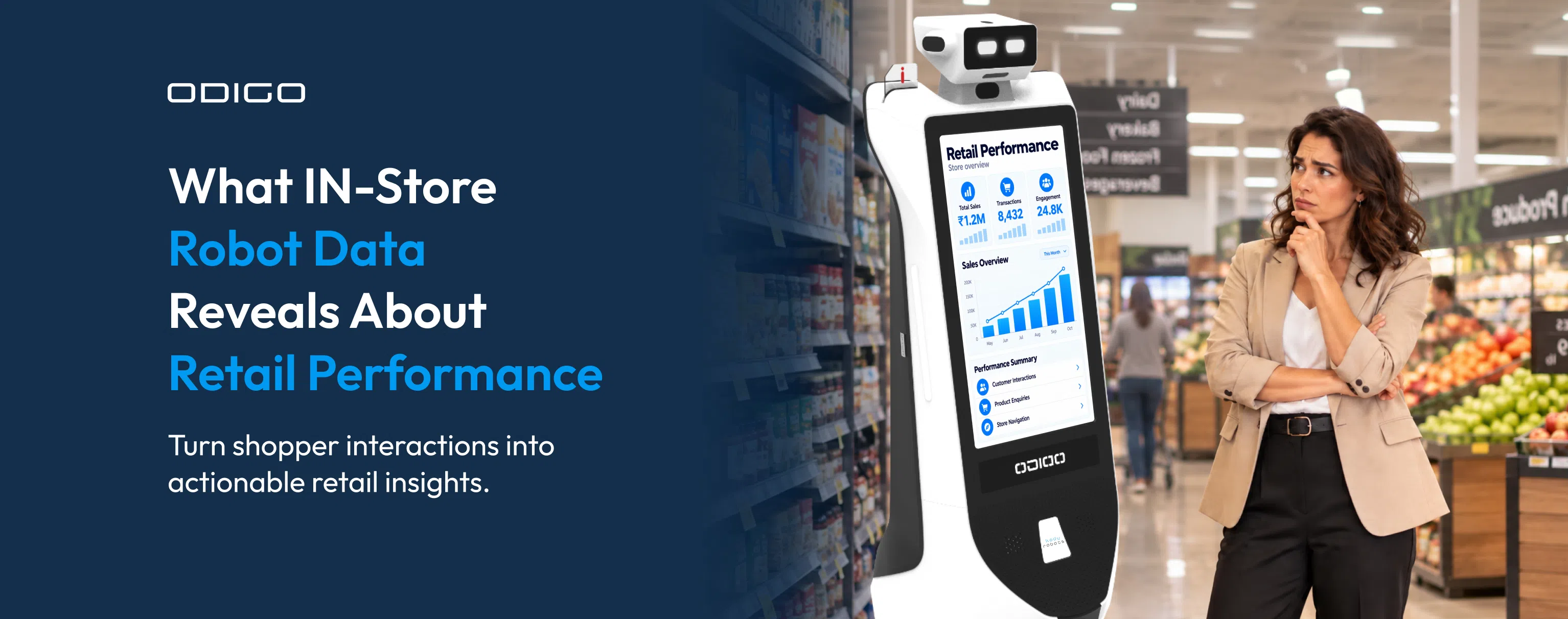
Retailers can compare navigation requests, shopper interactions, and other available activity data with point-of-sale records, stock information, and replenishment reports. This approach helps teams connect observed shopper activity with existing operational information.
Consider a department that consistently receives more navigation requests than other areas. Managers can review signage, product placement, traffic patterns, and operating schedules before deciding whether to adjust the layout or assistance strategy.
The same approach applies to repeated product enquiries. Teams can compare those enquiries with stock availability and sales trends to determine whether the pattern reflects shopper interest, difficulty finding products, or a possible availability issue.
The guide to in-store robot data collection explains how to interpret these signals and their limitations.
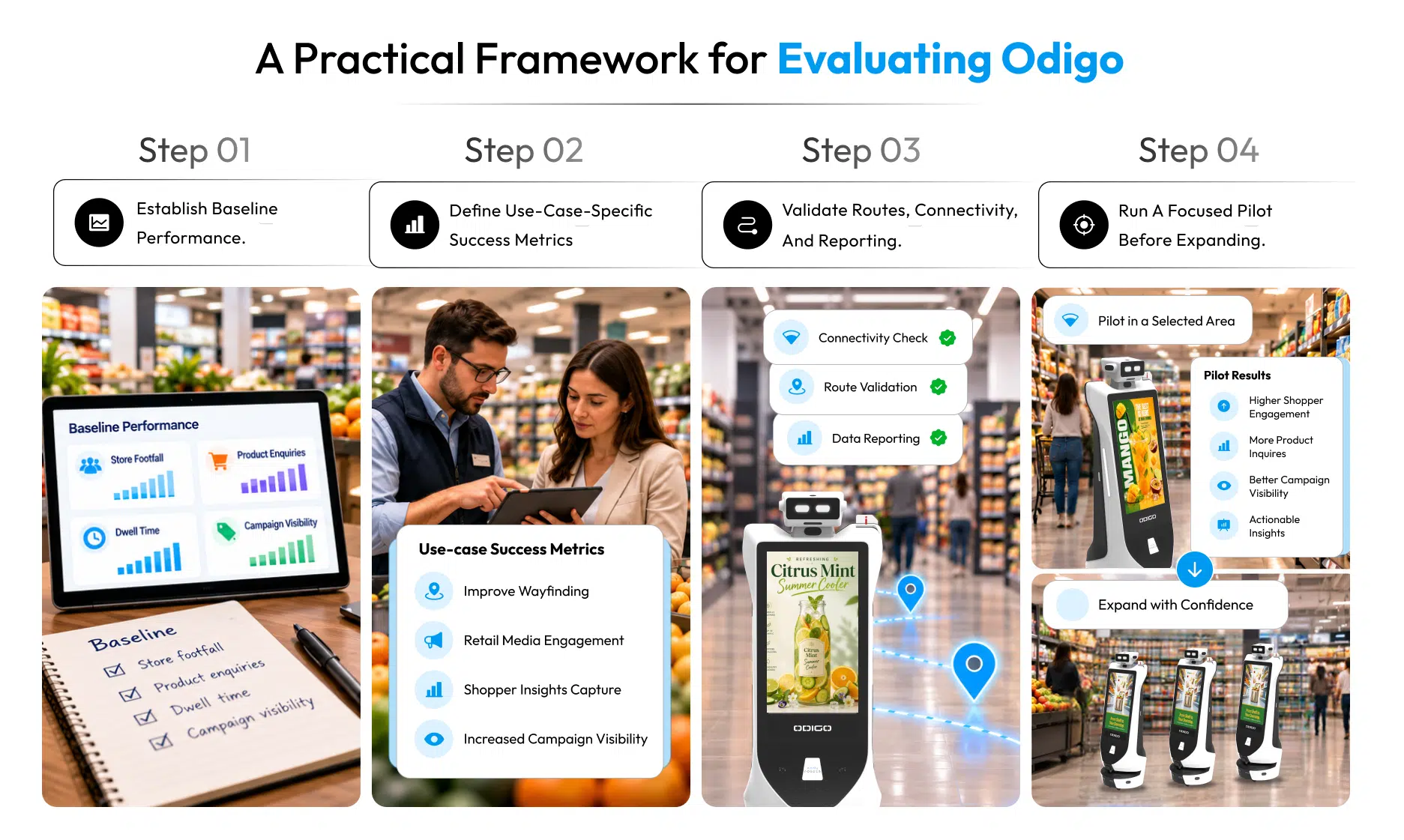
How Supermarkets Can Evaluate Odigo Across Three Business Priorities
Understanding why supermarkets deploy robots is only the first step. Retailers also need separate success measures for each business objective. Combining unrelated metrics into one overall engagement figure can hide whether the deployment meets its purpose.
Measuring the Shopping Experience
Track navigation requests, successful navigation outcomes where available, and recurring assistance needs. Compare these measures across departments and time periods.
Decision to make: If requests cluster in one area, investigate signage, product placement, and route design before deciding whether to change the deployment.
Measuring Retail Media Performance
Review scheduled and delivered ad plays, campaign availability, supported interactions, and the reporting metrics agreed with advertisers. Evaluate sales outcomes separately and use an appropriate measurement method before attributing changes to the campaign.
Decision to make: If the retailer cannot verify delivery for a proposed placement, resolve the reporting or operating issue before selling that placement as guaranteed inventory.
Evaluating Inventory-Related Insights
Compare relevant robot activity with inventory records, point-of-sale data, and replenishment information. Establish whether the patterns identify issues that existing systems or teams can investigate.
Decision to make: If enquiries increase for a product, check stock records and sales trends before changing replenishment plans or product placement.
These checks clarify how retail robots improve store efficiency. Useful results come from information that helps teams investigate problems and make better-informed decisions.
What Supermarkets Should Consider Before Deploying Odigo
Before deploying Odigo, supermarkets should assess their operational priorities, store environment, and expected business outcomes. A clear deployment plan helps retailers determine where robotic assistance can add value, whether the store can support the required routes and connectivity, and how the robot will fit into existing workflows. Retailers should also define data requirements, establish measurable performance indicators, and identify the resources needed to manage the deployment. These preparations help teams evaluate why deploy robot in supermarket operations and build a reliable basis for measuring results before expanding to additional stores.
Define the Use Case and Store Priorities
Start with one clearly defined objective, such as improving wayfinding, offering mobile retail media inventory, or investigating recurring shopper enquiries. This gives retailers a practical basis for deciding why deploy robot in supermarket operations and how to measure its contribution.
Establish a baseline and agree on success criteria before the pilot. This allows the retailer to compare results with its original objectives and decide whether the deployment merits expansion.
Plan Store Routes, Connectivity, and System Integration
Assess aisle widths, floor conditions, congestion, approved operating areas, and connectivity. Confirm how Odigo will fit into store workflows and which integrations the project requires.
A documented robot network configuration plan helps teams coordinate network access, operational requirements, and system responsibilities. Retailers should confirm the actual requirements with Kody Robots before deployment.
Establish Data Governance and Success Metrics
Define which data the deployment collects, who can access it, how the retailer retains it, and how teams will use it. Establish reporting methods for advertising delivery and shopper activity, and keep these measures separate from audience exposure and sales outcomes.
A structured pilot can also reveal practical deployment issues before expansion. The guide to why retail robots fail offers further considerations for evaluating business fit and deployment readiness.
Connect Shopper Experience, Retail Media, and Inventory Insights
The strongest reason to deploy a supermarket robot is a clearly defined business need. Odigo can support shopper assistance, mobile advertising, and supplementary store activity insights, but each application requires its own operating plan and measurement approach.
For supermarket leaders evaluating why supermarkets deploy robots, the decision should rest on practical objectives, measurable outcomes, and the robot’s confirmed capabilities. A focused pilot can help operations leaders and retail media teams determine where the platform adds value and where they need further evidence.
To assess how a retail store robot could fit your supermarket, book a demo with Kody Robots to discuss your store’s priorities.
Why Supermarkets Deploy Robots: General FAQs
These frequently asked questions explain why supermarkets deploy robots, how retailers can assess their applications, and which measures help determine whether a deployment supports business goals. Use these answers to evaluate Odigo a robot assistant against your supermarket’s operational and commercial priorities.
1. Why do supermarkets deploy robots in grocery stores?
Supermarkets deploy robots to support shopper assistance, create additional retail media opportunities, and gather supplementary store activity insights. The right application depends on the retailer’s objectives and the robot’s confirmed capabilities.
2. What are the main reasons to deploy Odigo in supermarkets?
The main reasons to deploy Odigo in supermarkets are interactive shopper assistance, mobile advertising, and additional insights from navigation and shopper interactions. Retailers should evaluate each application against a defined business objective.
3. How do robots improve the shopping experience in large supermarkets?
Robots such as Odigo can provide interactive assistance and guide shoppers towards supported destinations. Retailers can evaluate navigation outcomes, recurring assistance requests, and shopper feedback to determine whether the deployment meets their needs.
4. Can Odigo help supermarkets generate advertising revenue?
Odigo can provide mobile advertising placements that retailers package by eligible locations, schedules, and available ad slots. Revenue depends on inventory availability, advertiser demand, pricing, and campaign delivery.
5. Can supermarket robots manage inventory automatically?
That depends on the robot’s confirmed capabilities and integration with retail systems. Shopper activity data alone cannot verify stock levels, track expiry dates, or trigger replenishment.
6. How can robot data help supermarkets investigate stock-related concerns?
Retailers can compare recurring product enquiries and navigation requests with inventory records and sales data. This can highlight patterns for further investigation, but robot data alone cannot confirm a stock problem.
7. What data can Odigo report in a supermarket?
Depending on the deployed configuration, Odigo can report advertising plays, shopper interactions, navigation requests, runtime, and distance travelled. Retailers should confirm which metrics the deployment supports and what each metric can establish.
8. How should supermarkets measure the ROI of an advertising robot?
Retailers should compare deployment costs with measured outcomes tied to their objectives, such as advertising revenue or verified campaign delivery. They should use an appropriate attribution method before claiming that a campaign generated incremental sales.
9. Can supermarkets schedule robot advertising for specific campaigns?
Retailers can plan campaigns around supported schedules, eligible locations, and operating periods. They should confirm available inventory, delivery requirements, and reporting options before committing to an advertiser.
10. How should a supermarket evaluate a robot before deploying it across multiple stores?
Run a pilot in a representative store, establish baseline metrics, test operating conditions, and compare results with predefined targets. Expand only when the retailer has enough evidence to justify the next stage.
11. Do more robot interactions always indicate better store performance?
No. More interactions may reflect shopper interest, demand for directions, or difficulty finding information. Retailers should examine the type of interaction and compare it with relevant operational or customer experience measures.
12. Can Odigo support shopper assistance and retail media at the same time?
Odigo developed by Kody Robots combines advertising, interactive assistance, and wayfinding capabilities. Retailers should confirm the supported configuration and measure advertising delivery separately from shopper assistance outcomes.
13. What does robot efficiency in supermarket operations mean?
Robot efficiency in supermarket operations means assessing whether a robot supports defined tasks and provides useful results against agreed measures. Retailers can track navigation outcomes, advertising delivery, and relevant activity insights based on the deployment’s confirmed capabilities.
14. Why deploy robot in supermarket environments when stores already have staff?
Retailers may deploy a robot to provide additional shopper assistance, offer mobile advertising placements, or collect supplementary activity data. The goal is to support existing teams and workflows, with results measured against the supermarket’s specific business priorities.