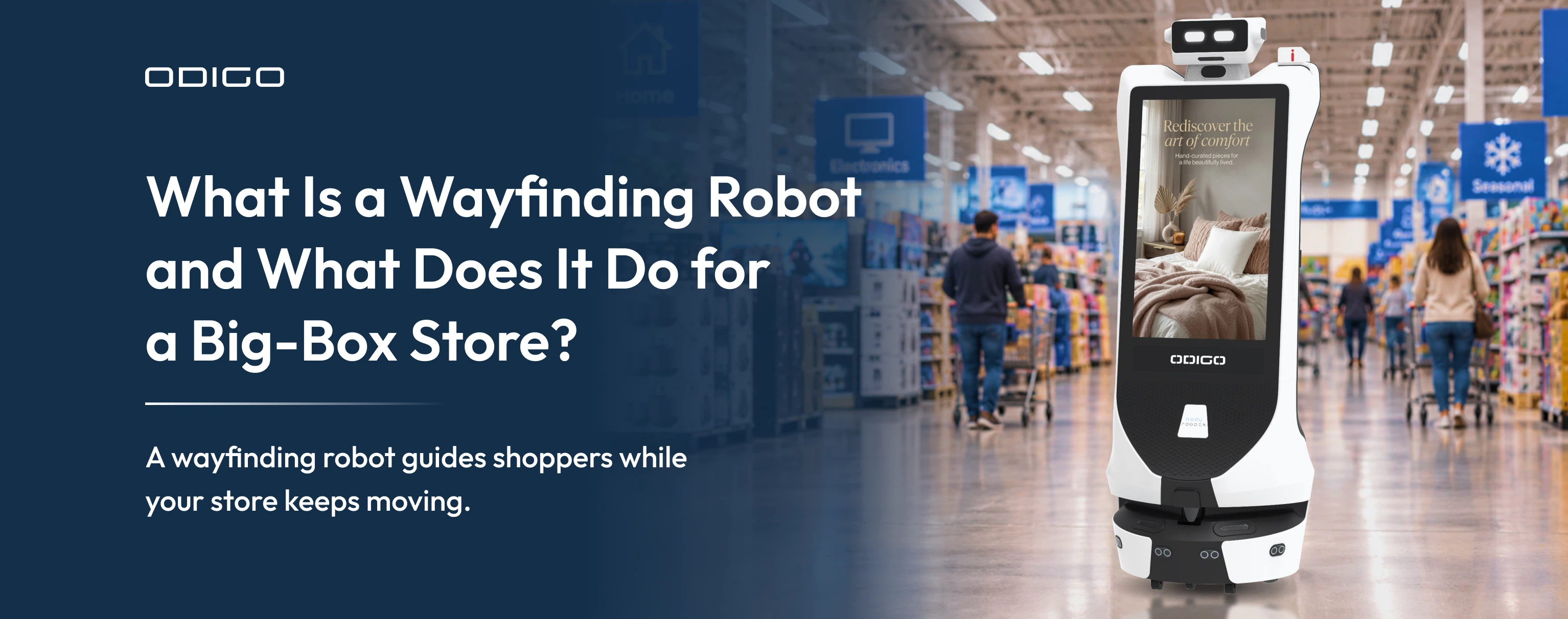

Quick Summary: A wayfinding robot is an autonomous robot assistant that helps shoppers find their desired products and navigates them to the shelf. The robot assistant saves shoppers time, helps make better purchases, and helps big-box stores get complete store analytics. Learn what is a wayfinding robot, how wayfinding robots work in retail stores, and how big-box retailers can use wayfinding robots for product finding and aisle navigation.
Key Takeaways
- A wayfinding robot can guide shoppers to specific stores or destinations, helping them navigate large retail spaces more easily.
- Big-box formats have a sales gap that wayfinding robots solve, since large footprints and frequent resets make product locations hard to remember.
- Odigo combines navigation with dynamic advertising, using its interactive display to promote sales, events, and other relevant content.
- The same screen that guides a shopper carries promotional content, so navigation and advertising share one asset rather than competing for budget.
- Odigo guides shoppers to specific stores and destinations, making navigation easier in large retail spaces.
- Accurate navigation and dynamic advertising work together to improve the shopper experience and create additional advertising revenue opportunities.
Why Is Wayfinding a Challenge in Big-Box Stores?
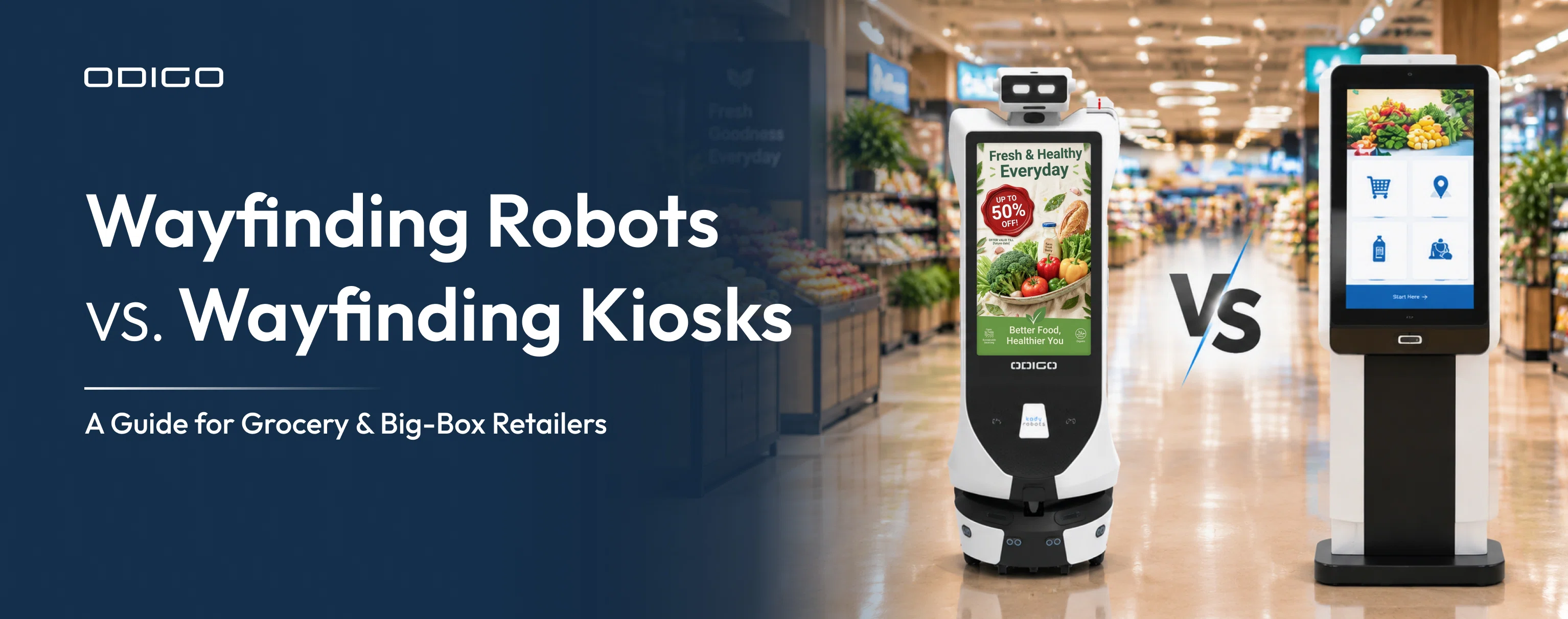
If you are a big-box store operator wondering, “What is a wayfinding robot?” and what does it do for large retail stores, you are in the right place. A wayfinding robot is a robot that helps shoppers navigate a retail space and find products or other destinations.
When a shopper needs one specific item inside a large store, finding the product can take time. Static signage may not always provide enough guidance across a large retail floor, adding to the frustration of finding the right aisle or department.
A shopper may know the brand and roughly what the packaging looks like, yet still walk in the wrong direction. The shopper may then need to find an employee for help or spend more time searching.
A wakefield research survey of 1,000 US consumers found that 46% had trouble finding what they wanted in big-box stores, while 42% could not find anyone to help. (Source: wwd)
A wayfinding robot can address the navigation challenge by providing directions and guiding shoppers toward specific destinations.
In this guide, you’ll learn what is a wayfinding robot, how wayfinding robots work in retail stores, and how big-box retailers can use them for product finding and aisle navigation.
What Is a Wayfinding Robot?
A wayfinding robot is an autonomous mobile assistant that helps shoppers locate products, departments, and services inside a store. Rather than displaying directions on a screen, the robot physically escorts the shopper to the destination.
The operative word in the definition above is “escorts.” Plenty of technology can tell a shopper that laundry detergent sits in an aisle, bay 6. A shopper standing inside a warehouse-format store often cannot translate an aisle number into a walking route. Wayfinding robots exist precisely because the gap between knowing a location and reaching a location is where most navigation tools quietly fail. Operators researching what is a wayfinding robot are usually trying to close exactly that gap.
A Simple Definition for Big-Box Operators
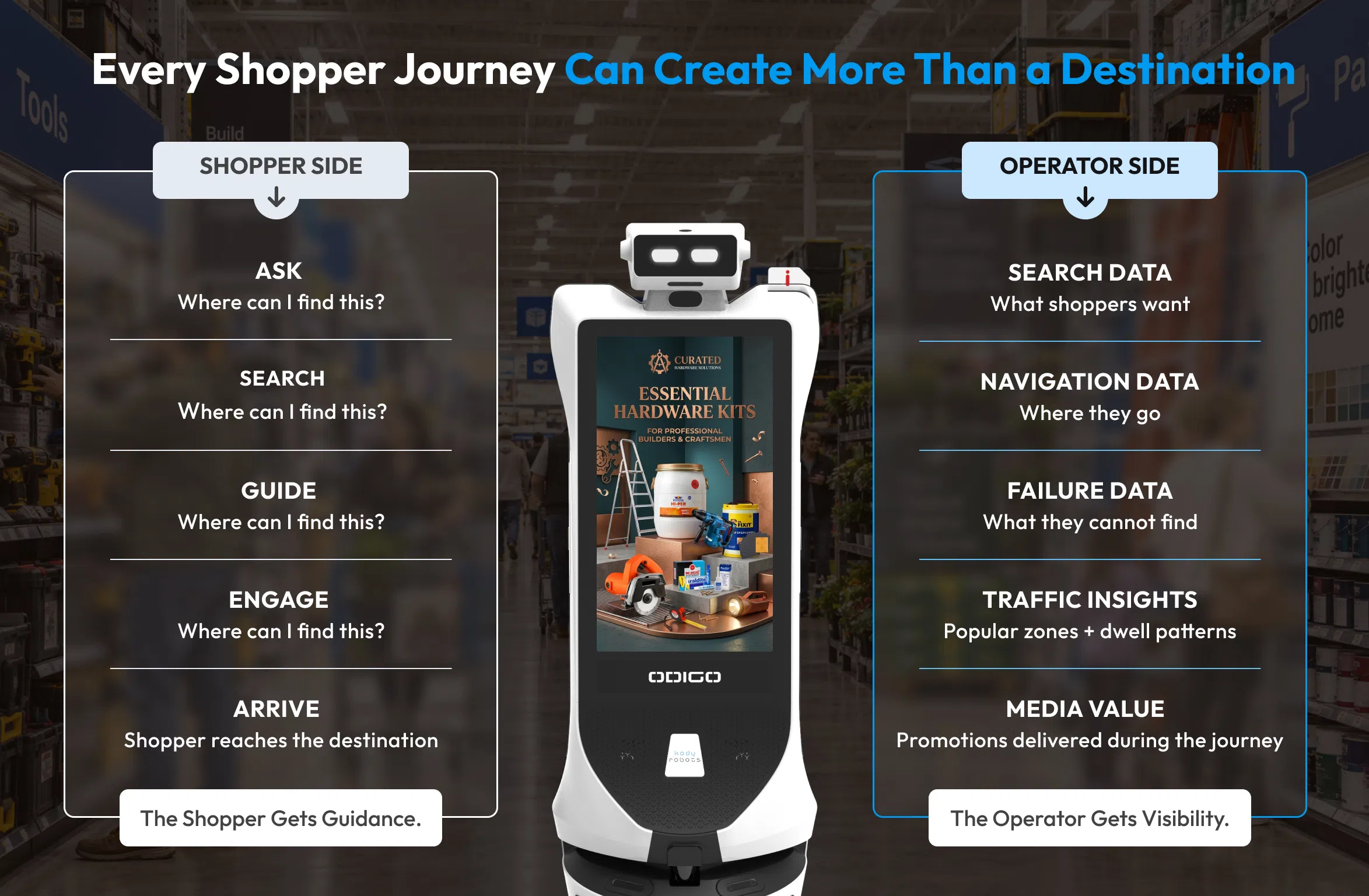
Strip away the robotics vocabulary and four capabilities sit inside one moving unit:
- Search, which lets a shopper ask for an item by voice, by touch, or through an on-screen directory.
- Location resolution, which turns a product name into the aisle and zone your store actually uses.
- Guide, which is the unit leading the shopper through the store to that spot.
- Reporting, which logs what people searched for, where they went, and how long each trip took.
Odigo, the robot built by Kody Robots for high-footfall environments, delivers all four capabilities on one platform, and the same hardware carries advertising content while the unit moves.
How a Wayfinding Robot Differs from Directories and Store Apps
Operators compare wayfinding robots against tools they already own, so an honest comparison beats a feature list. Here is where each option helps, and where each one runs out of road.
| Capability | Wayfinding robot | Printed directory | Store app | Wayfinding kiosk |
| Meets the shopper mid-aisle | Yes, the unit moves | No, fixed at the entrance | Only if already installed | No, fixed position |
| Walks the shopper to the shelf | Yes | No | No | No |
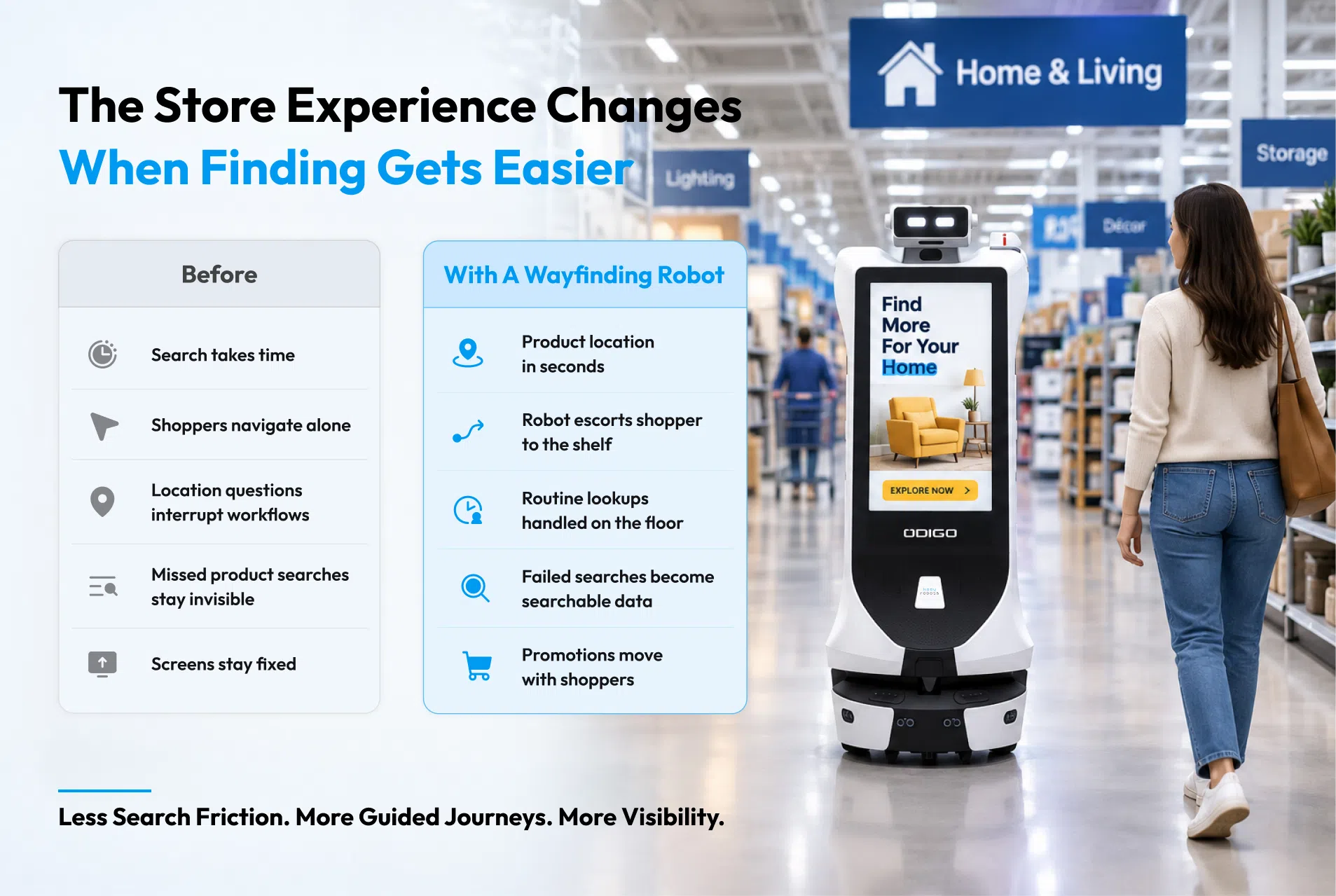
| Updates after a store reset | Remotely, in one action | Requires reprinting | Requires a data update | Requires a content push |
| Works with no download or sign-in | Yes | Yes | No, both required | Yes |
| Handles voice and multiple languages | Yes | No | Sometimes | Sometimes |
| Records what shoppers could not find | Yes, as searchable data | No | Partially | Partially |
Store apps deserve a fair hearing, since the technology is capable, and the data is rich. The catch is adoption, because a frustrated shopper holding a basket rarely stops downloading software and creating an account. A robot assistant removes every one of those steps, as the shopper simply speaks or taps and the unit responds.
What Is a Wayfinding Robot for Big-Box Stores Specifically?
A wayfinding robot for big-box stores helps shoppers navigate large retail spaces and find specific destinations. Large store layouts can make navigation challenging, creating a need for accessible, on-floor guidance. Big-box environments concentrate every condition that makes navigation hard:
- Footprints measured in acres, where a wrong turn costs several minutes.
- Product ranges running into tens of thousands of SKUs, resets included.
- Peak periods when question volume spikes and associates are least available.
- Mixed missions in one trip, spanning groceries, hardware, and pharmacy counters.
A store app requires shoppers to use their own devices, while a printed directory provides static guidance. A wayfinding robot for big-box retail brings navigation assistance directly onto the sales floor, helping shoppers find stores and destinations through interactive guidance. For the advertising side of the same platform, our guide to what is an advertising robot covers the topic in depth.
How Wayfinding Robots Work in Retail Stores
Wayfinding robots work in retail stores through three connected systems. A sensing and navigation stack moves the unit safely, a mapping and data layer translates product names into store locations, and an interaction layer handles the shopper conversation from question to arrival.
The three systems fail in different ways, and knowing which system owns which problem will make your vendor conversations considerably more productive.
For a closer look at how these systems play out across different store formats, our guide to wayfinding robot use cases breaks deployments down by department and floor plan.
Core Components and Hardware
The hardware solves one problem: moving a 65 kg machine through a crowded aisle without hitting anyone. Odigo handles that with a layered sensor suite, where each sensor covers a weakness in the others.
- 2D LiDAR scans 270 degrees at up to 25 meters, giving the unit its picture of aisle geometry and moving obstacles
- Three 3D depth cameras read the space directly ahead, catching shapes a flat laser scan would miss
- Four ultrasonic sensors handle low pallets, glass fixtures, and reflective surfaces, with anti-fall sensing covering level changes
- Dual 32-inch Full HD touchscreens carry the search interface on one face and promotional content on the other
- A LiFePO4 battery supports 10 or more hours of continuous operation, followed by autonomous docking
Software, Mapping, and Product Location Data
Hardware moves the unit, while software decides where the unit should go. Odigo builds its store map using dual SLAM, which fuses laser and visual sensing into one markerless map, so the deployment needs no floor tape, rails, or ceiling beacons. Cartographer handles mapping while AMCL handles positioning, and together they deliver the centimeter-level routing that makes an escort feel purposeful.
The harder half is product data, and most projects underestimate the work involved. Turning “cordless drill, 20 volt” into “aisle 22, bay 4” requires your own location data, which means inventory and point-of-sale integration gets scoped during implementation rather than assumed on day one*. Where that connection exists, the unit can also check live stock, compare unit pricing across pack sizes, and suggest a substitute the moment an item proves unavailable*.
From Shopper Question to Guided Arrival
The flow below shows what happens between a shopper’s question and the moment that shopper reaches the shelf. Every step generates data you can use later.
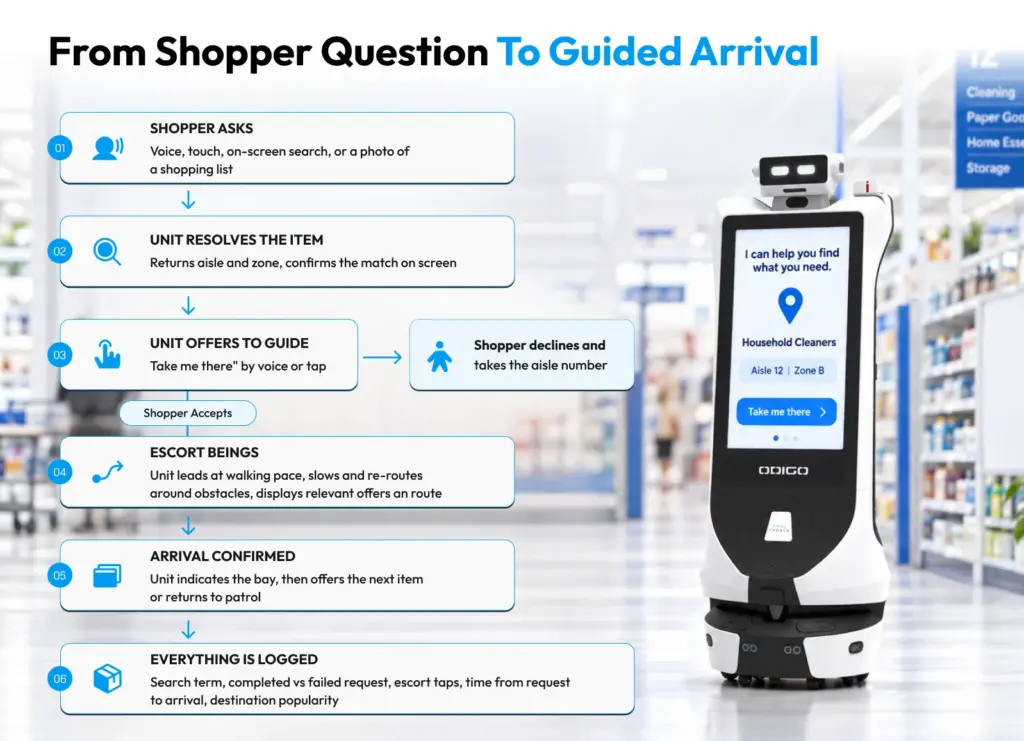
Step three matters more than operators expect, because many shoppers do not want an escort at all. Declining is fine, since the aisle number alone resolves the question for a confident shopper. Step six surprises most buyers, because failed searches turn out to be commercially richer than successful ones.
What Is a Wayfinding Robot Built to Handle in a Big-Box Store?
What is a wayfinding robot capable of once you move past the demo and into a trading store? The answer depends on deployment model, physical fit, and interaction design, and all three deserve scrutiny before a purchase decision.
Deployment Models Worth Considering
Not every unit needs the same job, and the model you choose shapes both your content plan and your placement strategy.
| Model | How It Works | Best Suited To |
| RaaS (Robot-as-a-Service) | Use Odigo through a recurring service model without purchasing the robot outright. | Retailers that want to pilot wayfinding, validate store-floor impact, or deploy with lower upfront investment. |
| Purchase | Purchase Odigo as a store-owned robotic platform for long-term deployment. | Retailers planning permanent deployments across stores and wanting direct ownership of the robot asset. |
Most big-box operators land on the purchase model, and the reason is simple the models give them complete control over their robot and program with additional support and service from us.
Physical and Operational Fit
Specifications only matter when they map to your building, so these are the ones that decide whether a deployment is viable at all.
Footprint
Odigo measures 535 mm wide by 630 mm long, stands 1650 mm tall, and weighs 65 kg, so main aisles accommodate the unit while congested seasonal displays may not.
Speed
Travel speed is configurable from 0.1 to 1.0 meters per second, giving a genuine walking pace for escorts and a faster pace for repositioning.
Floor surface
The unit needs a flat, solid indoor surface, and carpet, slopes, and outdoor areas fall outside the envelope, which rules out garden centers and exterior lots.
Temperature
Operating range runs from 5°C to 40°C, so chilled aisles are fine while walk-in freezers are not.
Coverage
Multi-map and multi-floor support handles stores split across levels, and virtual walls keep units clear of stockrooms and forklift routes.
Interaction
Multilingual voice and touch interaction with automatic language detection means no app, no account, and no sign-in.
Treat that list as a site-survey checklist rather than a spec sheet. When understanding What Is a Wayfinding Robot, store fit matters just as much as software capability. A store that fails on floor surface or aisle congestion will struggle no matter how strong the software is, and finding the mismatch during evaluation costs far less than finding the same mismatch after delivery.
How Big-Box Stores Use Wayfinding Robots
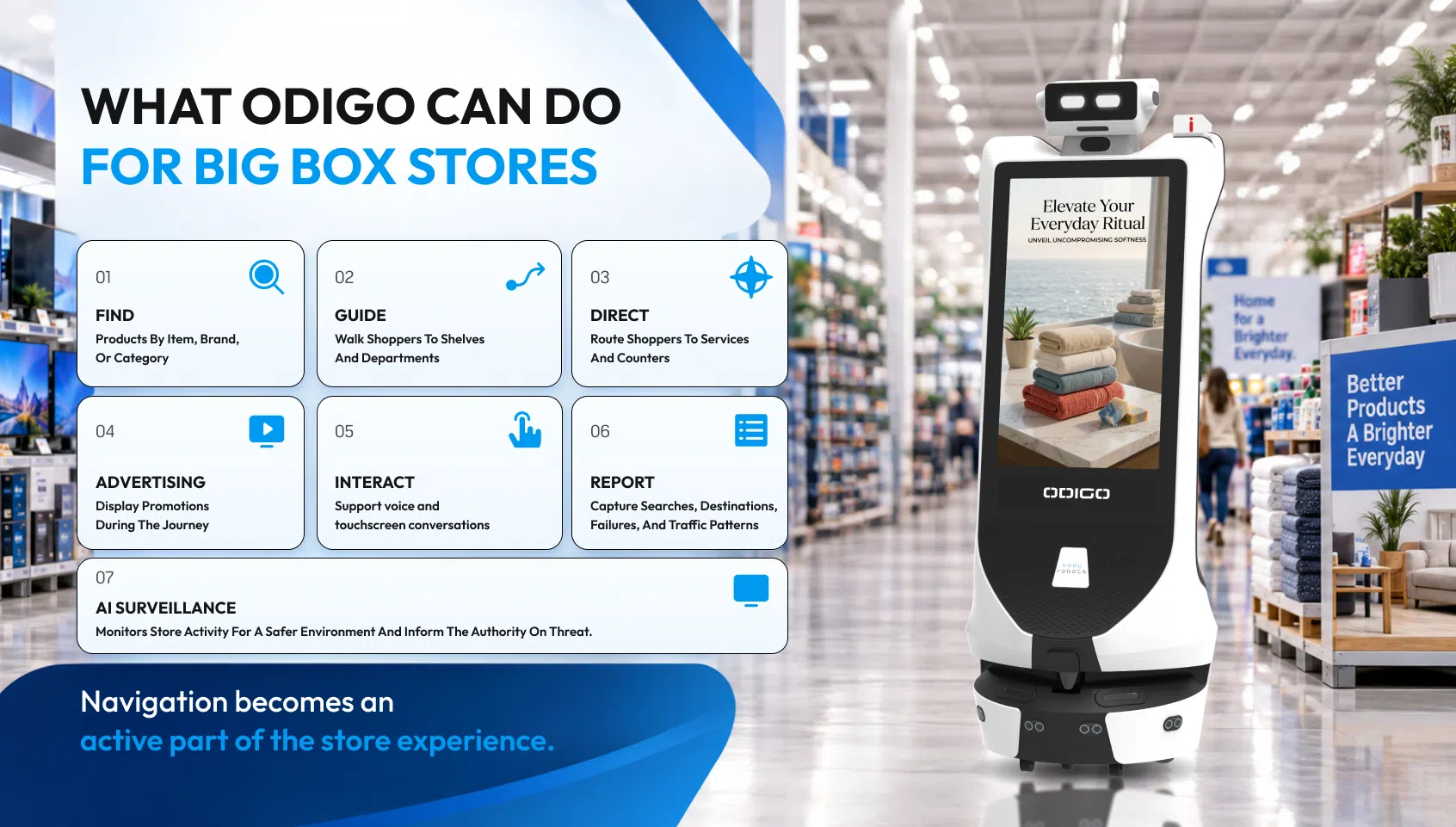
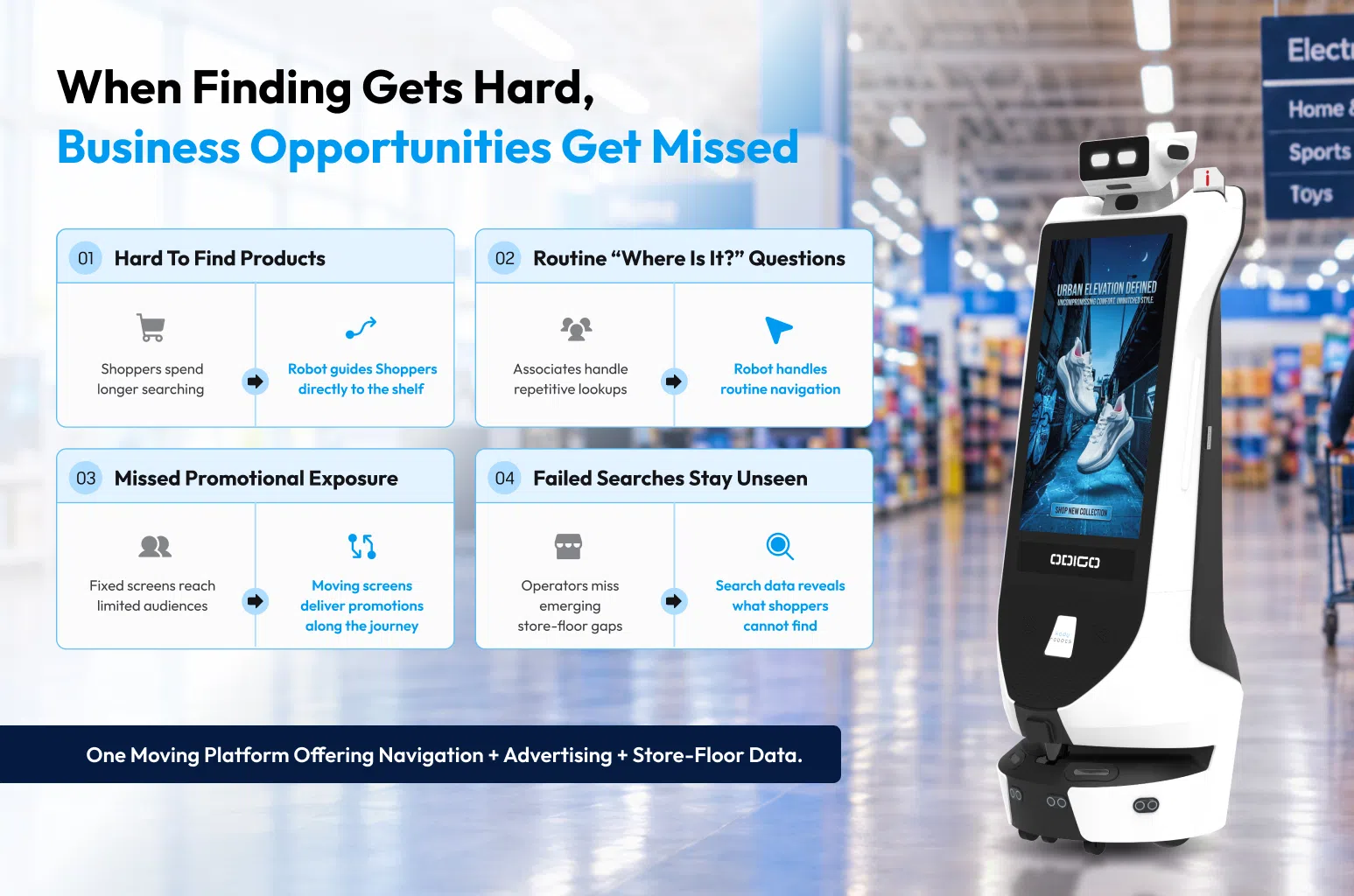
Big-box stores use wayfinding robots for four jobs that overlap on the sales floor. The four jobs are finding products, guiding shoppers to departments and service counters, surfacing promotions during the trip, and extending what associates can cover during peak hours.
Each job produces different data, and each job justifies the investment differently, so all four are worth separating.
Product Finding and Aisle Navigation
Product finding is the core use case, mapping directly to the complaint that sends shoppers home empty-handed. A retail wayfinding robot for product finding accepts a search by item name, brand, or category, returns the aisle and zone, then offers to walk the shopper there.
- Item finder returning aisle and zone location from a spoken or typed query.
- A wayfinding robot for aisle navigation that leads the shopper instead of reciting directions.
- Smart shopping list routing, where items submitted by voice, text, or photo become one optimized route, with skip and reorder controls. *
- Route sequencing that places chilled, frozen, and heavy items last in the run.
Department and Service Guidance
Big-box stores are really several stores stacked into one building, and shoppers routinely need a counter rather than a shelf. Odigo’s service concierge menu covers returns and exchanges, order pickup, membership, and customer service, each carrying a “guide me there” action alongside an “I need help” option.
- Amenity wayfinding to restrooms, pharmacy, optical, order pickup, service desk, and exits
- “You are here” orientation, plus opening hours, returns policy, and stock availability answered on the spot
- Queue depth detection at checkout counters, which signals a manager when a lane should open
- Instant help tickets raised from the screen, capturing issue type, zone, and timestamp
Promotions Delivered During the Trip
A shopper walking behind a screen for ninety seconds is an audience, and audience time is the commercial argument that turns a navigation project into a funded one. Content schedules by zone, route, and individual point of interest, so the offer shown while escorting toward hardware differs from the one shown near the pharmacy.
- Always-on promotional display during patrol, running independently of any interaction
- Section-specific offers driven by the unit’s current position
- Brand-sponsored interactive experiences triggered at a set physical location
- Discovery routing that walks footfall past active sampling and demonstration zones
If you are weighing that revenue argument against fixed screens, our comparison of Advertising robot vs interactive kiosk vs digital signage sets out the trade-offs. The advertising robot page covers the media platform itself.
Extending What Associates Can Cover
Let’s be precise, because the staffing argument is often made badly. The point is reach, not a replacement, so the comparison between a wayfinding robot and an associate ends here. An associate helps one shopper at a time, and during a rush. Whereas a wayfinding robot for big-box stores absorbing those routine lookups frees the associate to reach the shopper who needs product expertise or a judgment call no screen can make.
- Consistent answers across every shift, including for seasonal hires still learning the layout
- Announcements broadcast during idle periods, covering closing time, recalls, and parking alerts
- Escalation paths that route a shopper to a human when the question genuinely needs one
Together, these use cases help answer what Is a wayfinding robot by showing how the technology supports both shoppers and store teams. It reduces navigation friction, improves access to store services, supports promotions, and gives associates more time to handle higher-value customer needs.
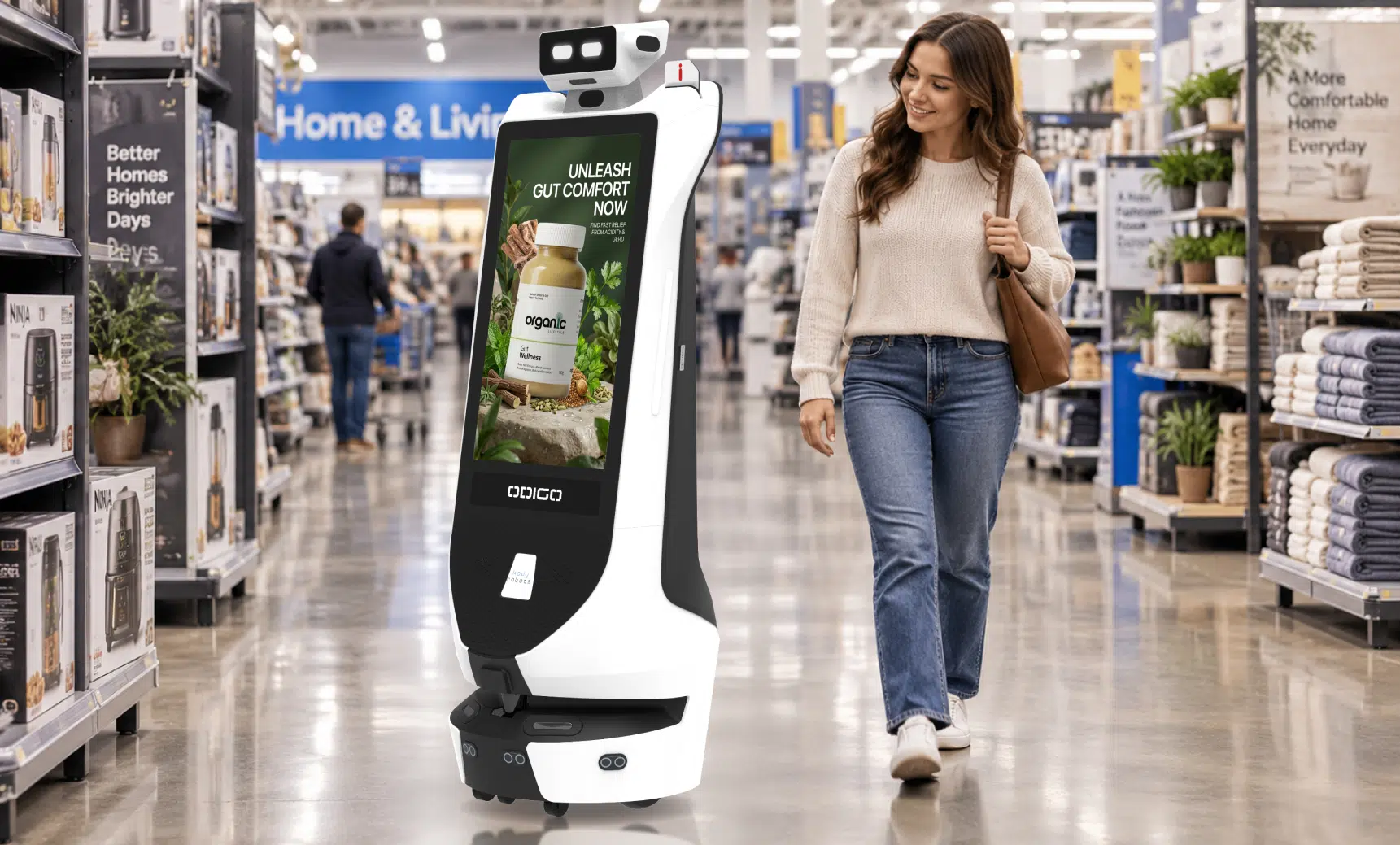
Odigo with Real Wayfinding Numbers from LuLu Mall
Now that we are clear about all the basics and how a wayfinding robot works. Let’s take a look at what a wayfinding robot actually produces after a live deployment in a real-world environment.
Kody Robots deployed Odigo, a wayfinding robot, across the 2 floors at Lulu Mall, Thiruvananthapuram, for 61 days, logging every interaction, escort, and ad play along the way.
Shoppers engaged with Odigo 47,350 times, and the shopper navigation requests were 6,050. These shoppers requested store escorts and had a 12.8% navigation conversion rate.
All the numbers mentioned above were held steady within the floor, and the entire deployment window is proof that the underlying search-to-escort loop performs highly effectively irrespective of the increase in footfall at Lulu Mall.
The same screen works as an advertising robot. The smart assistant played 313,875 ads across multiple months, proving that navigation and advertising share one moving asset instead of competing for budget.
| Metric | Result |
| Shopper interactions | 47,350 |
| Store navigation requests | 6,050 |
| Navigation conversion rate | 12.8% |
| Distance covered | 1,317.5 km |
| Total runtime (patrol + escort) | 868 hours |
| Ads played on the same screen | 313,875 |
Shopper flow: Interaction → Navigation request (12.8% convert) → Guided escort → Promotion shown en route → Arrival logged
For operators asking “what is a wayfinding robot for big-box stores,” we really understand you and answered your question. What we also understand is the ask: whether the escort-and-report loop holds up under real footfall, not a lab demo. LuLu Mall answers the doubt for you, with two floors of production data collected over two months.
Where Wayfinding Robots Work Best?
A wayfinding robot earns its place in any store where the floor is large enough to lose a shopper and busy enough to stretch staff thin.
Big-box retail
Warehouse-format stores with acres of floor space and tens of thousands of SKUs lean on a big box store robot to escort shoppers straight to the shelf instead of leaving them to decode aisle signage.
Shopping malls:
Large malls can use wayfinding robots to guide visitors to stores, services, amenities, and key destinations while creating opportunities for promotional engagement.
Supermarkets
Frequent, fast grocery runs reward speed, and an AI robot assistant for supermarket environments can trim search time on repeat visits while surfacing today’s offers along the route.
Retail stores:
Department stores and specialty retailers can use wayfinding robots to help shoppers locate products, departments, services, and promotional areas across larger sales floors.
Grocery stores
Fresh and packaged goods sit across aisles that reset weekly, so an AI grocery store robot keeps location data current without reprinting a single sign.
General retail and malls
Multi-brand floors, department stores and shopping malls alike, route shoppers between tenants and departments using the same navigation engine.
Benefits of Wayfinding Robots in Large Retail Stores
Wayfinding robots help shoppers find products quickly in large stores without getting lost or having to ask an employee.
The wayfinding robot also helps store staff save time and understand what products or areas customers are looking for most.
The benefits of wayfinding robots in large retail stores fall into three groups: fewer abandoned trips, a measurably better shopper experience, and operational visibility store teams did not previously have.
The focus here is on the mechanism behind each benefit, making it easier to assess how it could apply across different stores.
Conversion and Basket Outcomes
The mechanism is simple. A shopper who finds the item buys the item, whereas a shopper who gives up leaves with an incomplete basket or none at all. Removing the search failure removes one specific reason for walking out.
- Fewer trips abandoned because a product could not be located.
- Longer guided routes that expose shoppers to promoted zones along the way.
- Substitution offered the moment an item proves unavailable, which keeps the sale in store*.
One honest caveat belongs here. Robot activity data on its own is not sales attribution, and connecting escort activity to basket outcomes requires point-of-sale and loyalty integration*. Scope that work deliberately and set expectations with your finance team early.
Shopper Experience and Accessibility
Orientation is the first thing a shopper needs and the last thing most big-box stores provide well. A unit that greets on approach, detects the shopper’s spoken language automatically, and offers to lead the way changes the opening moments of the trip.
- Multilingual voice and touch interaction with automatic spoken-language detection.
- Immediate orientation for first-time shoppers and time-pressed regulars, with no app or account required.
- On-screen forms, ratings, and feedback capture, giving you a direct channel for shopper sentiment.
Operational Visibility
Operators tend to discover operational visibility after deployment rather than during evaluation, and visibility is arguably the most durable of the three benefits. The unit is already moving through the store for navigation reasons, so the observation costs nothing extra.
- Top searched items and categories, plus search volume trends over time.
- Navigation requests split into completed and failed, which exposes gaps in your location data.
- Average time from request to arrival at destination.
- Popular destinations, peak usage windows, and language distribution.
- Zone traffic, dwell patterns, and high-intent zone identification.
Failed searches deserve particular attention. When shoppers repeatedly hunt for something you do not stock, or cannot find something you do, the search pattern points straight at a range gap or a planogram error. Neither problem shows up in a sales report.
The Technology That Powers a Wayfinding Robot
Operators do not need an engineering briefing, yet you do need enough grounding to judge whether a platform survives a real trading Saturday. The table below explains each capability in plain terms, with the matching Odigo specification in the second column.
| What the unit does on the floor | The specification behind the capability |
| Builds its own store map without tape, rails, or beacons | AI-powered dual SLAM combining laser and visual sensing, using Cartographer and AMCL |
| Sees aisle geometry, moving shoppers, and carts at distance | 2D single-line LiDAR scanning 270 degrees at up to 25 meters |
| Catches shapes ahead, low pallets, glass, and reflective surfaces | Three 3D structured-light depth cameras plus four ultrasonic sensors |
| Slows and steers around a crowd instead of stopping dead | Multi-sensor obstacle avoidance, speed configurable from 0.1 to 1.0 m/s |
| Stays out of stockrooms, docks, and forklift routes | Software-defined virtual walls and restricted zones, plus anti-fall sensing |
| Hears a shopper and shows search plus promotion at once | Four-microphone array, two 32-inch Full HD touchscreens, 7.9-inch top display |
| Runs a full trading day and recharges without staff help | 10+ hours on LiFePO4, with autonomous docking and automatic resumption |
| Updates and reports without local technical staff | Dual-band Wi-Fi and Bluetooth, remote monitoring, over-the-air updates |
Navigation Behavior Under Real Store Conditions
Specifications describe capability, while behavior describes what you will actually watch happen on the floor. Three behaviors matter most inside a big-box aisle.
Graded response to obstacles
The unit slows and re-routes rather than halting, which stops a stalled machine from blocking a busy aisle.
Local operation during network loss
Core navigation runs locally, so connectivity affects the remote dashboard rather than the shopper interaction.
Central route governance
Points, routes, and cruise paths are defined centrally and assigned per unit, so a store reset becomes a map update rather than a site visit.
Safety and Operator Control
Safety questions come up in every evaluation, and safety questions should come up, since a moving unit shares floor space with children and shopping carts.
- Emergency stop that halts all functions immediately, using a physical switch on the unit.
- Configurable speed limits, letting you slow units during peak trading hours.
- Virtual walls and restricted zones keeping units away from back-of-house operations.
- A PIN-protected operator panel, plus direct override of what a unit displays and where the unit travels.
Data Governance and Privacy Positioning
US operators should treat data governance as a first-order question rather than a compliance footnote, particularly given state and city biometric legislation.
Odigo’s detection and data-capture functions are configurable per site, and individual detection classes can be enabled or disabled independently. Permissions are granular, retention windows are configurable, and recordings sit on customer-controlled infrastructure*. Your legal and privacy teams therefore decide which functions are active before the unit goes live, rather than inheriting a fixed configuration.
Implementation Guide for Big-Box Operators
Knowing what is a wayfinding robot is one thing, and getting a unit working inside a trading store is another. Deployments succeed or fail on preparation rather than hardware, and the stores that struggle almost always treat mapping and product data as afterthoughts.
Pilot Design and Success Criteria
Start narrow and measure honestly, because a pilot trying to prove everything usually proves nothing.
- Deploy one or two units in a single high-traffic store rather than spreading across locations.
- Define metrics up front, using time from request to arrival, completed versus failed searches, and escort completion rate.
- Compare zones or days with units active against equivalent periods without them, across a weekday pattern and a full weekend peak.
Site Readiness and Store Operations
Site work is where the project timeline actually lives, so plan the site work properly.
- Map the store layout, then define points of interest, routes, and cruise paths.
- Set virtual walls around stockrooms, receiving, compactors, and forklift operations.
- Choose charging dock locations with power access and clear approach paths.
- Connect product location data so item searches resolve to your real aisle and bay references*.
- Assign one operations owner per store for daily checks and content refresh.
Change Management and Staff Briefing
Your floor team will make or break shopper acceptance, so bring them in before the unit arrives.
- Brief managers and associates on what the unit does and what the unit deliberately does not do.
- Write short operating procedures covering start-up, content refresh, and incident handling.
- Collect associate feedback during the pilot, since floor staff spot friction that dashboards miss.
Our overview of autonomous robots for superstore environments covers the operational side in more detail for multi-store rollouts.
Wayfinding Robot Costs and How to Evaluate Vendors
Nobody publishes credible pricing for wayfinding robots, so understanding what Is a wayfinding robot is only one part of the buying decision. Any vendor quoting a universal payback period is guessing because the real variables sit inside your stores rather than inside the robot. What you can do is build a complete cost picture and question the vendor properly.
Cost Components to Build into Your Business Case
- Hardware, covering the units themselves plus charging docks and spares.
- Platform and content management, including the central console and user licensing.
- Deployment services, spanning site survey, mapping, configuration, and commissioning.
- Integration work, scoped separately for inventory, point-of-sale, or loyalty connections*.
- Ongoing support and software updates, plus the internal operations time your team absorbs.
Set against the costs above, remember the offset available on the advertising side. A unit carrying brand-funded campaigns generates commercial return through the media platform, and Odigo includes a partner and wallet module tracking performance and earnings per advertising partner.
Vendor Evaluation Checklist
Use the table below as a scoring sheet during vendor conversations, because the answers separate mature platforms from prototypes quickly.
| Area | The question to ask | What a strong answer looks like |
| Navigation | What sensing does the unit combine, and are floor markers required? | Fused laser and visual SLAM, markerless deployment |
| Aisle behavior | What happens when a crowd blocks the path? | Slows and re-routes, rather than stopping until cleared |
| Endurance | How long does the unit run, and who plugs the unit in? | A full trading day, with autonomous docking |
| Store fit | What floor surfaces and temperatures are supported? | A clear operating envelope, stated in writing |
| Mapping | How is a store reset handled? | Central map and route update, pushed remotely |
| Integration | How does product location data reach the unit? | Scoped integration work, defined in the statement of work |
| Governance | Who controls detection settings, retention, and access? | Per-site configuration under customer control |
| Measurement | What reporting comes back with no integration at all? | Native analytics with exportable records |
One further comparison is worth running before you commit, since a fixed unit suits some stores better. Our breakdown of wayfinding robots vs wayfinding kiosks works through that decision against the same criteria.
Next Steps for Big-Box Operators
What is a wayfinding robot worth to your stores? The question only resolves against your own floor data, which is exactly what a scoped pilot produces.
If your stores are large, your SKU count is high, and your associates spend their shifts answering the same location questions, wayfinding robots deserve a serious evaluation. Begin with a site assessment covering floor surface, aisle clearance, and the state of your product location data, since those three factors determine viability faster than any demonstration will.
Kody Robots runs pilot programs for US retailers, and you can explore the platform through the AI robot assistant for supermarket page or book a store assessment with our team.
What Is a Wayfinding Robot – General FAQs
Below are answers to all your questions regarding “what is a wayfinding robot” and how the robot assistant works in your big-box stores.
What is a wayfinding robot?
The short answer is an autonomous mobile assistant that helps shoppers find products, departments, and services, then escorts them to the destination while logging the interaction. The smart assistant helps both shoppers with finding products and navigating, and store operators with analytics and retail intelligence.
What is a wayfinding robot for big-box stores?
The wayfinding robot for big-box stores is a navigation system built for high footfall areas like Kroger and Costco. The wayfinding robot has multiple other features such as mobile advertising, AI surveillance, and retail intelligence. So, it handles product finding, aisle guidance, service-counter routing, and promotional delivery across mapped store zones.
How do wayfinding robots work in retail stores?
The wayfinding robot maps the store using laser and visual sensing. Resolves a spoken or typed query and guides shoppers to their requested aisle or product. While the robot assistant navigates through the retail store, it avoids obstacles and logs the requested trip or query for store operators and also registers the SKU in the system.
Can a wayfinding robot help increase the store sales?
Yes, wayfinding robots help increase your big-box store sales. Initially, shoppers who couldn’t find an item often left without buying due to frustration and other factors like time. The wayfinding robot removes the search failure from the store, ultimately increasing sales and engagement.
How do wayfinding robots handle aisle navigation and product finding?
A shopper searches by item, brand, or category; thereafter, the robot assistant searches the request in the system and guides the shopper there.
What data does a wayfinding robot collect?
A wayfinding robot collects Item searches, top categories, completed versus failed navigation requests, escort taps, popular destinations, average time to arrival, language selection, footfall, dwell time, SKUs, zone traffic patterns, and more such useful data that ultimately helps big-box operators make better decisions.
Are wayfinding robots safe around shoppers and staff?
Yes, absolutely; a wayfinding robot is safe to be deployed around humans because of the technology it uses, like LiDAR and ultrasonic sensors. The robot combines multi-sensor obstacle avoidance, anti-fall sensing at level changes, configurable speed limits, and virtual walls, alongside an emergency stop that halts all functions immediately. In fact, it also extends itself with AI surveillance, reporting any possible threat in real time, which makes the store safe.
Does a wayfinding robot require shoppers to download an app?
No. A wayfinding robot can interact with shoppers through voice and a touchscreen. Shoppers can search for a product, department, or service without downloading an app, creating an account, or signing in.
Can a wayfinding robot adjust when the store layout changes?
Yes. Store maps, routes, and navigation points can be updated when aisles, departments, or displays change. This helps the wayfinding robot continue guiding shoppers to the correct destinations after a store reset.
How does a wayfinding robot stay available throughout the day?
A wayfinding robot can operate for long periods and return to its charging dock when needed. For example, Odigo supports more than 10 hours of operation and can dock automatically for charging before returning to work.
How do wayfinding robots deliver ROI for big-box stores?
Wayfinding robots deliver ROI in three main ways:
- Protect sales: Help shoppers find products, reducing abandoned purchases.
- Save associate time: Handle routine “where is it?” questions so staff can focus on higher-value customer needs.
- Improve store operations: Failed-search data can reveal inventory gaps and planogram issues.
To measure revenue impact, you should consider connecting robot activity with POS and loyalty data from the start.