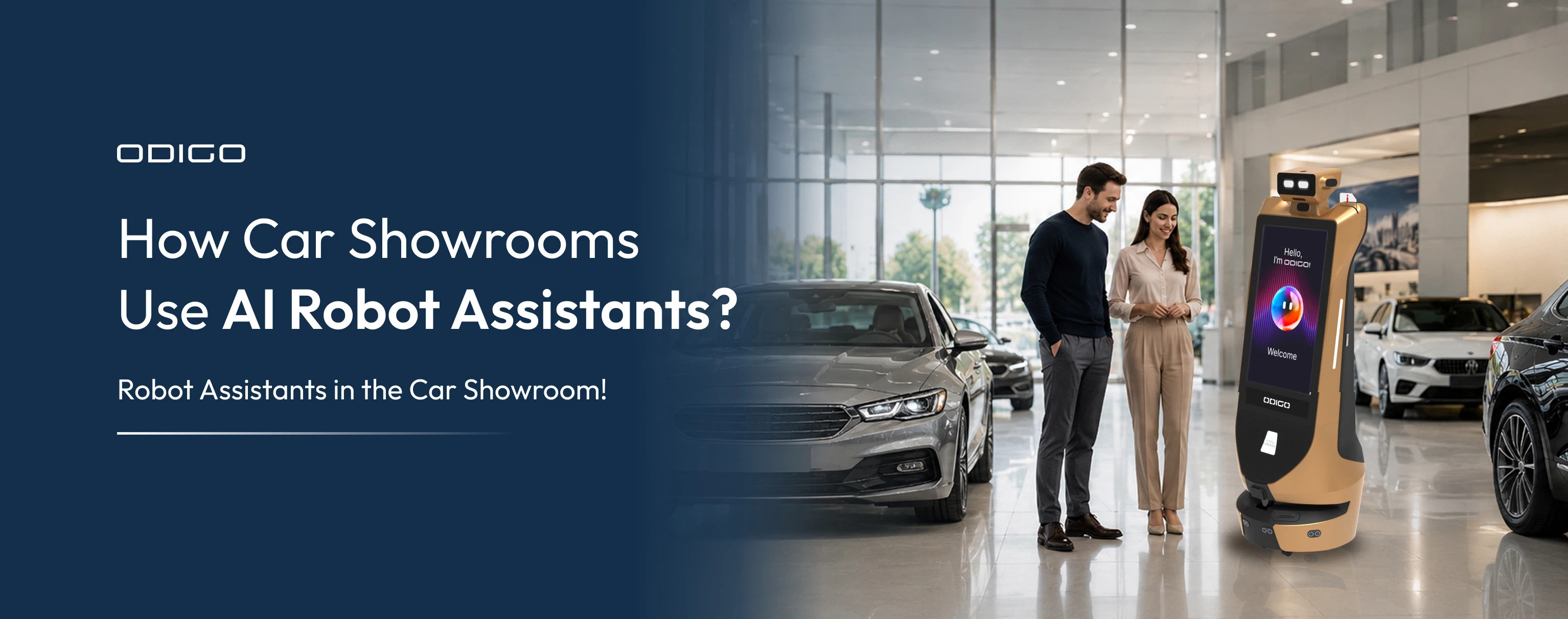

Quick Summary: Car showrooms use AI robot assistants to greet visitors, answer product questions, and capture leads while consultants help other customers. The technical blog covers how car showrooms use AI robot assistants across their showrooms for the visitor journey. How Odigo handles visitors, helps them discover, compare models, and answer every question they have.
Key Takeaways
Here’s what showroom operators should know before reading further:
- AI robot assistants in car showrooms step in the moment a consultant is occupied, so visitors do not stand around unattended.
- Odigo pulls comparisons and specs from approved dealership content instead of open-ended answers, keeping information consistent across shifts.
- A showroom robot can walk a customer to a selected vehicle and demonstrate specific features on request.
- The robot assistant collects contact details, budget range, and test-drive interest before a consultant joins the conversation.
- Consultants start each handover already knowing what the customer wants, based on that captured context.
- Each interaction adds to a showroom-level record of which models and features draw the most attention.
A shopper walks into the showroom on a Saturday afternoon, browses the SUVs alone, and waits because the consultants are busy with other customers. Cox Automotive found 71% of vehicle buyers enter the purchase process unsure which vehicle to buy, so the unattended wait is also a missed chance to guide a real decision.
How car showrooms use AI robot assistants starts with closing exactly the same gap in showrooms. Odigo is an AI robot assistant for car showrooms. The car showroom robot greets shoppers, answers questions, suggests car variants, and keeps them engaged until a consultant is free. The robot assistant for car showrooms provides live feature demonstrations and books the test drive. In the end, the smart assistant delivers a customer ready to purchase.
What Is an AI Robot Assistant for a Car Showroom?
An AI robot assistant for a car showroom is a mobile unit that interacts with customers on the floor to answer their questions. The robot assistant combines features such as conversational AI, touchscreens, cameras, and autonomous navigation with dealership software for smooth operations.
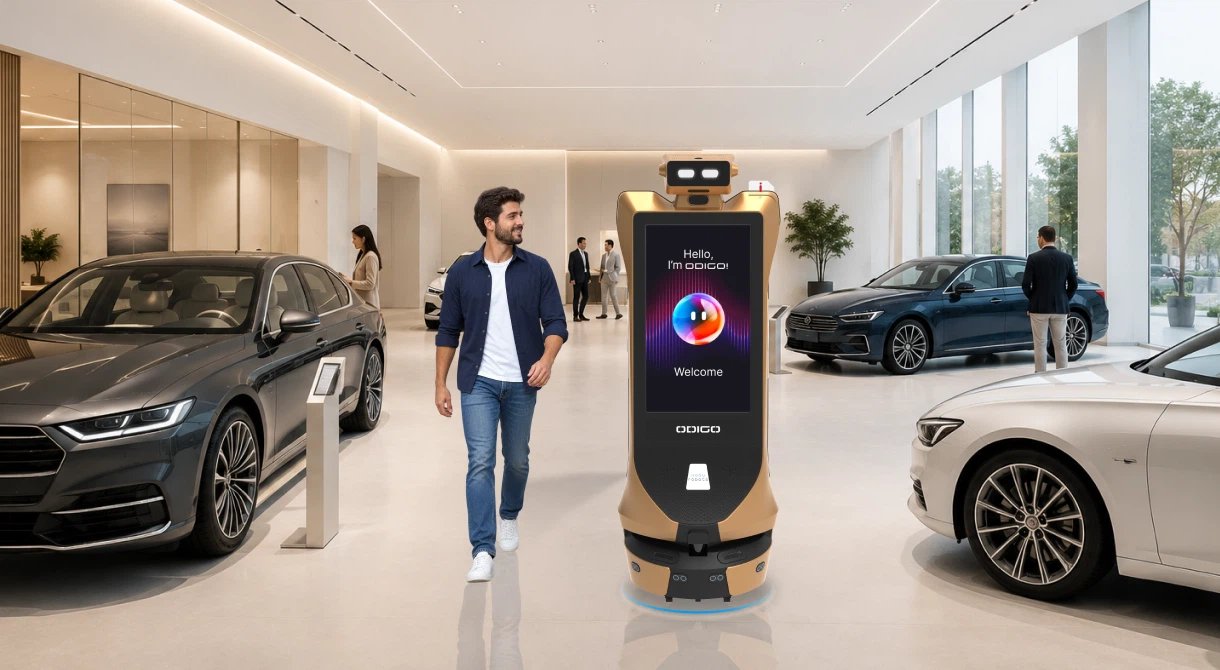
Odigo is an AI robot assistant that greets visitors, answers questions, and demonstrates vehicles without a fixed kiosk location on the floor. The car showroom robot is designed to approach the visitor the moment they enter the floor so they are not left unattended.
Robot Assistant for car showrooms stands apart from other floor technology in three specific ways:
1: Physical presence:
A robot assistant moves through the showroom and approaches visitors, unlike a website chatbot that only answers typed questions online.
2: Combined technology:
Complete technology combining conversational AI, touchscreens, cameras, and navigation software works together inside one unit instead of running as separate systems.
3: A middle position:
A robot assistant handles early questions and demonstrations, then hands qualified visitors to a consultant for negotiation and closing.
AI robot assistants help visitors understand vehicle options, features, pricing, and financing. They can also demonstrate models and answer common questions before customers speak with a consultant. So, what technologies make an AI robot assistant possible? Let’s explore the answer to this question next and understand the technologies powering robot assistants in car showrooms.
What Technologies Power a Car Showroom Robot?
How AI robot assistants work in car showrooms comes down to a handful of core technologies. Conversational AI, voice recognition, and touchscreens handle interaction, while LiDAR and visual SLAM handle movement across the floor.
- Conversational AI and multilingual voice recognition let a robot assistant answer spoken questions in the customer’s language, without a wait for staff.
- Dual touchscreens present model comparisons, pricing, and finance calculators side by side for self-paced browsing.
- Laser and visual SLAM navigation guide the robot around parked vehicles and showroom traffic to reach a selected car or zone.
- A facial recognition camera, used on an opt-in basis, flags a returning or high-value customer and alerts the assigned sales representative.
- CRM, DMS, and inventory integrations, managed through a centralized dashboard, connect conversations to dealership records and keep pricing and offers current.
These technologies showcase the capabilities of a car showroom robot and what the robot assistant can do for your showroom sales efficiency. Technologies such as conversational AI and multilingual voice recognition, facial recognition, laser, and visual SLAM navigation make a robot assistant a complete autonomous solution for car showrooms. The next question is why dealerships are adding this layer in the first place.
Why Are Car Showrooms Introducing AI Robot Assistants?
Car showrooms introduce AI robot assistants to handle uneven footfall, repetitive questions, and inconsistent product explanations that stretch sales teams thin during peak hours.
When car showrooms use smart assistants, they free their sales team to close priority deals. The technology also closes the gap between online research and the in-showroom experience.
Car showroom automation with AI robot assistants is now one of the necessary requirements because of a few recurring gaps on the floor:
- High footfall during weekends, launches, and promotions outpaces consultants available at the showrooms.
- Visitors wait without acknowledgment while staff finish other conversations.
- Sales teams repeat the same variant and feature questions all day.
- Product explanations differ between consultants, creating inconsistent messaging for buyers and their budget.
- Walk-in visitors who leave without speaking to anyone go unrecorded, creating a huge gap as they could be a potential lead.
- Multilingual customers need support that not every consultant can provide.
- Online research and in-showroom visits often feel disconnected for the customer.
- Showrooms have limited visibility into what visitors explored before becoming leads.
Consultants often spend a large share of each shift repeating the same variant and pricing details instead of guiding serious buyers toward a decision. Without a record of what a visitor explored before leaving, a showroom loses visibility into which vehicles draw real interest and which promotions actually work on the floor.
The next section breaks down how car showrooms use AI robot assistants across 11 common use cases, in the order a visitor typically experiences them.
How Are AI Robot Assistants Used in Car Showrooms?
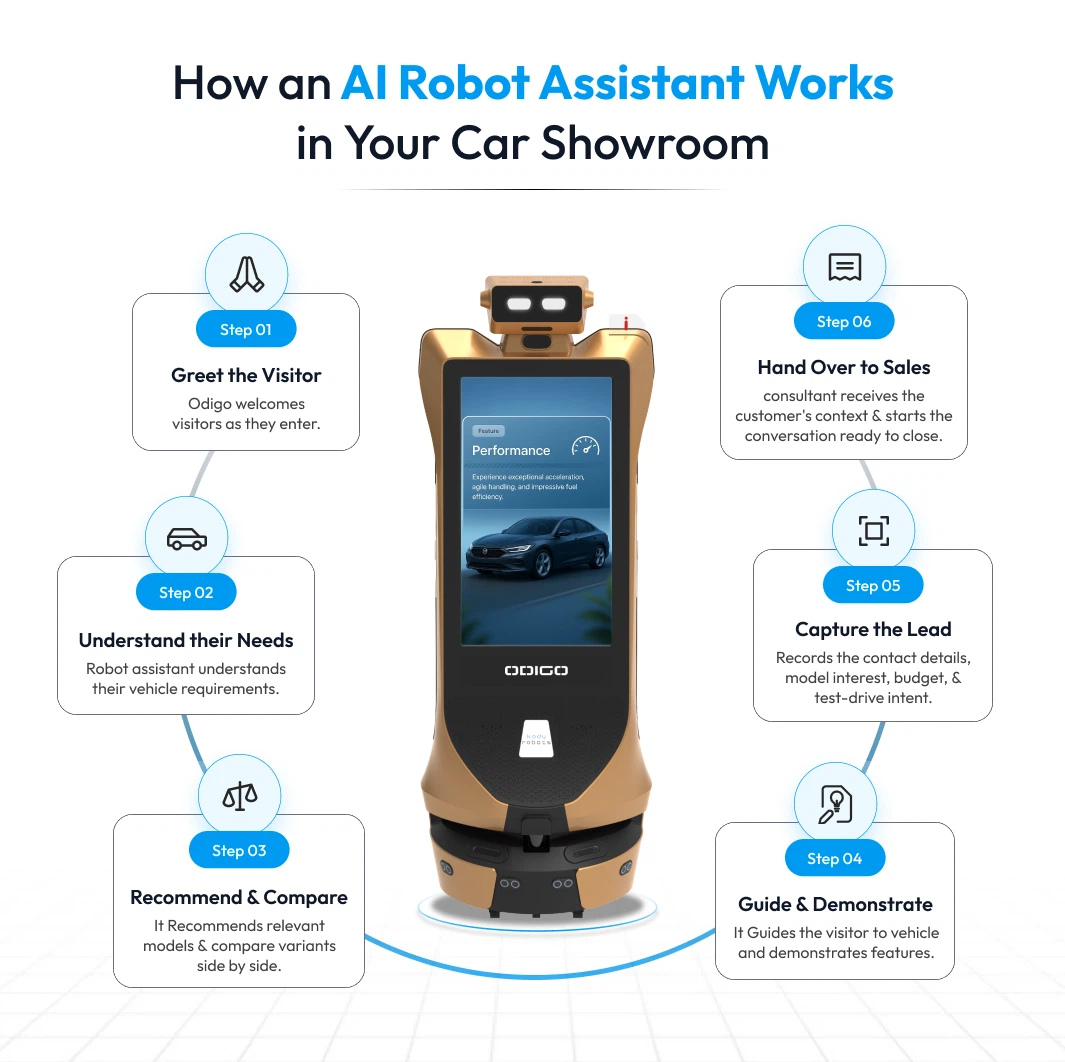
Odigo takes on a defined role at each stage of a visitor’s time in the showroom. This section shows how car showrooms use AI robot assistants across 11 stages: greeting, comparison, demonstration, booking, and handover.
1. Welcoming and Engaging Showroom Visitors
A robot assistant positioned near the entrance notices an arriving visitor and starts the interaction before a consultant is free. Odigo asks what model or vehicle type the visitor wants to explore first.
- Positioned at the entrance, Odigo notices and greets each arriving visitor without a wait.
- The robot asks the visitor’s model or vehicle-type preference to open the conversation.
- Odigo keeps the visitor engaged with model highlights until a sales consultant becomes available.
This first contact sets up the next step: learning what the customer actually needs.
2. Understanding the Customer’s Vehicle Requirements
Once a visitor stays engaged, Odigo asks a short set of questions about budget, vehicle type, and daily use. These answers narrow the showroom’s full lineup down to relevant options.
- Budget range and preferred vehicle type
- Seating capacity and daily driving distance
- Fuel or powertrain preference
- Safety and technology priorities
With these requirements captured, Odigo narrows its next suggestions to matching vehicles.
3. Recommending Suitable Vehicles and Variants
Based on the stated requirements, Odigo suggests specific models and variants that match the customer’s budget, seating needs, and driving habits. When a preferred vehicle is unavailable, the robot presents close alternatives instead of a dead end.
- Matches stated needs against the current lineup to suggest specific models and variants.
- Offers comparable alternatives when the first-choice vehicle is unavailable.
- Gives an undecided visitor a concrete starting point instead of an open browse.
With a shortlist in hand, the visitor is ready to compare options side by side.
4. Comparing Car Models, Trims, and Specifications
On its touchscreen, Odigo displays side-by-side comparisons of price, engine, mileage, safety features, and trim differences. Comparison data comes from centrally approved and regularly updated dealership content, which keeps comparisons consistent no matter which consultant joins the conversation.
- Price, engine or powertrain, and mileage or driving range
- Safety features, infotainment, and seating configuration
- Available colors, trims, and warranty or ownership terms
Once a customer settles on a shortlist, Odigo can guide them to see the vehicles in person.
5. Guiding Visitors to Vehicles and Showroom Zones
Using laser and visual SLAM navigation, Odigo escorts a customer directly to a selected vehicle. Odigo also directs visitors toward finance desks, accessory counters, or the test-drive reception area.
- Walks a customer directly to a chosen car after a recommendation or comparison.
- Navigates between brand sections, floors, and experience zones in larger dealerships.
- Points visitors toward finance, accessories, or the test-drive desk on request.
Once at the vehicle, Odigo moves into hands-on feature demonstrations.
6. Demonstrating Vehicle Features
At the vehicle, Odigo walks a customer through specific features such as infotainment, drive modes, or ADAS systems. Odigo can repeat the same walkthrough for the next visitor.
- Demonstrates infotainment functions, seating configurations, and boot or tailgate operation.
- Walks through drive modes, safety and ADAS features, and connected-car functions.
- Covers charging features for electric models on request.
For a customer who wants to hear from a specialist, the AI robot assistant hand overs the customer to a consultant on the customer’s request.
7. Answering Questions in Multiple Languages
Odigo answers customer questions through two-way voice interaction in multiple languages, with matching on-screen text. Responses stay consistent across languages, which matters most for dealership groups operating in linguistically diverse markets.
- Two-way voice interaction lets a customer ask a question aloud and get a spoken answer in the same language.
- On-screen text mirrors the spoken response for customers who prefer to read along.
- Responses stay consistent across languages, since Odigo pulls from the same approved content set.
- Multilingual support lets a dealership serve a walk-in even when no consultant on shift shares that language.
As one of the more versatile AI showroom robots for customer engagement, Odigo moves this conversation toward pricing and financing next.
8. Presenting Prices, Finance Plans, and Showroom Offers
Odigo displays on-road price breakdowns, EMI illustrations, and current showroom offers on its touchscreen. Pricing and offer details come from the dealership’s own systems, which a consultant should confirm before a customer commits.
- On-road price breakdowns covering registration, insurance, and applicable charges
- EMI illustrations based on price, down payment, and loan tenure
- Exchange offers, current promotions, and available insurance or warranty options
- Accessory and add-on pricing shown alongside the base vehicle
With pricing and offers in view, many customers are ready to schedule a test drive.
9. Booking Test Drives and Managing Queues
Odigo collects a customer’s preferred test-drive date and time, checks demo-car availability, and registers the request. When the matching demo vehicle is busy, Odigo places the customer in a managed queue instead of an open-ended wait.
- Collects the customer’s preferred date, time, and vehicle for the test drive
- Checks whether the matching demo vehicle is currently available
- Captures license and contact information ahead of the drive
- Places the customer in a queue and notifies the assigned consultant when the demo vehicle is busy
A confirmed test-drive slot is also the point where Odigo starts building a qualified lead record.
10. Capturing and Qualifying Showroom Leads
Odigo works as one of the more direct AI robot assistants for vehicle sales and lead generation on the showroom floor. Odigo captures contact details, model interest, budget range, and purchase timeline instead of just a visitor count.
- Customer name, contact information, and preferred language
- Model and variant interest, along with budget range
- Purchase timeline and any trade-in requirement
- Test-drive intent and the specific questions asked during the visit
This structured record is what the assigned sales consultant receives once the handover happens.
11. Handing Qualified Prospects to Sales Consultants
At handover, Odigo summarizes the customer’s stated interests and shares that context with the assigned consultant. The customer does not need to repeat basic details, and the consultant can focus on negotiation and closing.
- Odigo summarizes the customer’s model interest, budget, and questions asked so far
- The assigned consultant receives that interaction context before starting the conversation
- The customer does not need to repeat information already captured
- The consultant takes over negotiation, relationship-building, objection handling, and closing
All 11 use cases add value to your showroom sales: the AI robot assistant removes wait time, improves engagement to qualify leads, and enables smooth operation to hand over customers to consultants.
What Does the AI-Assisted Car Showroom Journey Look Like?
The AI-assisted car showroom journey follows a set order from arrival to handover. Understanding how AI robot assistants work in car showrooms means following one visitor through all ten steps in sequence.
The AI-assisted car showroom journey unfolds in ten steps:
- A visitor arrives at the showroom entrance.
- Odigo welcomes the visitor and opens the conversation to understand their requirements.
- Collects the visitor’s vehicle requirements to recommend models they’d like to buy.
- Recommends suitable models and variants in case they are looking for more flexible options.
- Odigo compares the shortlisted vehicles and variants on-screen.
- Guides the visitor to the selected vehicle for model briefing.
- Demonstrates the vehicle’s features and offers the feature to customize the look of the car on its screen.
- The visitor books a test drive or consultation so that they can roll further with the purchase or test drive.
- Odigo sends the captured lead information to the CRM.
- A briefed sales consultant takes over the conversation.
Some visitors only need a quick answer and skip most of these steps, while a serious buyer moves through the full sequence toward a booked test drive.
This full path, from a visitor’s arrival to a consultant’s handover, is what the next section looks at from the sales team’s side.
How Do Robot Assistants Support Car Showroom Sales Teams?
One of the clearest benefits of AI robot assistants for car dealerships is staff support. Understanding how robot assistants support sales staff starts with the repeatable, first-level interactions they can handle. Odigo manages this groundwork so consultants can focus on negotiation and closing. Consultants keep the high-trust conversations, while Odigo supports the repetitive tasks around them.
Robot assistants support car showroom sales teams in several concrete ways:
- Odigo reduces repetitive first-level explanations by answering common model and pricing questions directly.
- AI robot assistant covers visitors during peak periods when consultants are occupied with other customers.
- The robot assistant standardizes product information so each visitor hears the same specs and pricing.
- It prepares prospects with early answers before a consultant joins the conversation.
- The robot assistant reduces manual data entry by capturing customer details directly on-screen.
- Odigo routes captured leads to the appropriate desk, whether sales, finance, or accessories.
- Consultants spend more time on negotiation and closing instead of repeat explanations.
- Odigo maintains engagement with waiting customers instead of leaving them idle.
This staff support role also generates a byproduct: a steady record of visitor activity. The next section covers what the visitor activity record actually includes.
What Data Can Car Showroom Robots Capture?
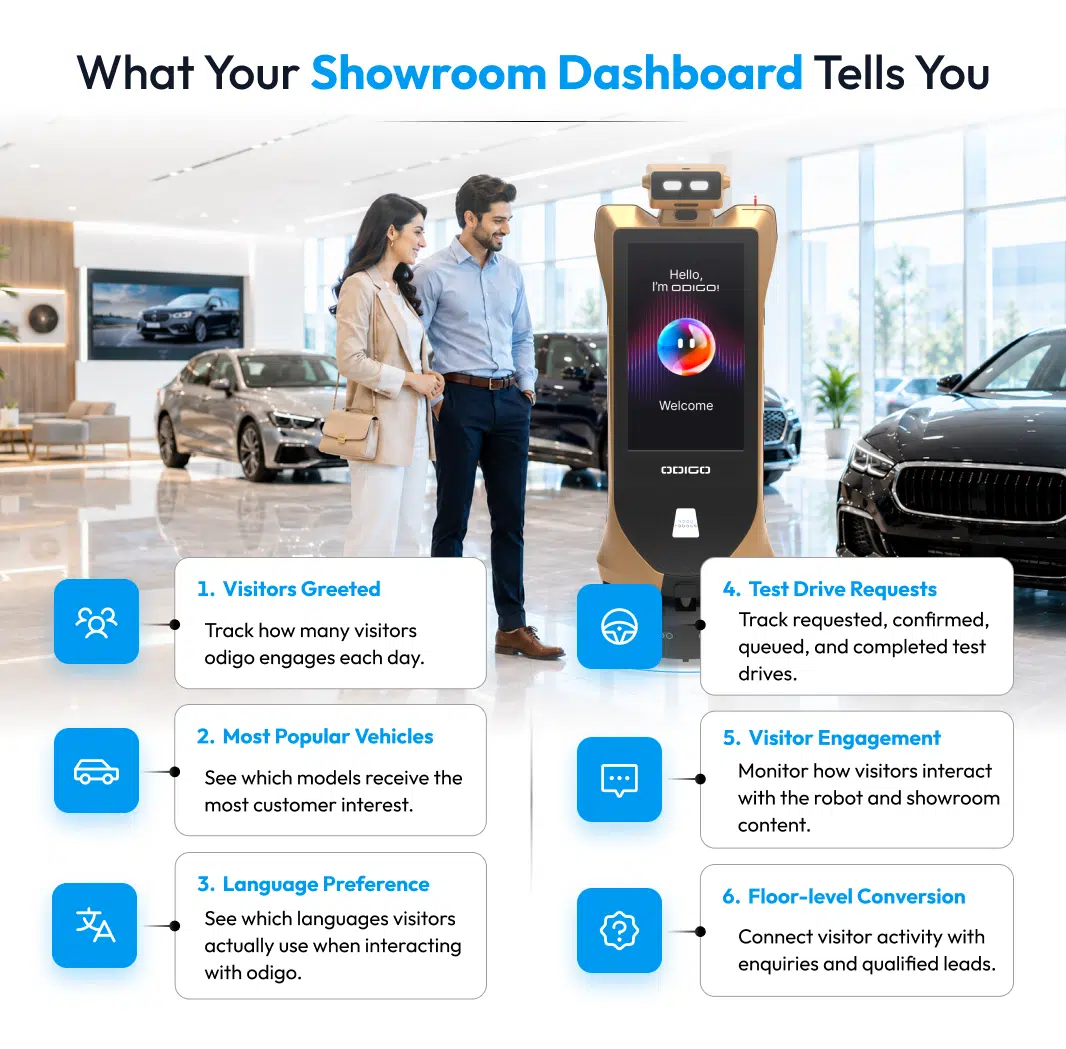
A car showroom robot captures structured records of what happens on the floor: who visited, what each visitor explored, and how many became qualified leads.
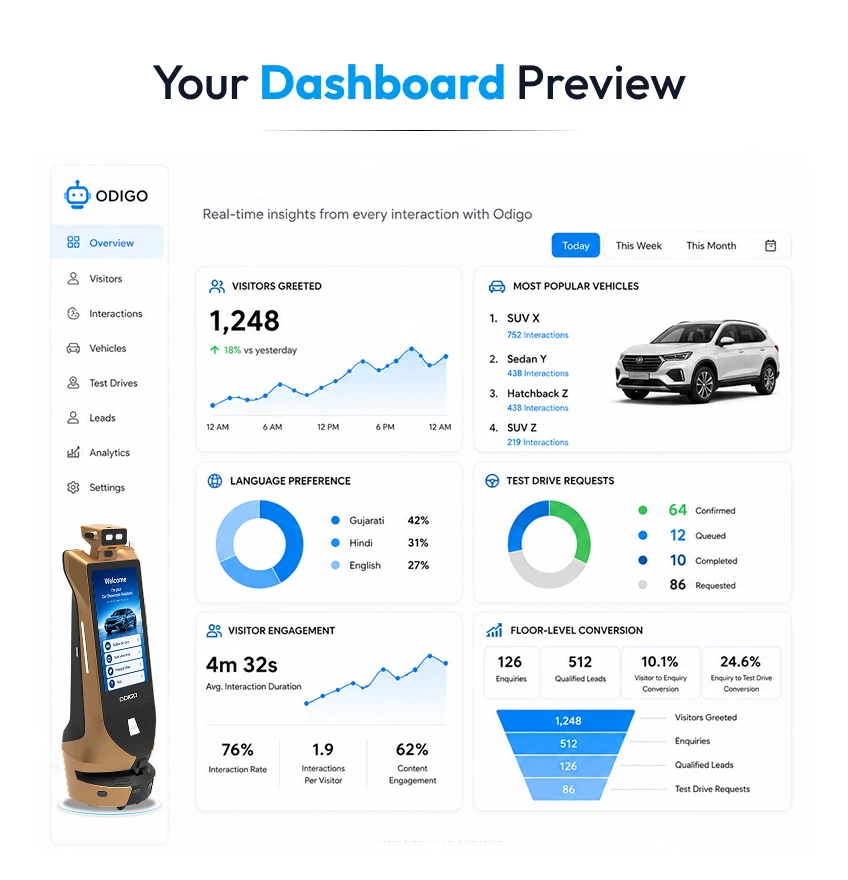
This captured data helps managers plan staffing, content, and vehicle placement.
A car showroom robot can track:
- Total visitors greeted and the resulting interaction rate
- Average engagement duration per visitor
- Models and variants explored during each visit
- Most frequently asked questions and preferred languages
- Test-drive requests and qualified leads captured
- Repeat visitor activity across return visits
- Brand or showroom-zone interest
- Visitor-to-enquiry and enquiry-to-test-drive conversion rates
Showroom managers use these figures to guide staffing, vehicle placement, and campaign decisions. Dealerships that also run a dedicated advertising robot alongside Odigo can add screen-level impression and dwell-time data to this same record.
This record is what separates a robot assistant from a passive display. The next section compares how car showrooms use AI robot assistants against a digital kiosk, feature by feature.
How Is an AI Robot Assistant Different from a Digital Kiosk?
An AI robot assistant moves through the showroom and approaches visitors directly, while a digital kiosk stays fixed in one spot and waits for someone to walk up. That difference shapes how each technology fits into a car showroom.
| Capabilities | Smart Assistant | Kiosk |
| Approaches visitors | Yes | No |
| Moves around the showroom | Yes | No |
| Holds voice conversations | Yes | Limited |
| Guides customers to vehicles | Yes | No |
| Demonstrates physical features | Possible | No |
| Captures leads | Yes | Possible |
| Books test drives | Yes | Possible |
| Provides multilingual support | Yes | Possible |
| Produces floor-level insights | Yes | Limited |
| Creates visual attention | High | Moderate |
This comparison shows why a static kiosk cannot cover the interactions a mobile robot assistant handles. The next section looks at where this technology delivers the most value across different showroom types.
Where Can AI Robot Assistants Deliver the Most Value?
AI robot assistants deliver the most value in showrooms with heavy visitor traffic, multiple brands, or several product zones. Showroom type determines where the value is highest, including high-volume dealerships, luxury showrooms, multi-brand floors, EV showrooms, and multi-location groups.
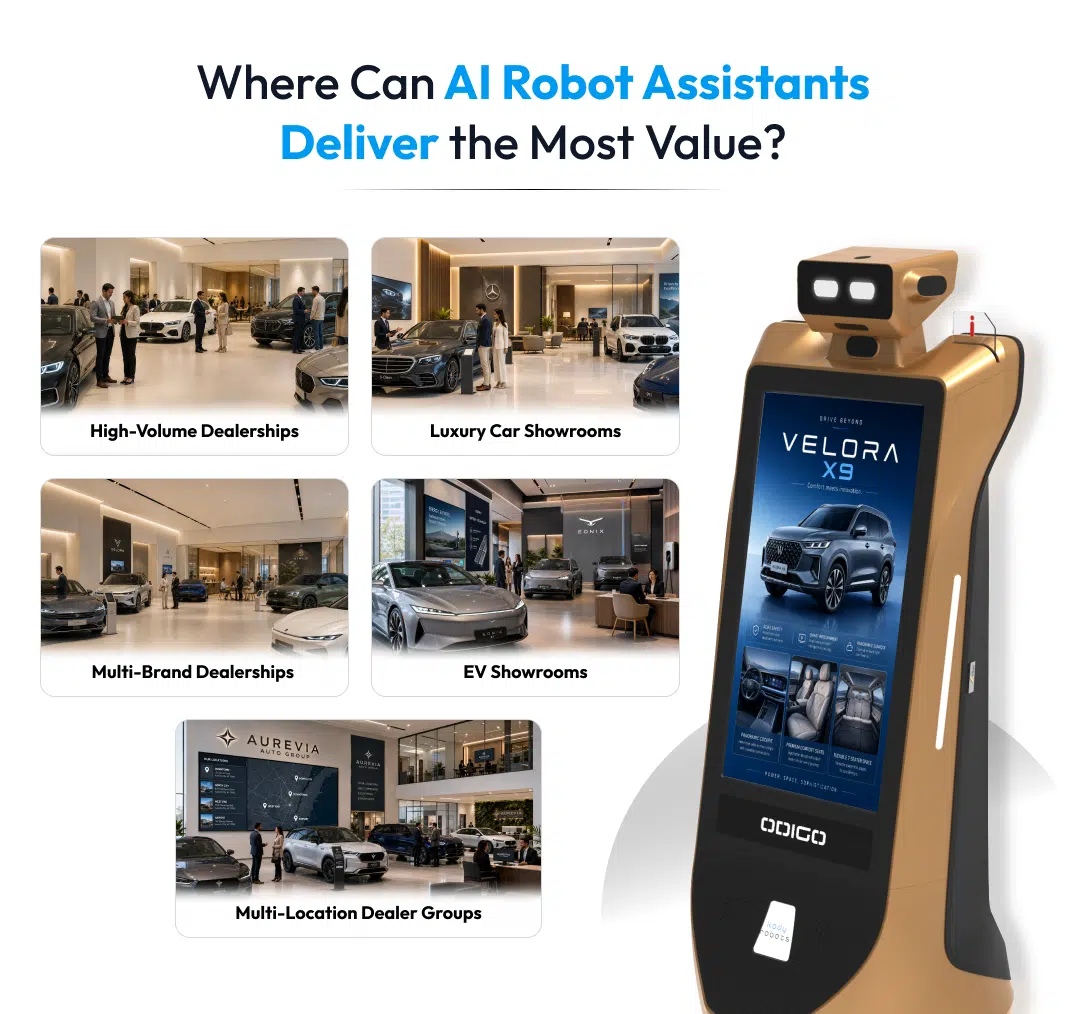
Value differs by showroom type. Here’s what stands out in five common environments.
High-Volume Dealerships
High-volume dealerships see the clearest gains from AI robot assistants during peak hours, when consultants cannot reach each visitor fast enough. Odigo covers that gap by engaging visitors the moment a consultant is busy.
- Engages visitors immediately during weekend and launch-day rushes, when wait times run longest.
- Frees consultants to focus on visitors closest to a purchase decision.
Luxury Car Showrooms
Luxury car showrooms use AI robot assistants for premium first contact and recognition of returning customers. Odigo’s opt-in facial recognition can flag a known high-value visitor and alert the assigned consultant directly.
- Opt-in facial recognition flags a returning or flagged high-value customer for a personal welcome.
- Odigo demonstrates premium features and finishes without rushing the first impression.
Multi-Brand Dealerships
Multi-brand dealerships use AI robot assistants to keep model comparisons fair and product information consistent across brand zones. Odigo pulls the same approved content regardless of which section of the floor a visitor is standing in.
- Guides visitors between brand sections and floors in large, multi-zone dealerships.
- Attributes each captured lead to the correct brand for clear per-brand reporting.
EV Showrooms
EV showrooms use AI robot assistants to explain range, charging, and battery warranties without repeating the same technical points for each visitor. This is a practical example of how AI robot assistants educate EV buyers. Odigo also covers incentives and ownership-cost questions that come up often with electric vehicles.
- Explains range, charging time, and battery warranty terms on the touchscreen.
- Walks a customer through applicable incentives and total ownership costs.
Multi-Location Dealer Groups
Multi-location dealer groups use AI robot assistants to push the same approved content to each showroom from one central dashboard, keeping messaging consistent across locations. Group-level data also shows which locations need staffing or content adjustments.
- Centralized dashboard pushes content and pricing updates to each location at once.
- Group-level analytics compare engagement and lead quality across showrooms.
These five environments show how showroom type shapes where an AI robot assistant adds the most value. The next section groups those gains into the core business benefits car dealerships can expect.
What Are the Business Benefits of AI Robot Assistants for Car Dealerships?
The core benefits of AI robot assistants for car dealerships fall into four areas: lead capture, cost efficiency, customer experience, and marketing insight.
Together, these outcomes affect both showroom operations and revenue.
1: Higher lead capture and conversion.
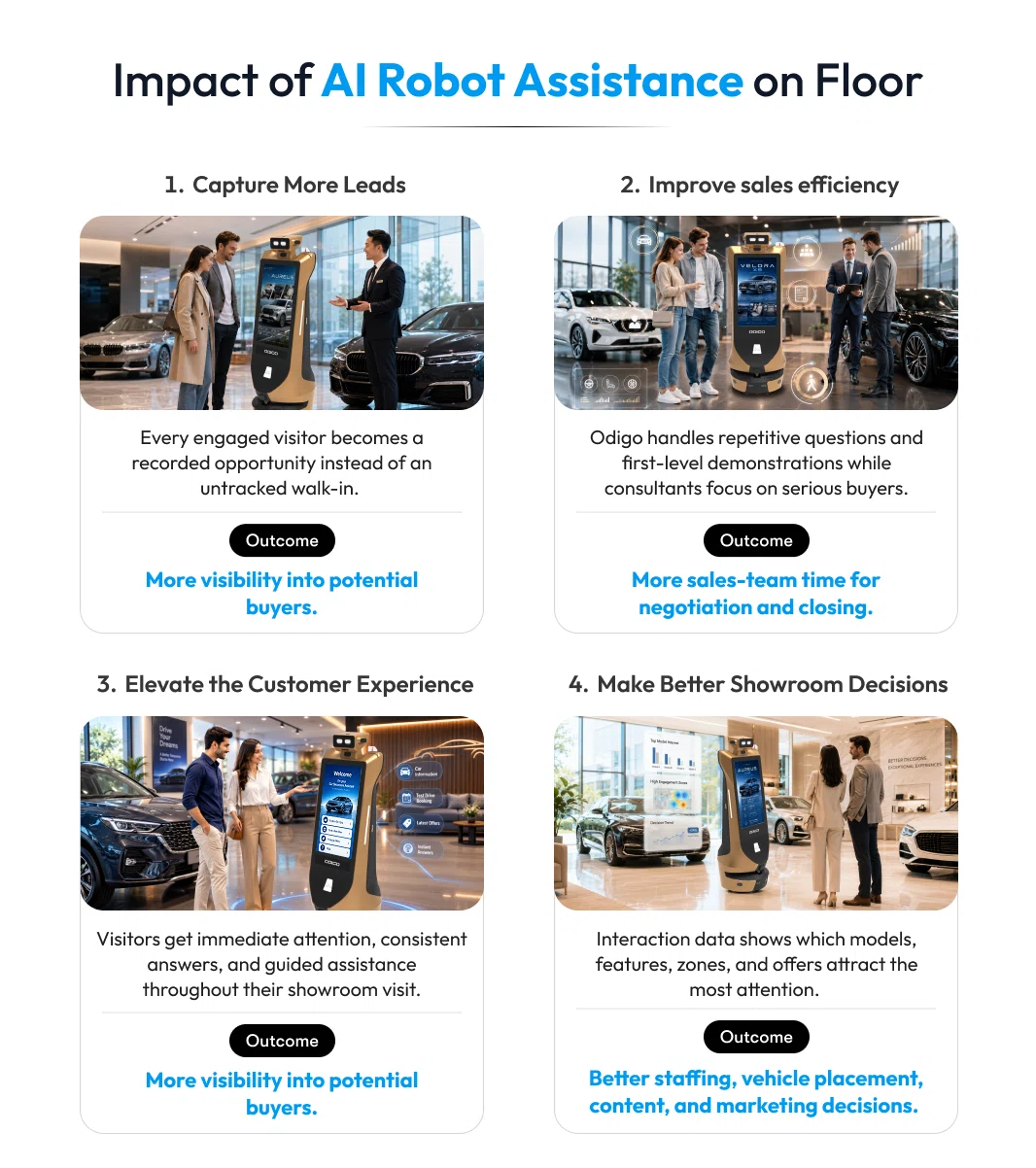
Every engaged visitor becomes a recorded lead instead of an unlogged walk-in, and consistent product information builds early trust that supports the sales conversation.
2: Lower cost per visitor interaction.
One robot assistant can engage several visitors during a single peak period without added headcount.
3: Stronger customer experience.
Visitors get prompt attention, consistent answers, and hands-on demonstrations instead of an unattended wait near the entrance.
4: Better marketing and floor insight.
Engagement data guides inventory placement, promotional content, and marketing spend across the showroom.
These benefits confirm that how car showrooms use AI robot assistants affects the dealership’s bottom line, not just the visitor experience. The next section covers the steps for putting a robot assistant to work on the floor.
How Do Dealerships Implement an AI Robot Assistant?
Car showroom automation with AI robot assistants follows a defined setup sequence: floor assessment, content approval, staff training, a trial period, and full rollout. Each step prepares both the technology and the sales team for daily use.
1: Assess showroom floor layout and traffic zones.
Map entry points, high-traffic aisles, and vehicle sections to decide where the robot assistant can move safely and stay visible.
2: Define priority use cases and goals.
Decide whether the main role is greeting, lead capture, demonstrations, or a mix of all three.
3: Load approved vehicle and pricing content.
Upload current specs, comparisons, and offers so every answer matches what consultants already tell customers.
4: Configure navigation zones and safety limits.
Set movement boundaries, speed limits, and obstacle-avoidance settings for the specific showroom layout.
5: Set up CRM and inventory integrations.
Connect the robot assistant to dealership systems so captured leads and vehicle availability stay current.
6: Train staff on handover procedures.
Show consultants how to review captured customer context before taking over a conversation.
7: Run a pilot in one zone.
Test the robot assistant in a single section before expanding across the full floor.
8: Collect visitor and staff feedback.
Gather input from customers and consultants on what worked and what needs adjustment.
9: Adjust content and placement based on results.
Refine scripts, routes, and positioning using pilot data before wider rollout.
10: Expand to full showroom deployment.
Roll the robot assistant out across all zones once the pilot results hold up.
A trial period like this lets a dealership refine the setup before wider rollout. The next section looks at how to measure the results.
How Do Dealerships Measure ROI From an AI Robot Assistant?
Dealerships measure ROI from an AI robot assistant by tracking leads captured, cost per engaged visitor, test-drive conversions, and time saved on repetitive explanations. These figures show whether the investment is paying off.
1: Leads captured per period
AI robot assistants for vehicle sales and lead generation should show a clear increase in qualified leads compared to pre-deployment rates.
2: Cost per engaged visitor
Divide the robot assistant’s operating cost by the number of visitors engaged to see cost per interaction.
3: Test-drive and sales conversion
Track how many robot-qualified leads go on to book test drives or complete a purchase.
4: Consultant time saved
Estimate the hours consultants no longer spend on repetitive product questions and first-level demonstrations.
5: Visitor engagement trends
Watch dwell time and repeat engagement to see whether interest holds up over weeks, not just on launch day.
These metrics turn day-to-day engagement data into a clear picture of return on investment for management.
Why AI Robot Assistant Belongs on Your Car Showroom Floor?
AI robot assistants for car showrooms are an additional force for the sales team and automotive industry. Instead, functioning as one of the AI showroom robots for customer engagement, the robot assistant extends what a showroom team can handle during peak hours and repetitive questions.
Odigo, an AI robot assistant for car showrooms, greets visitors, demonstrates features, and prepares qualified leads so consultants can focus on negotiation and closing.
Across the visitor journey, how car showrooms use AI robot assistants follows a clear pattern: consistent information, faster response times, and better visibility into customer interest. Dealerships that add this layer report stronger engagement and cleaner lead data without adding headcount.
For a showroom evaluating Odigo, a demo at your showroom floors is the practical starting point. You can book Odigo demo or talk to Kody Robots experts if you want to understand how the smart assistant will work in your showrooms.
How Car Showrooms Use AI Robot Assistants – General FAQs
Find quick answers to common questions about how car showrooms use AI robot assistants, including how the technology works, what it can do, implementation costs, multilingual support, data privacy, and ROI.
1: What Is an AI Robot Assistant for a Car Showroom?
Still have doubts about how car showrooms use AI robot assistants? Get answers to your questions, including what Odigo can do, how you can implement it, costs, support, data privacy, ROI, and more.
2: How Do Car Showrooms Use AI Robot Assistants?
Car showrooms use AI robot assistants to greet visitors, answer product and pricing questions, compare models, demonstrate features, and capture leads before a consultant joins the conversation. Odigo handles these tasks during peak hours and repetitive first-level interactions, so consultants can focus on negotiation, relationship-building, and closing the sale.
3: Are AI Robot Assistants in Car Showrooms Replacing Sales Staff?
AI robot assistants in car showrooms support sales staff rather than replace the sales team. Odigo handles repetitive questions, demonstrations, and lead capture, while consultants keep responsibility for negotiation, relationship-building, financing discussions, and closing the sale. The robot assistant prepares a customer for that conversation instead of skipping it.
4: How Much Does an AI Robot Assistant Cost for a Dealership?
Cost depends on the robot assistant’s features, the number of units deployed, and whether a dealership chooses purchase or subscription pricing. Vendors provide dealership-specific quotes based on showroom size and required integrations, such as CRM or payment gateway connections. A direct conversation with the sales team gives the clearest figure for a specific showroom.
5: Can an AI Robot Assistant Handle Multiple Languages?
Odigo supports multilingual voice interaction and matching on-screen text, so a customer can ask questions in a preferred language and receive a spoken and visual answer. This capability helps dealerships in linguistically diverse markets serve walk-in visitors even when no consultant on shift shares that customer’s language.
6: What Data Privacy Protections Apply to Facial Recognition on the Robot?
Facial recognition on Odigo developed by Kody Robots works on an opt-in basis, used mainly to flag a returning or high-value customer for a personal welcome. A dealership should disclose this feature to visitors and follow applicable local data protection regulations before enabling it for showroom use. Visitors who prefer not to be recognized can decline the feature without losing access to other robot assistant functions.
7: How Long Does It Take to See ROI From a Car Showroom Robot?
Most dealerships start seeing measurable engagement and lead-capture gains within a few weeks of a pilot deployment. Full ROI depends on showroom traffic, pilot scope, and how quickly staff adopt the handover process, so a single pilot zone is the fastest way for a dealership to gather showroom-specific numbers.
8: What Are Common AI Robot Assistant Use Cases in Car Showrooms?
Common AI robot assistant use cases in car showrooms include greeting visitors, comparing models and variants, demonstrating features, guiding customers to vehicles, booking test drives, and capturing qualified leads for the sales team. Odigo also supports multilingual interaction and presents financing details such as EMI estimates.