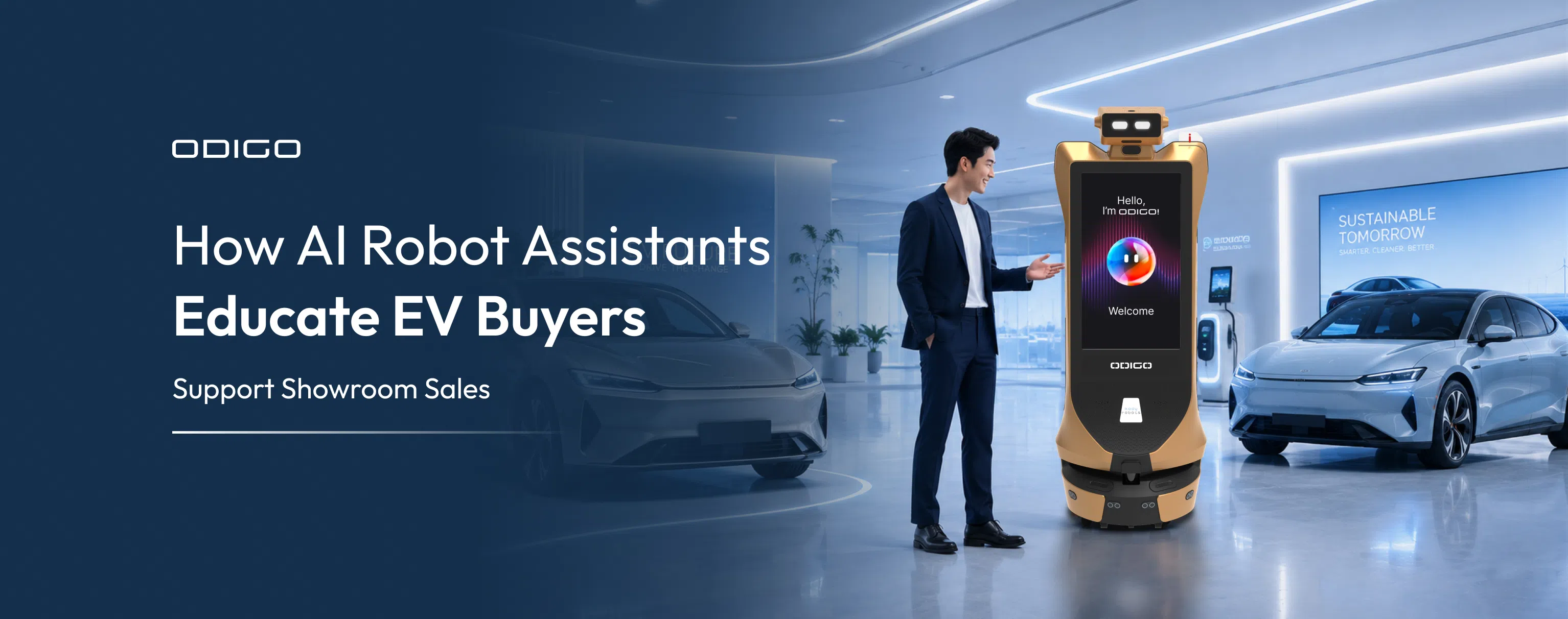

Quick Summary: AI robot assistants educate EV buyers with instant answers to questions about models, range, and incentives. This blog explains how AI robot assistants educate EV buyers across discovery, comparison, demonstrations, and financing. Learn how your EV showroom can improve buyer confidence, support sales teams, and create a more consistent customer experience.
Key Takeaways
- Most EV buyers need clear answers on range, charging, and true cost.
- AI robot assistants educate EV buyers by answering buyer questions instantly, freeing advisors to focus on active customers.
- The robot assistant presents model briefings and helps buyers explore vehicle options independently.
- Odigo hands off questions requiring judgment, negotiation, or signatures to your sales team.
- AI robot assistants save staff time while improving buyer confidence and showroom engagement.
- AI robots explain EV range and charging using approved vehicle data and updating the knowledge as per the new model launch.
- The role of AI robot assistants in the EV buying journey covers discovery, comparison, and financing support.
Why Do EV Buyers Still Need Education Inside the Showroom?
Most EV shoppers complete their first round of research online. Buyers compare EV range figures, browse vehicle trims, and read reviews before visiting a showroom. Online research explains an EV in general. The showroom visit must explain the specific EV model, variant, features, and ownership considerations.
Official EV range rarely reflects every real-world driving condition. Actual EV range changes with weather, driving style, passenger load, and cargo. EV charging also depends on the vehicle’s connector type, home charging setup, and local charging infrastructure.
EV incentives vary by state and month, while dealer offers can expire mid-quarter. A robot assistant for car showroom can help deliver this changing information consistently, giving customers the details they need to make a more informed decision.
AI Robot Assistants Bring Consistent EV Education to the Floor
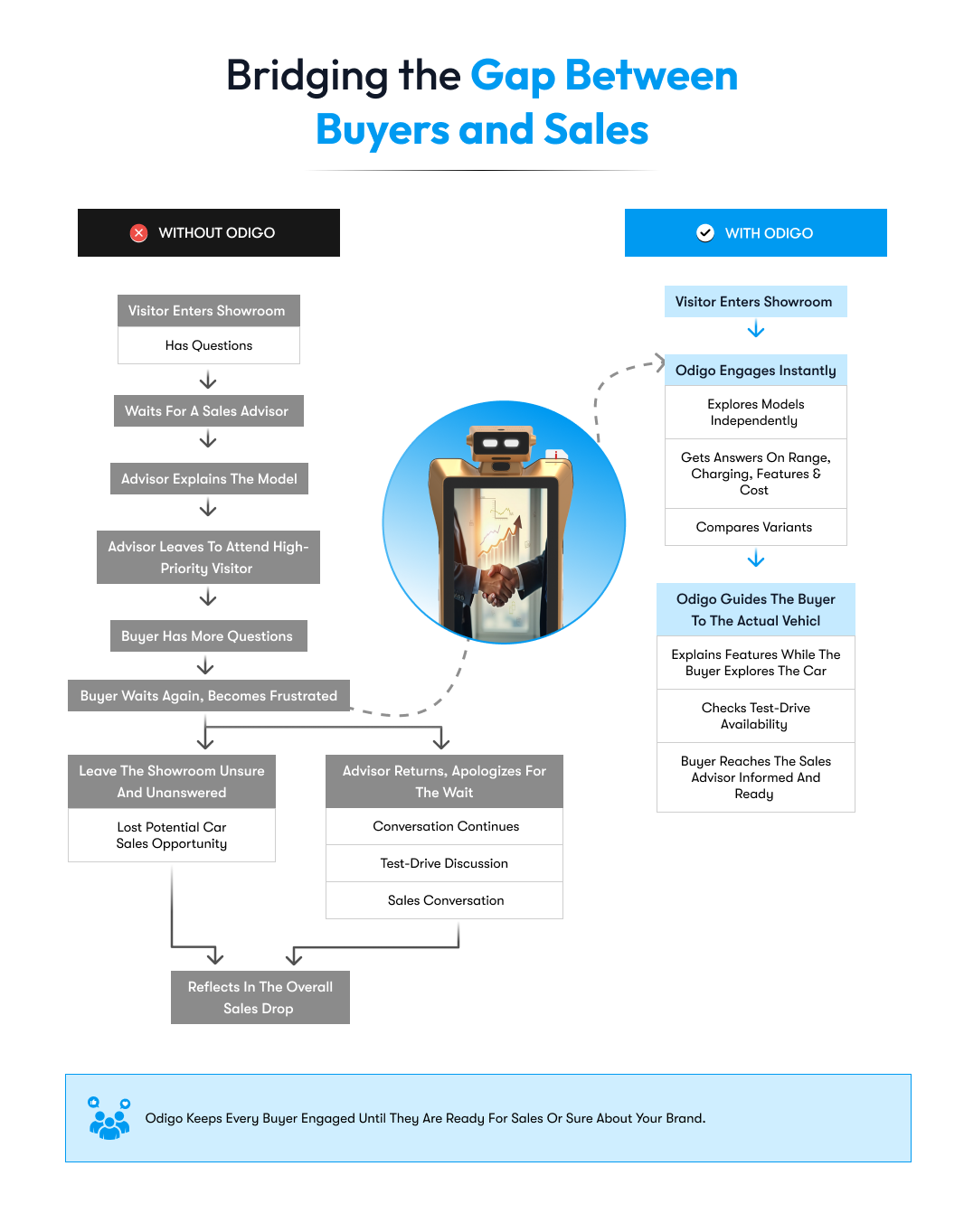
Your well-trained sales team can’t guarantee their presence everywhere. What one advisor covers in a quick conversation may differ slightly from what another shares. During busy hours, buyers wait longer for the same basic answer, and what the customers hear can depend on which advisor helps them.
How AI robot assistants educate EV buyers becomes the answer to all the questions a customer has when they enter your showroom. Odigo gives consistent, on-the-spot information regardless of who a buyer talks to.
Charging is the number one reason buyers still hesitate on an EV; 46% of new-vehicle shoppers say it’s their top concern (JD Power 2026). Buyer confidence has room to grow too: Cox Automotive research shows many showrooms still have work to do here (Cox Automotive). Neither issue is really about buyers losing interest in EVs. Both come down to the same thing: buyers aren’t getting clear, consistent answers exactly when they need them. That’s the gap AI robot assistants for EV buyer education are built to close, right on the showroom floor.
What Is an AI Robot Assistant for an EV Showroom?
An AI robot assistant for an EV showroom is a mobile, interactive system. The system combines autonomous navigation, voice interaction, and touchscreen content with approved vehicle information. The robot guides visitors around the floor and connects them with staff when needed.
Robot Assistant built by Kody Robots, is an AI robot for electric vehicle showrooms that delivers a smooth customer experience and better sales conversion. The smart assistant moves independently around the showroom’s display zones. The robot answers questions through voice and a touchscreen, in multiple languages where configured.
The AI assistant presents approved specifications, pricing, and promotional content. Every interaction stays within approved content, with no improvised answers. When a buyer asks a question beyond the robot’s scope, the assistant routes the request to an available staff member.
The robot assistant and the sales advisor serve different roles. The smart assistant delivers consistent factual answers, guided self-service, and a starting point for discovery. The sales advisor builds on that foundation with judgment, negotiation, and the trust that closes a sale. Together, they carry a buyer’s questions across every stage of the showroom visit.
The smart assistant prepares the buyer for that conversation by answering initial questions and guiding product discovery. The advisor then builds the trust that helps move the buyer toward a purchase.
How Is Odigo Different from a Kiosk or Chatbot?
Most showrooms already have a kiosk, a website chatbot, or both. Neither one moves, and neither one hands a buyer off to a person.
Here’s what changes when you adapt to an AI robot for electric vehicle showrooms.
| Parameter | Robotics Assistant | Digital Kiosk |
| Location | Fixed, one spot on the floor | Moves across the entire showroom |
| Interaction | Touchscreen only | Voice, touchscreen, and gesture |
| Buyer guidance | None, buyer has to find it | Escorts buyers to the actual vehicle |
| Content updates | Rarely updated | Live, approved showroom content |
| Staff handoff | No handoff mechanism | Routes the buyer to an available advisor |
| Best for | Passive spec lookup | Active, on-floor buyer education |
Odigo pulls ahead on three points: mobility, voice, and a handoff to a real person. That mobility is what makes self-service discovery possible in the first place.
How Does Odigo Support Self-Service EV Discovery?
A buyer rarely waits by the door for a free advisor. Most walk the floor on their own first, and that’s exactly where self-service discovery earns its place.
Odigo greets visitors right at the entrance, before anyone reaches for a phone. From there, buyers can browse the full vehicle catalog at their own pace and explore models and variants without waiting in line. A short quiz then recommends a suitable starting point based on lifestyle and budget. Together, these interactions show how AI robot assistants work to make vehicle discovery more convenient, personalized, and self-directed.
Buyers scan a QR code and take the spec sheet home. They can also skip the browsing and ask a single, specific question directly. Once they pick a vehicle, Odigo walks them straight to it. This works even when every advisor is already busy with another customer. No visitor has to wait for someone else’s conversation to end.
The quiz suggests a direction, not a final decision. Buyers can skip it and ask for a person at any point.
Self-service discovery gives every buyer a clear starting point. Once they land on a specific model, the next question is almost always about range and charging.
How AI Robot Assistants Educate EV Buyers on EV Range and Charging?
AI robot assistants educate EV buyers by answering their queries regarding range, charging, performance, cost, and financing. AI robot assistants compare different EV models and explain the vehicle features and benefits. By resolving buyers’ questions and providing relevant information, AI robot assistants help customers make confident purchase decisions while building trust and a strong foundation for purchase.
Explaining Official and Real-World Range
Here’s how AI robots explain EV range and charging: Odigo shows the official range for each model and variant first. Thereafter, the robot assistant walks through what actually changes that number, such as city driving stretching range further than highway speeds. Cold weather, heavy use of heating or air conditioning, and aggressive driving all pull it down. Extra passengers and cargo do the same. Battery charge level at the start of a trip matters too.
Odigo explains these factors using approved vehicle information, not a live tracking system. Any range figure it gives stays indicative, not a guarantee for a specific trip.
Simplifying Home and Public Charging
Charging questions usually split into two types: home and public. Odigo covers both in plain, practical terms. It explains the difference between AC and DC charging, and which connector each model uses. It states battery capacity and the manufacturer-approved charging time for a full charge. For home charging, it outlines what a typical installation requires. For public charging, it covers the basics of finding and using a compatible station.
Live tariff and network data depend on an approved integration. Where that integration exists, Odigo can show localized charging costs and nearby station availability. Where it doesn’t, buyers still leave with accurate, manufacturer-approved numbers instead of a guess.
Range and charging answer the buyer’s biggest worry. Once that’s settled, most buyers want to see how models actually compare against each other.
How Do AI Robot Assistants Compare EV Models, Variants, and Features?
Buyers rarely commit to the first model they see, and that’s a good instinct. AI robots for EV model and feature comparisons take the buyer’s natural urge to compare and put it right on the screen, side by side, in a few taps. The comfort of having comparison, live feature demonstration, and exploring options without any pressure helps buyers make better and more confident purchase decisions.
Odigo places two or three models side by side, on request. It shows variant-level differences within a single model line. Range, battery capacity, and charging capability sit next to each other. So do safety features, ADAS, comfort, and infotainment. Warranty terms and approved pricing appear in the same view. Where configured, Odigo also shows an estimated ownership cost for each option. This is one example of how robot assistants support sales staff by helping buyers understand key differences before moving into a detailed sales conversation.
Every comparison carries its data source and the date it was last updated. Anything with changing conditions, like pricing or warranty terms, routes back to a staff member for final confirmation.
| Comparison Factor | What Robot Assistant Shows |
| Range | Official range by model and variant |
| Battery | Capacity and warranty terms |
| Charging | Connector type, supported speed, and time |
| Features | Safety, ADAS, comfort, and infotainment |
| Price | Approved showroom or on-road pricing |
| Ownership | Indicative charging, service, and resale costs |
A standardized comparison also protects the showroom’s credibility. Two buyers asking the same question, on different days, get the same answer.
Comparisons tell a buyer what’s different on paper. Seeing those differences on the actual vehicle is the next step.
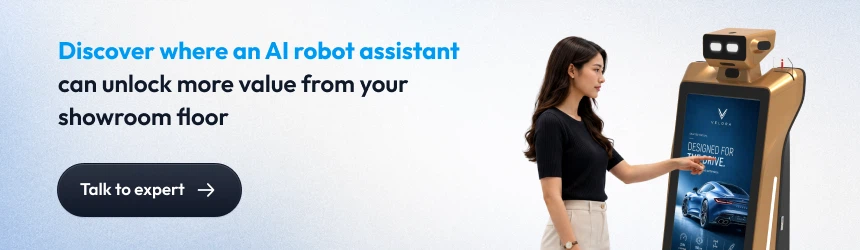
How Can Odigo Support EV Product Demonstrations?
Paper comparisons only go so far on their own. This is where AI robot assistants for EV product demonstrations bring those differences to life, on the actual car.
Odigo plays a short, feature-specific video on request, covering features such as ADAS alerts and terrain modes. This reflects how car showrooms use AI robot assistants to make vehicle demonstrations more interactive and easier to understand. The robot leads a guided walkthrough around the vehicle’s exterior and highlights key design details. Odigo also guides buyers through the interior, covering seating, storage, and controls. The smart assistant explains the charging port location and connector type directly on the vehicle, while its display helps buyers understand the infotainment layout and available drive modes.
Odigo guides the explanation, but doesn’t operate the vehicle itself. Powered tailgates, seat adjustments, and infotainment controls stay with a sales advisor. So does anything that needs a key or vehicle access.
A good demonstration often makes buyers want to explore other vehicles and features on the showroom floor. Odigo helps buyers discover relevant vehicles and showroom zones after the demonstration.
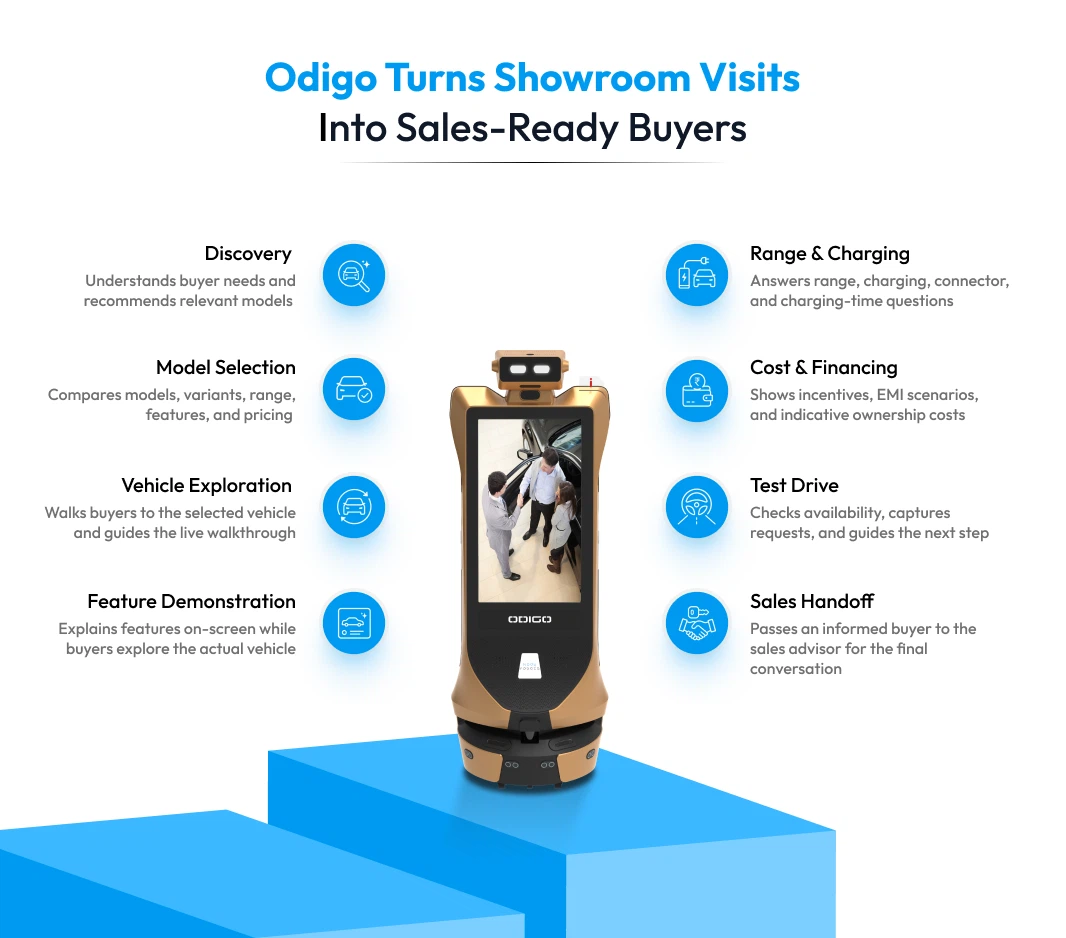
How Does Odigo Guide Buyers Around the Showroom?
Showrooms are bigger than a single vehicle bay. Odigo makes sure a buyer’s next stop is never a guess.
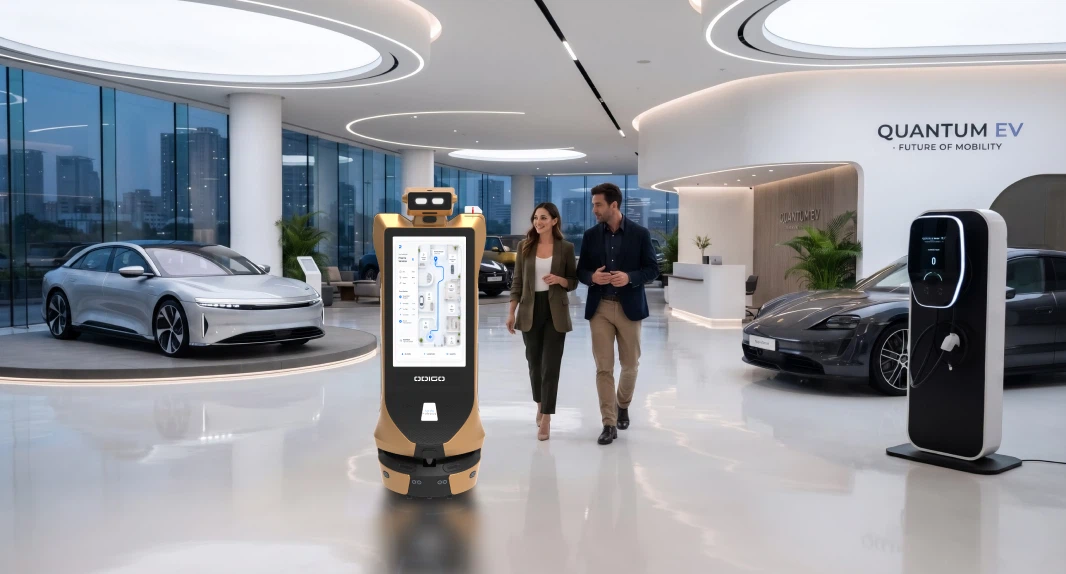
Once a buyer picks a vehicle, Odigo escorts them straight to it. It also runs a broader guided tour, moving between different vehicle zones on request. Along the way, it points buyers toward accessories, the service reception, or the finance desk. Buyers keep asking questions the entire time they walk. Near each vehicle zone, Odigo also surfaces offers relevant to that specific model.
Unlike a static kiosk, Odigo Advertising Robot connects digital product information with the physical location of the actual vehicle.
Every stop on that tour eventually leads to the same question: what will this actually cost.
How Can AI Robot Assistants Explain EV Incentives and Financing?
What this actually costs is rarely a simple number. AI robot assistants for EV incentives and financing break that question into parts a buyer can actually follow.
Presenting Offers and Incentives
Odigo lists government incentives that apply to the buyer’s location and chosen model. It shows manufacturer offers and current dealer promotions side by side. Exchange bonuses appear too, wherever they apply. Every offer carries its expiry date and terms, so nothing gets assumed.
Illustrating Financing and Ownership Costs
Odigo breaks down the on-road price, including registration and other add-ons. Buyers adjust the down payment and loan tenure, and see an indicative EMI update live. Multiple EMI scenarios sit side by side, for easy comparison. It also estimates charging cost, service cost, and resale value over time, building a rough total cost of ownership. Where a trade-in is involved, Odigo gives an indicative range, not a final number.
| What Robot Assistant Can Show | What Requires Final Confirmation |
| Published incentive information | Final incentive eligibility |
| Indicative EMI scenarios | Credit approval and interest rate |
| Approved offers | Negotiated final price |
| Ownership-cost estimate | Actual future expenses |
| Indicative trade-in range | Final inspected trade-in value |
Live pricing, lender, and incentive data depend on an approved integration behind the scenes. Where that connection exists, Odigo’s numbers stay current automatically. Where it doesn’t, every figure is clearly marked as indicative, never final.
Range, comparisons, demonstrations, and financing cover most of what happens before a decision. The next question is how all of this fits into one connected buying journey.
What Role Does Robot Assistant, Play in the EV Buying Journey?
Every capability above is really one piece of a longer sequence. This is the real role of AI robot assistants in the EV buying journey. It connects each stage to the next, without replacing any of them.
| Journey Stage | Robot Assistant Supports | Human Team Handles |
| Arrival | Greets visitors and identifies initial interest | Welcomes priority visitors personally |
| Discovery | Presents models, specs, and EV information | Understands the buyer’s specific needs |
| Comparison | Shows approved model and variant data | Recommends the best-fit option |
| Demonstration | Plays videos and leads guided walkthroughs | Operates and demonstrates the vehicle |
| Test Drive | Captures and routes the request | Confirms and conducts the drive |
| Financing | Presents indicative cost scenarios | Confirms eligibility and final terms |
| Decision | Shares buyer interest and open questions | Resolves objections and closes the sale |
Odigo doesn’t own this journey by itself. It supports the information-heavy stages, and prepares buyers for the human conversations that actually close a sale.
Test drive and financing sit near the end of that table for a reason. They’re usually the last steps before a decision, and they deserve a closer look.
How Does Odigo Move an Informed Buyer Toward a Test Drive?
A test drive is often the moment a buyer commits to seriously considering a purchase. Odigo handles the logistics around it, not the drive itself.
When integrated with the showroom’s test-drive system, Odigo can check whether the demo vehicle for a chosen model is free. It captures the buyer’s request, along with basic pre-drive details. If the vehicle is busy, it adds the buyer to a queue and displays the expected wait time. It then notifies staff, and routes the buyer to the right desk or location.
This doesn’t guarantee more test drives on its own. What it does show clearly is whether robot-led education is moving buyers toward real purchase intent, request by request.
A test-drive request is one clear signal to escalate to a person. It’s far from the only signal that matters.
When and How Does Odigo Transfer Buyers to Sales Staff?
Every showroom conversation eventually reaches a point Odigo shouldn’t handle alone. Knowing exactly when to step back is as important as the education itself.
- The buyer asks for help, or reaches a point Odigo can’t resolve.
- Odigo records the vehicle, zone, and question involved.
- That request routes to an available team member nearby.
- The advisor receives the buyer’s context, not just a name.
- The conversation continues without asking the buyer to repeat themselves.
This context only carries over where the system supports it. A handoff should trigger in several situations:
- A personalized recommendation, beyond general product facts
- A physical demonstration or test drive
- Negotiation on price or trade-in
- Final incentive eligibility or finance approval
- A trade-in inspection
- A complaint or an unusual, unverified question
An EV showroom robot should transfer a buyer to a sales advisor at a clear trigger point. That trigger is judgment, verification, negotiation, vehicle access, or a binding decision.
None of this works without accurate information behind every answer Odigo gives. That’s a separate, and equally important, part of the setup.
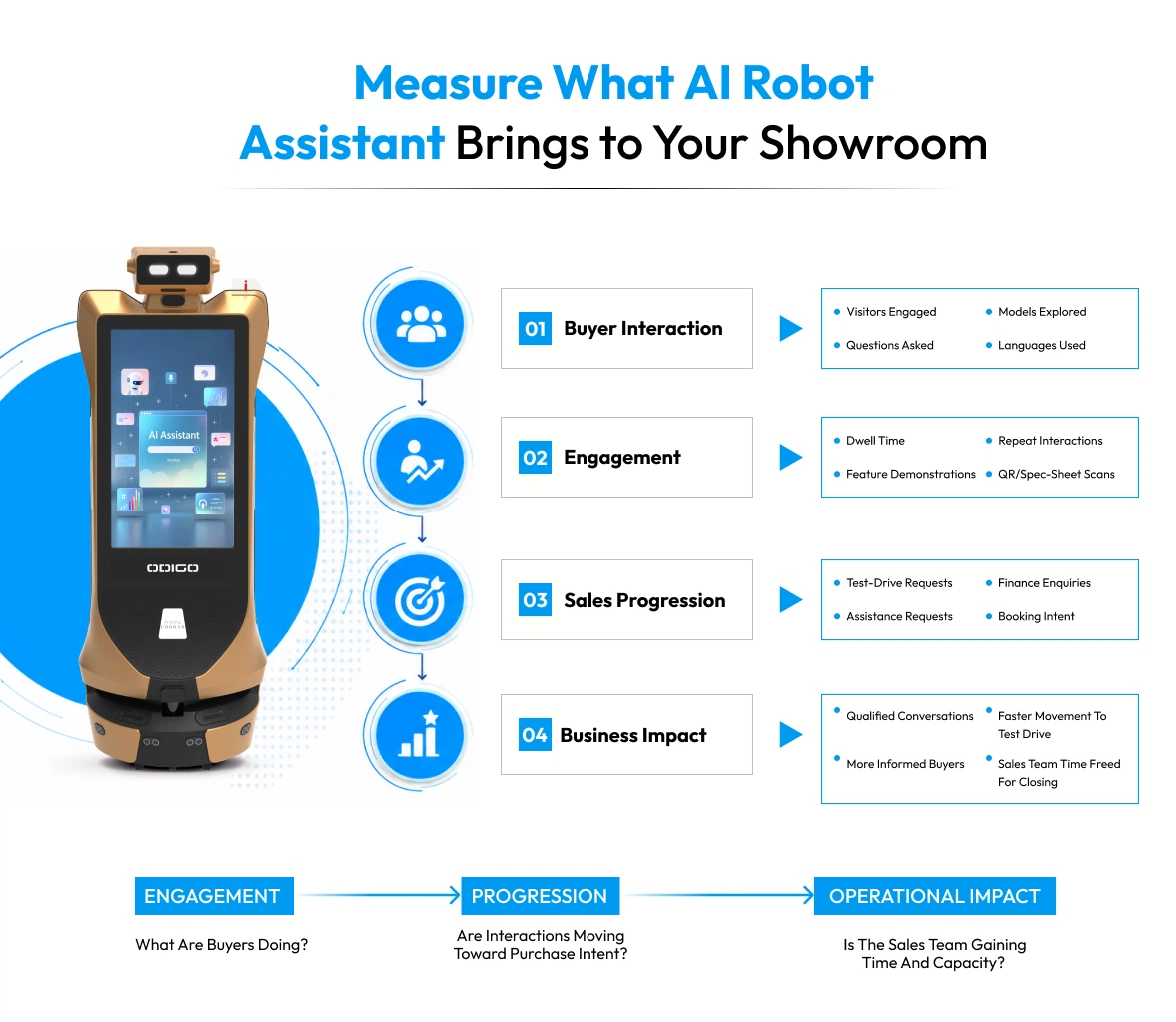
How Do EV Showrooms Keep Odigo’s Answers Accurate?
Every answer above depends on where the underlying data comes from. Accuracy isn’t a feature on its own. It’s a discipline a showroom has to maintain.
Use Approved Information Sources
Every figure Odigo shows should trace back to an approved source:
- Manufacturer specifications
- Dealer-approved pricing
- Official incentive information
- Approved product videos and charging specs
- Finance illustrations and live inventory data
Establish Content Governance
Someone has to own that content, on a set schedule. A clear owner, a review date, and an error-reporting path keep information current, not just accurate on day one.
Define Integration Requirements
Live data depends on connected systems: inventory, pricing feeds, approved finance tools, and charging sources. Internet connectivity makes live information possible, not automatically accurate. Accuracy still depends on the source’s quality, approval status, and update frequency.
Even with strong sources, some questions will still fall outside what’s approved. What happens next matters just as much.
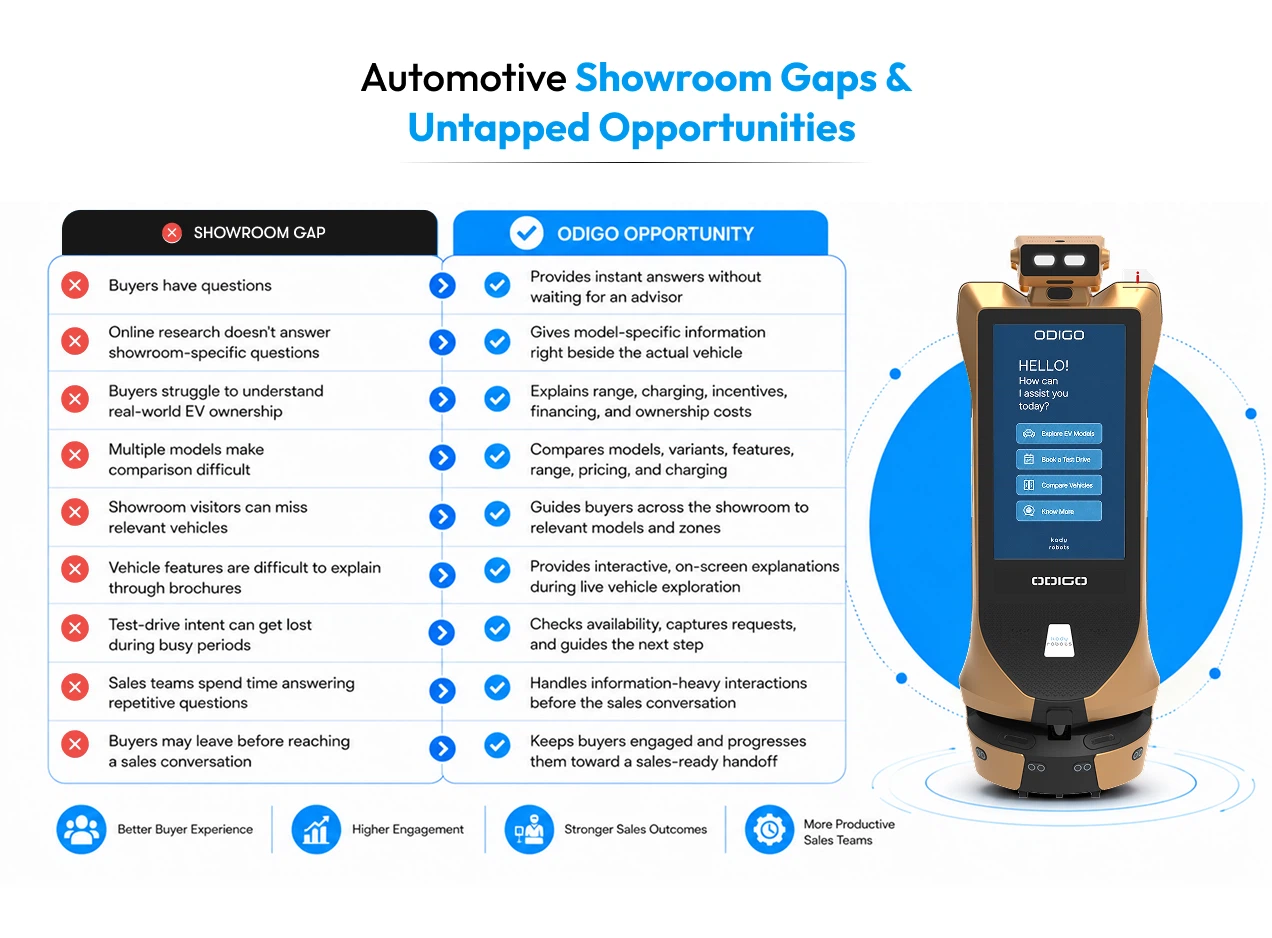
How Can Showrooms Measure Odigo’s Business Impact?
Every feature so far assumes Odigo is worth the floor space. Showrooms should measure that, not assume it.
Three kinds of numbers matter most here.
Engagement metrics show how buyers actually use Odigo:
Interactions per day, questions asked, models compared, and languages selected.
Progression metrics connect that engagement to intent:
Staff-assistance requests, test-drive requests, and consented leads captured.
Operational metrics show the impact on staff:
Questions resolved without an advisor, and estimated time saved during peak hours. Footfall, dwell time, and zone-level attention round out the picture.
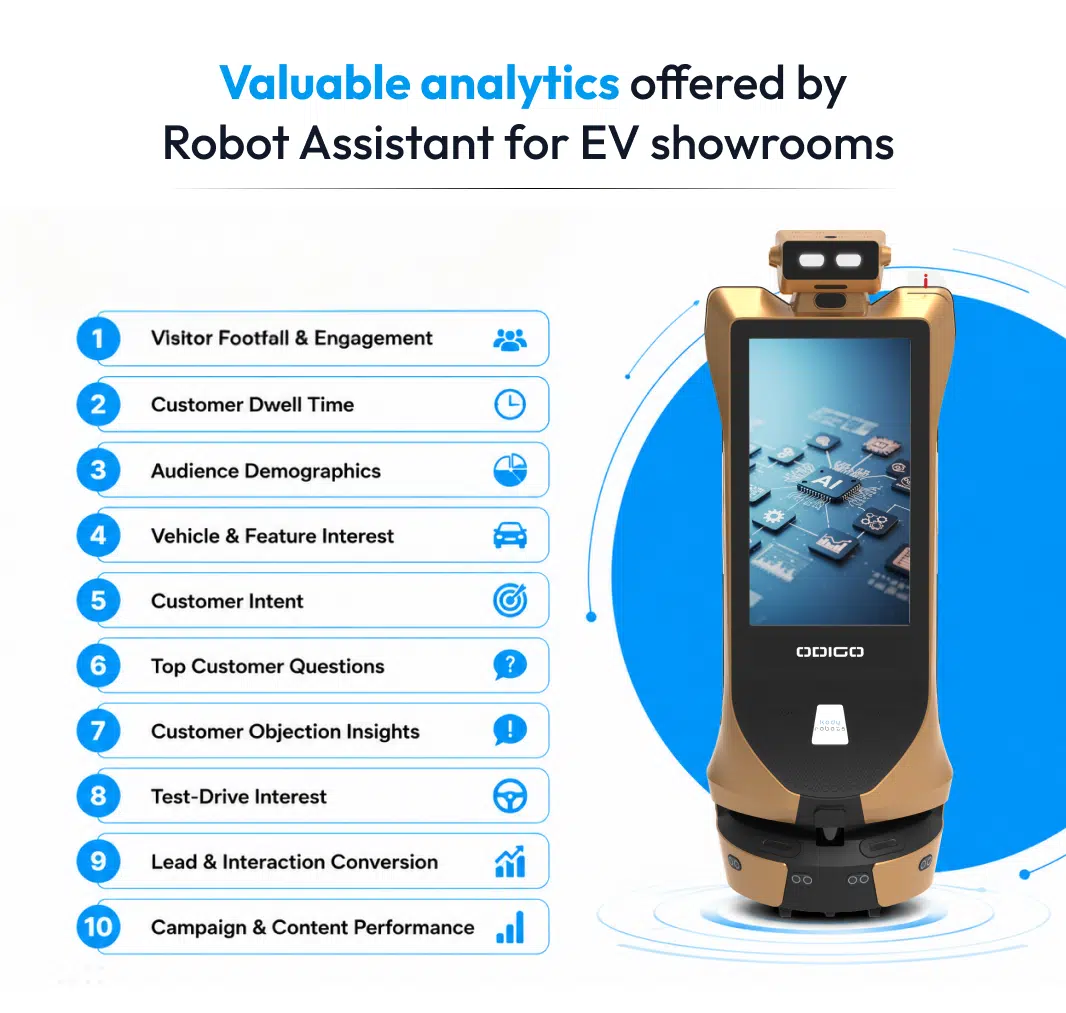
| Analytics / Insight | What the showroom gets |
| Visitor Footfall & Engagement | Total visitors, how many noticed/interacted with Odigo, and engagement rate |
| Customer Dwell Time | How long visitors stay around the showroom and interact with Odigo/content |
| Audience Demographics | Audience trends such as gender and other available demographic insights |
| Vehicle & Feature Interest | Which EV models, variants, features, offers or information attract the most attention |
| Customer Intent | Identifies visitors showing stronger buying interest based on their interactions |
| Top Customer Questions | What visitors are asking most about range, charging, battery, price, EMI, warranty, etc. |
| Customer Objection Insights | Identifies recurring concerns such as price, charging infrastructure, range or battery life |
| Test-Drive Interest | Number of visitors engaging with or requesting test-drive information/actions |
| Lead & Interaction Conversion | Tracks interactions and actions such as QR scans, registrations, enquiries and lead-generation activities |
| Campaign & Content Performance | Which vehicle ads, offers and messages generate the most impressions, interactions and engagement |
A fair measurement sets a baseline before deployment, then compares equivalent periods during a defined pilot. Not every sale should get credited to the robot. The goal is a clear read on engagement and progression, not an inflated claim.
Value scales with the complexity of the operation. A large, multi-brand dealership with heavy footfall gets more from Odigo than a small, single-model showroom. Several EV models and multilingual buyers add to that value. Both types of showroom can deploy it, though the return looks different.
Knowing the value is one thing. Getting the groundwork right before launch is another.
What Should EV Showrooms Confirm Before Deploying Odigo?
A strong case for Odigo still needs groundwork before launch. A short checklist keeps that groundwork from turning into guesswork.
- Confirm which buyer questions Odigo should handle, and which stay with staff
- Line up approved product, pricing, and incentive data, with a named content owner
- Set languages, showroom zones, and routes for guided navigation
- Define handoff rules, and connect CRM or test-drive systems where needed
- Set privacy and consent rules before enabling any recognition features
- Establish baseline metrics, then run a controlled pilot before scaling
None of this replaces the sales team. It simply gives them a better-informed buyer, and a running record of what happened before they walked in. That record can extend past the sale too, into delivery and service, once a showroom is ready for it.
The Bottom Line on AI Robot Assistants for EV Buyer Education
Range, charging, incentives, and financing are the questions that stall an EV sale the longest. Odigo answers each one on the floor, using approved information. It hands off to a person exactly when judgment, negotiation, or a signature is needed.
This is how AI robot assistants educate EV buyers today without replacing a single advisor. A robot assistant for EV showroom environments like Odigo can support discovery, comparison, demonstrations, and next-step progression, while sales advisors remain responsible for recommendations, physical demonstrations, financing confirmation, negotiation, and closing.
Accurate content, clear handoff rules, and defined metrics make that support measurable, not just a novelty. Is a robot assistant for EV showroom floors worth it for you? That depends on your footfall, your model range, and how much staff time goes to repeat questions today. For most busy EV floors, that answer points toward yes.
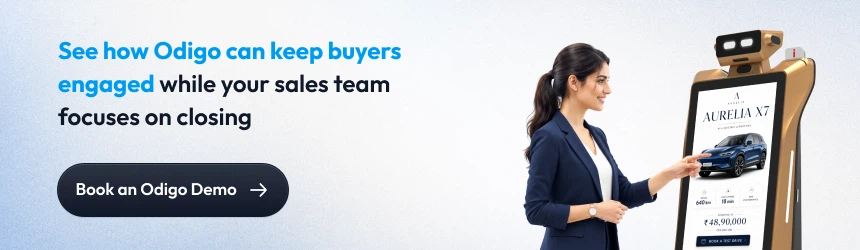
See how Odigo, from Kody Robots, can support EV buyer education and sales progression on your floor.
How AI Robot Assistants Educate EV Buyers – General FAQs
Get clear answers on how AI robot assistants educate EV buyers, support sales teams, and guide customers through the showroom journey.
1: How AI robot assistants educate EV buyers?
AI robot assistants educate EV buyers by answering range, charging, comparison, and incentive questions on the showroom floor using approved vehicle information.
2: How do AI robot assistants educate EV buyers on range and charging?
AI robot assistants educate EV buyers on range and charging by explaining official range, real-world factors, charging types, connector compatibility, and approved charging times.
3: Can Odigo explain real-world EV range?
Yes. Odigo explains how weather, driving style, cargo, passengers, and other conditions can affect range, using approved vehicle data and indicative figures.
4: Can Odigo compare EV models and variants?
Yes. Odigo Manufactured by Kody Robots compares models and variants side by side, showing range, battery capacity, charging, features, warranty terms, and approved pricing.
5: Can Odigo display incentives and EMI estimates?
Yes. Odigo displays approved incentives, offers, and indicative EMI scenarios based on down payment and loan tenure. Final eligibility and pricing require staff confirmation.
6: Can Odigo support buyers in multiple languages?
Yes. Odigo supports multilingual voice and touchscreen interaction where configured, helping buyers access consistent product, range, charging, and incentive information.
7: Does Odigo replace EV showroom sales staff?
No. Odigo handles factual questions, discovery, comparisons, and demonstrations. Recommendations, negotiation, test drives, financing confirmation, and closing remain with sales staff.
8: What happens when a buyer needs a sales advisor?
Odigo routes questions beyond its scope to an available staff member. The handoff can include the vehicle, showroom zone, and buyer’s question for a smoother conversation.